
Many English learners confuse impatient and inpatient because they look and sound similar. However, these two words have completely different meanings and are used in different situations.
Understanding the difference between impatient vs inpatient will help you avoid common mistakes and communicate more clearly in both writing and conversation.Many learners also confuse Their vs There vs They’re Just like impatint and inpatint.
Comparison Overview
Although impatient and inpatient differ by only one letter, they belong to different contexts.
- Impatient describes a person’s attitude or feeling when they cannot wait calmly.
- Inpatient refers to a patient who stays in a hospital for treatment.
Because they are unrelated in meaning, substituting one for the other can completely change the meaning of a sentence.
| Feature | Impatient | Inpatient |
| Part of Speech | Adjective | Noun (sometimes adjective) |
| Main Meaning | Unable to wait calmly | A hospital patient admitted for treatment |
| Context | Emotions, behavior | Healthcare, hospitals |
| Opposite | Patient | Outpatient |
| Example | She became impatient. | The inpatient stayed overnight. |
Definition of Impatient
Impatient is an adjective that describes someone who becomes annoyed, restless or frustrated because something is taking too long.
It can also describe someone who wants something to happen immediately instead of waiting.
Key Characteristics
- Describes feelings or emotions
- Indicates lack of patience
- Used for people or attitudes
- Common in everyday English
Examples
- The children became impatient while waiting for lunch.
- He grew impatient during the long meeting.
- I’m impatient to hear the results.
- She looked impatient after waiting for an hour.
- Customers became impatient because of the delay.
Definition of Inpatient
Inpatient is a noun referring to a person who is admitted to a hospital and stays there while receiving medical treatment.
It may also be used as an adjective before another noun, such as inpatient care or inpatient treatment.
Key Characteristics
- Medical term
- Refers to hospitalized patients
- Opposite of outpatient
- Common in healthcare settings
Examples
- The inpatient recovered quickly after surgery.
- She remained an inpatient for five days.
- The hospital expanded its inpatient services.
- Doctors examined every inpatient each morning.
- Inpatient treatment was recommended.
Main Differences Between Impatient and Inpatient
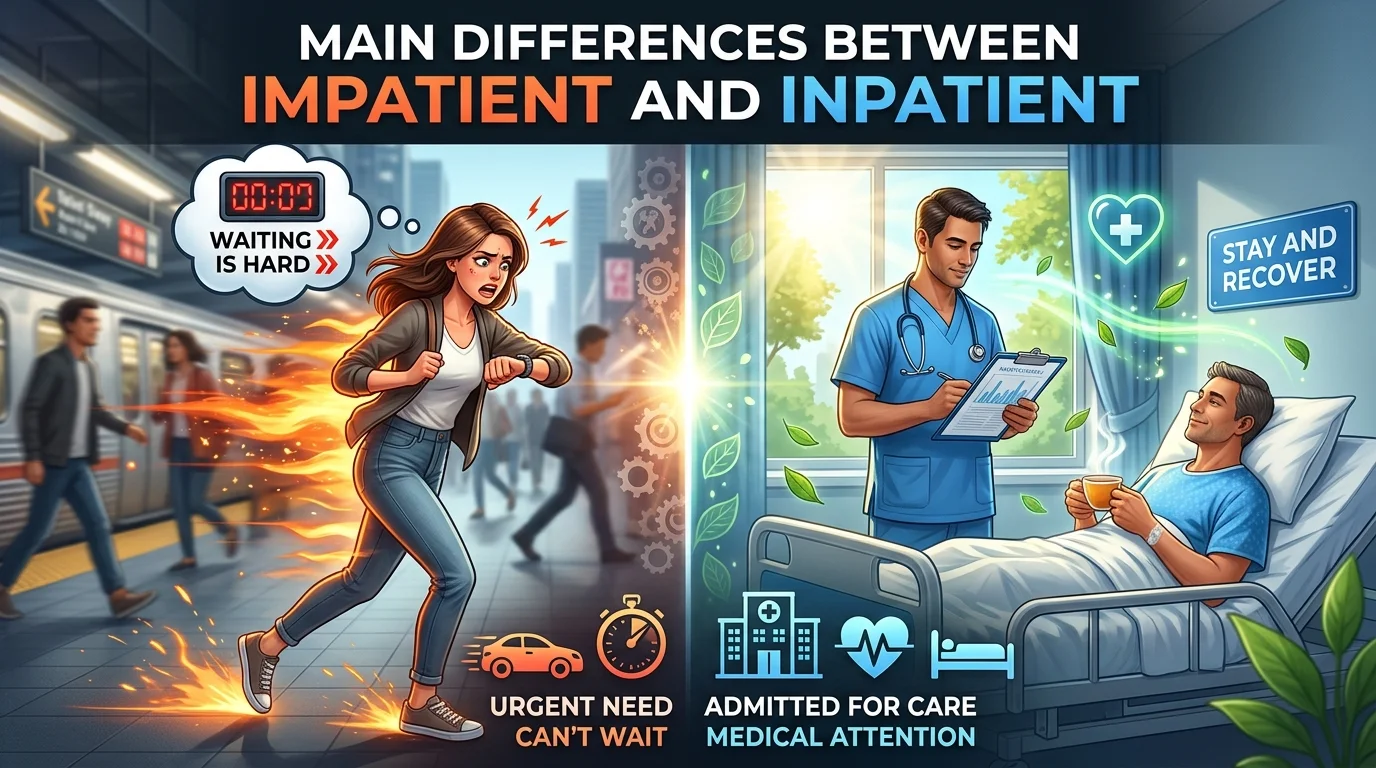
| Feature | Impatient | Inpatient |
| Meaning | Unable to wait | Hospital patient |
| Category | Emotion or personality | Medical status |
| Part of Speech | Adjective | Noun (also adjective) |
| Used With | People, feelings, behavior | Hospitals, healthcare |
| Example | Don’t be impatient. | The inpatient needs medication. |
Key Difference
If you’re talking about waiting or frustration, use impatient.
If you’re talking about someone staying in a hospital, use inpatient.
Why People Confuse These Words
These words are often confused because:
- They differ by only one letter.
- They have similar pronunciation.
- Both begin with “in.”
- Fast reading or typing can lead to spelling mistakes.
- Spell-check may not catch the error because both are real words.
Comparison Table
| Situation | Correct Word | Why |
| Waiting in line | Impatient | Describes emotion |
| Staying overnight in a hospital | Inpatient | Refers to an admitted patient |
| Feeling frustrated | Impatient | Emotional state |
| Hospital treatment | Inpatient | Medical term |
| Delayed flight | Impatient | Describes reaction |
| Hospital ward | Inpatient | Medical context |
Grammar Guide
Parts of Speech
Impatient
- Adjective
- Describes a person or feeling
Examples:
- She is impatient.
- They became impatient.
Inpatient
- Usually a noun
- Sometimes an adjective before another noun
Examples:
- The inpatient is recovering.
- Inpatient services are available.
How Each Term Is Used in Sentences
Using “Impatient”
Pattern:
Subject + be + impatient
Examples:
- I am impatient.
- She became impatient.
- They seemed impatient.
Pattern:
Impatient + to + verb
Examples:
- I’m impatient to begin.
- He’s impatient to leave.
Using “Inpatient”
Pattern:
The + inpatient + verb
Examples:
- The inpatient rested comfortably.
- The inpatient was discharged today.
Pattern:
Inpatient + noun
Examples:
- Inpatient care
- Inpatient treatment
- Inpatient facility
- Inpatient program
Common Mistakes Learners Make
❌ The impatient stayed in the hospital for two weeks.
✅ The inpatient stayed in the hospital for two weeks.
❌ I became inpatient because the bus was late.
✅ I became impatient because the bus was late.
❌ The doctor examined every impatient.
✅ The doctor examined every inpatient.
❌ She felt inpatient while waiting.
✅ She felt impatient while waiting.
Simple Rules to Remember
- Impatient = “I can’t wait.”
- Inpatient = “In the hospital.”
- If emotions are involved, choose impatient.
- If healthcare is involved, choose inpatient.
- Think of “in” as meaning inside the hospital for inpatient.
Quick Tips for Writing and Speaking
- Ask yourself whether you’re talking about a feeling or a hospital.
- Replace impatient with restless to test the sentence.
- Replace inpatient with hospital patient to check meaning.
- Read medical writing carefully because inpatient appears frequently.
- Proofread these words since spell-check may not detect the mistake.
When to Use Each One
Use “Impatient” When
- Describing frustration
- Talking about waiting
- Explaining emotions
- Discussing behavior
- Writing informal or formal English
Examples:
- She became impatient.
- We were impatient for the news.
- The audience grew impatient.
Use “Inpatient” When
- Discussing hospitals
- Talking about medical care
- Referring to admitted patients
- Writing healthcare documents
- Explaining treatment plans
Examples:
- The inpatient received medication.
- Inpatient care lasted three days.
- Every inpatient had a private room.
When NOT to Use Each One
Do not use impatient when referring to someone admitted to a hospital.
❌ The impatient underwent surgery.
✅ The inpatient underwent surgery.
Do not use inpatient to describe someone’s emotions.
❌ I felt inpatient while waiting.
✅ I felt impatient while waiting.
Avoid assuming that the words are interchangeable simply because they look alike.
Which One to Use (Decision Guide)
Use this quick guide whenever you’re unsure.
| If you mean… | Use |
| Can’t wait | Impatient |
| Feeling annoyed by delays | Impatient |
| Hospital patient | Inpatient |
| Medical treatment | Inpatient |
| Emotional state | Impatient |
| Hospital admission | Inpatient |
Decision Rule
- Talking about feelings → Impatient
- Talking about hospital care → Inpatient
Real-World Practical Examples
Impatient Examples
- Education: Students became impatient while waiting for exam results.
- Daily Life: I grew impatient in the long grocery store line.
- Business: Investors became impatient with the company’s slow progress.
- Technology: Users were impatient because the app loaded slowly.
- Conversation: She sounded impatient during the phone call.
Inpatient Examples
- Healthcare: The inpatient received medication every six hours.
- Hospital Administration: New inpatient rooms opened this month.
- Insurance: The policy covers inpatient treatment.
- Medical Research: Researchers studied inpatient recovery rates.
- Daily Healthcare: The doctor checked every inpatient before breakfast.
Self-Assessment (Fill in the Blanks)
- I will use ______ when referring to someone who cannot wait calmly. The correct word is ______ because it describes an emotion.
- I will use ______ when referring to a person admitted to a hospital. The correct word is ______ because it is a medical term.
- She became ______ after waiting two hours. The correct word is ______ because she felt frustrated.
- The doctor visited every ______ this morning. The correct word is ______ because the sentence refers to hospital patients.
- We were ______ for the concert to begin. The correct word is ______ because it describes excitement and lack of patience.
- The hospital built a new ______ wing. The correct word is ______ because it relates to hospital care.
- Don’t become ______ while waiting. The correct word is ______ because it refers to behavior.
- Every ______ received breakfast at 8 a.m. The correct word is ______ because the sentence is about hospitalized patients.
- He looked ______ during the traffic jam. The correct word is ______ because it describes a feeling.
- The nurse cared for each ______ carefully. The correct word is ______ because it refers to patients.
- Customers became ______ due to slow service. The correct word is ______ because they were frustrated.
- The insurance company approved ______ treatment. The correct word is ______ because it concerns hospital admission.
- The children grew ______ while standing in line. The correct word is ______ because it describes emotion.
- The ______ remained in the hospital overnight. The correct word is ______ because the patient stayed in the hospital.
- I am ______ to hear your answer. The correct word is ______ because it expresses eagerness.
- The doctor explained the ______ recovery plan. The correct word is ______ because it concerns hospitalized care.
- Drivers became ______ because of road construction. The correct word is ______ because it describes their reaction.
- The hospital hired more staff for ______ services. The correct word is ______ because it relates to admitted patients.
- She felt ______ after several delays. The correct word is ______ because it describes her feelings.
- Every ______ followed the treatment schedule. The correct word is ______ because it refers to hospital patients.
Answers
- impatient, impatient
- inpatient, inpatient
- impatient, impatient
- inpatient, inpatient
- impatient, impatient
- inpatient, inpatient
- impatient, impatient
- inpatient, inpatient
- impatient, impatient
- inpatient, inpatient
- impatient, impatient
- inpatient, inpatient
- impatient, impatient
- inpatient, inpatient
- impatient, impatient
- inpatient, inpatient
- impatient, impatient
- inpatient, inpatient
- impatient, impatient
- inpatient, inpatient
Final Verdict
Although impatient and inpatient look similar, they have entirely different meanings. Impatient is an adjective that describes someone who is unable to wait calmly or who becomes frustrated by delays. Inpatient, on the other hand, is a medical term referring to a person who is admitted to a hospital for treatment and stays there overnight or longer.
Remember this simple rule: if you’re talking about feelings or behavior, choose impatient; if you’re discussing hospital care or admitted patients, choose inpatient. Keeping this distinction in mind will help you write more accurately, avoid embarrassing mistakes and communicate confidently in both everyday conversations and professional contexts.
Conclusion
Understanding the difference between impatient vs inpatient is easier once you know that these two similar-looking words belong to completely different contexts. Impatient describes a feeling of frustration or restlessness when someone has to wait, while inpatient refers to a person who stays in a hospital for medical treatment. Mixing them up is a common spelling mistake because they differ by only one letter, but remembering their meanings and grammatical roles can help you use each word confidently.
Whether you’re writing an email, completing schoolwork, reading medical information or improving your English vocabulary, choosing the correct word makes your communication clearer and more professional. By practicing the examples, grammar rules and usage tips in this guide, you’ll quickly recognize when each term fits the situation. Now you know the difference between impatient and inpatient.Just like these two words,many learners also confuse Affect vs Effect and Than vs Then.
FAQs
What is the difference between impatient and inpatient?
The main difference is that impatient is an adjective describing someone who becomes restless or frustrated while waiting, whereas inpatient is a noun referring to a person admitted to a hospital for treatment. One relates to emotions and the other relates to healthcare.
Is impatient a noun or an adjective?
Impatient is an adjective. It describes a person’s attitude or emotional state when they find it difficult to wait or remain calm. It is commonly used before a noun or after linking verbs such as is, was or became.
Is inpatient always used in a medical context?
Yes. Inpatient is almost always used in healthcare settings. It refers to someone who stays in a hospital or medical facility for treatment that requires admission, usually for at least one night under professional medical supervision.
Can impatient and inpatient be used interchangeably?
No. These words have completely different meanings and cannot replace one another. Impatient describes feelings or behavior, while inpatient identifies a hospitalized patient. Using the wrong word changes the meaning of the sentence and creates confusion.
What is the opposite of inpatient?
The opposite of inpatient is outpatient. An outpatient receives medical treatment without being admitted to the hospital overnight. Unlike an inpatient, an outpatient returns home after receiving care or completing a medical procedure.
What is the opposite of impatient?
The opposite of impatient is patient. A patient person remains calm, tolerant and willing to wait without becoming annoyed or frustrated. This adjective is commonly used to describe someone’s personality or behavior in everyday situations.
Why do people confuse impatient and inpatient?
People often confuse these words because they differ by only one letter and share the word patient. Their similar spelling and pronunciation can lead to typing or reading mistakes, especially for English learners who are unfamiliar with their different meanings.
Can inpatient be used as an adjective?
In some healthcare contexts, inpatient can function as an adjective, such as in the phrase inpatient care or inpatient treatment. However, it is most commonly used as a noun to describe a person receiving hospital care.
How can I remember the difference between impatient and inpatient?
A simple trick is to connect impatient with waiting and emotions, while linking inpatient with staying in a hospital. If the sentence is about frustration, choose impatient. If it is about medical admission, choose inpatient.
Which word should I use in everyday writing?
Choose impatient when describing someone’s feelings, reactions or behavior in everyday life. Use inpatient only when discussing hospitals, healthcare or medical treatment. Thinking about the context first is the easiest way to select the correct word.