
Many English learners wonder whether they should use ourselves or ourself. Although these two words look very similar, they are not used in the same way.
Understanding the difference will help you write and speak more naturally, avoid common grammar mistakes and choose the correct reflexive pronoun in both formal and everyday English.
Comparison Overview
Ourselves and ourself are both reflexive pronouns related to the pronoun we. They refer back to the subject of a sentence. However, they differ in frequency, grammatical acceptance and context.
In modern English, ourselves is the standard and widely accepted form. Ourself is uncommon and appears mainly in formal, historical, literary or institutional contexts where a group is treated as a single unit.
| Feature | Ourselves | Ourself |
| Grammatical status | Standard English | Rare and specialized |
| Common usage | Very common | Uncommon |
| Refers to | Multiple people (“we”) | A collective “we” acting as one unit |
| Used in everyday English | Yes | Rarely |
| Best choice for learners | Yes | Usually no |
Definition of Ourselves
Ourselves is the standard reflexive pronoun used with the subject we. It refers back to the people acting.
It is used when the subject and object of a sentence are the same group of people.
Examples:
- We taught ourselves French.
- We enjoyed ourselves at the party.
- We introduced ourselves to the new neighbors.
It is also used for emphasis.
Example:
- We completed the project ourselves.
Definition of Ourself
Ourself is a rare reflexive pronoun that refers to we when the speaker considers the group as a single unit rather than separate individuals.
Today, it is mostly found in:
- Historical writing
- Formal institutional language
- Royal or official statements
- Literary works
Examples:
- We consider ourselves responsible as an organization.
- We dedicate ourselves to public service.
In normal conversation, ourselves is almost always preferred.
Main Differences Between Ourselves and Ourself
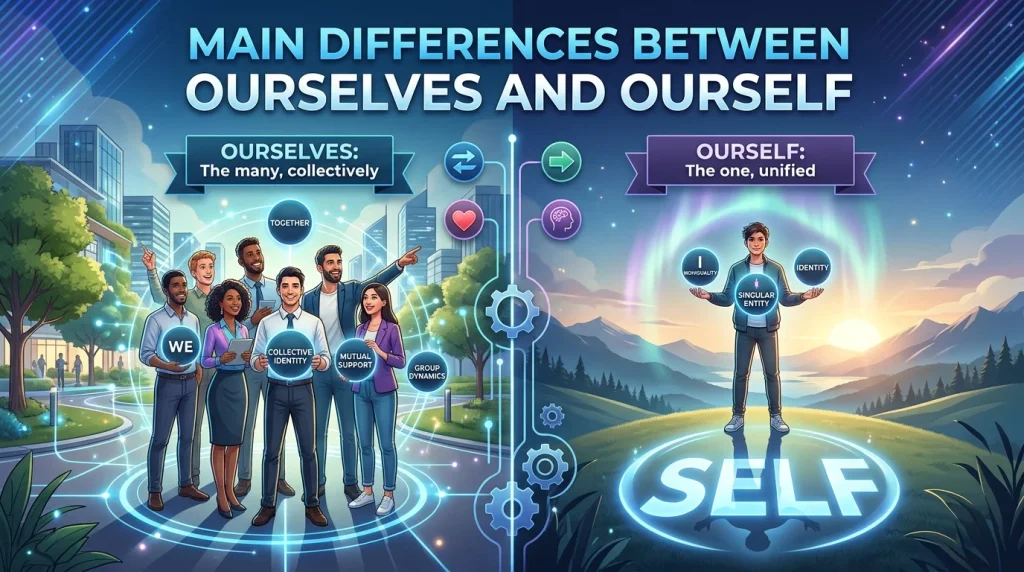
| Aspect | Ourselves | Ourself |
| Meaning | Refers to several people individually | Refers to a collective group as one entity |
| Grammar | Standard reflexive pronoun | Rare alternative |
| Everyday use | Yes | No |
| Formal documents | Yes | Sometimes |
| Modern English | Preferred | Limited use |
Key Differences
- Ourselves is the standard form taught in schools.
- Ourself is uncommon in modern English.
- Ourselves refers naturally to multiple individuals.
- Ourself emphasizes a collective identity.
- Most English speakers rarely use ourself in everyday speech.
Ourselves vs Ourself Comparison Table
| Category | Ourselves | Ourself |
| Pronoun type | Reflexive | Reflexive |
| Number | Plural | Collective singular idea |
| Frequency | Very high | Very low |
| Accepted in everyday English | Yes | Rarely |
| Used in academic writing | Yes | Only in special contexts |
| Safe choice for learners | Yes | No |
Grammar Guide
Both words are reflexive pronouns. They refer back to the subject we.
How Each Term Is Used in Sentences
Ourselves
Pattern:
We + verb + ourselves
Examples:
- We blamed ourselves.
- We prepared ourselves.
- We introduced ourselves.
- We enjoyed ourselves.
- We reminded ourselves to stay calm.
Ourself
Pattern:
We + verb + ourself
Examples:
- We regard ourselves as one organization.
- We present ourselves as a united team.
- We dedicate ourselves to excellence.
These uses are uncommon outside formal institutional writing.
Common Mistakes Learners Make
Mistake 1
❌ We enjoyed ourself.
✔ We enjoyed ourselves.
Mistake 2
❌ We introduced ourself.
✔ We introduced ourselves.
Mistake 3
Using ourself in ordinary conversation.
Instead, use ourselves.
Mistake 4
Thinking both words are equally common.
Actually, ourselves is overwhelmingly more common.
Simple Rules to Remember
- Use ourselves with we in almost every situation.
- Use ourself only in rare collective or institutional writing.
- If you’re unsure, choose ourselves.
- Modern English strongly favors ourselves.
- Schools and style guides recommend ourselves.
Quick Tips for Writing and Speaking
- Think: “We = ourselves.”
- Avoid ourself in emails, essays, and conversations unless writing in a special formal style.
- Read your sentence aloud. If it sounds unusual, ourselves is probably correct.
- Use ourselves for both reflexive and emphatic meanings.
- Reserve ourself for historical or institutional contexts.
When to Use Each One
Use Ourselves When
- Talking about a group including yourself.
- Writing school assignments.
- Speaking in daily conversations.
- Writing emails.
- Giving presentations.
- Writing business communication.
- Describing shared actions.
- Adding emphasis.
Examples:
- We finished the work ourselves.
- We congratulated ourselves.
- We introduced ourselves.
Use Ourself When
- Writing in a formal institutional voice.
- Referring to an organization as one entity.
- Writing historical documents.
- Mimicking traditional or literary style.
Example:
- We commit ourselves to serving the public.
When NOT to Use Each One
Do not use ourself:
- In normal conversations.
- In most essays.
- In school homework.
- In everyday emails.
- In casual writing.
Do not replace ourselves with ourself simply because both refer to we.
Which One to Use (Decision Guide)
Ask yourself these questions:
Are you writing normal English?
→ Use ourselves.
Are you talking about multiple people including yourself?
→ Use ourselves.
Are you writing an official statement for an organization acting as one unit?
→ Ourself may be appropriate.
Unsure?
→ Choose ourselves.
Real-World Practical Examples
Ourselves Examples
Education
- We taught ourselves algebra before the exam.
Daily Life
- We cooked dinner ourselves.
Business
- We introduced ourselves to the clients.
Technology
- We fixed the computer ourselves.
Conversation
- We enjoyed ourselves during the trip.
Ourself Examples
Government
- We dedicate ourselves to serving every citizen.
Organization
- We define ourselves as a community-first company.
Business Policy
- We present ourselves as a unified organization.
Historical Writing
- We declare ourselves committed to peace.
Formal Statement
- We hold ourselves accountable for these actions.
Self-Assessment (Fill in the Blanks)
- I will use ______ when referring to a group including myself. The correct word is ______ because it is the standard plural reflexive pronoun.
- We introduced ______ at the meeting. The correct word is ______ because the subject is “we.”
- I will use ______ in everyday conversation. The correct word is ______ because it is standard English.
- We enjoyed ______ during the vacation. The correct word is ______ because it refers back to “we.”
- The organization described ______ as united. The correct word is ______ because the organization is treated as one unit.
- We prepared ______ for the interview. The correct word is ______ because the action returns to the subject.
- We blamed ______ for the mistake. The correct word is ______ because it is the accepted reflexive form.
- In ordinary writing, choose ______. The correct word is ______ because it is commonly accepted.
- The committee referred to ______ as one body. The correct word is ______ because it emphasizes unity.
- We taught ______ coding. The correct word is ______ because multiple people learned together.
- We challenged ______ to improve. The correct word is ______ because it refers back to the subject.
- We reminded ______ to stay focused. The correct word is ______ because it is the standard reflexive pronoun.
- The institution presents ______ as a single authority. The correct word is ______ because it uses collective identity.
- We completed the assignment ______. The correct word is ______ because it adds emphasis.
- We introduced ______ politely. The correct word is ______ because it is normal English.
- We can solve this problem by ______. The correct word is ______ because it refers to the same group.
- We entertained ______ at the festival. The correct word is ______ because it is the correct reflexive form.
- The organization described ______ in an official statement. The correct word is ______ because it is acting as one entity.
- We motivated ______ before the competition. The correct word is ______ because it is standard usage.
- Most English learners should choose ______. The correct word is ______ because it is correct in nearly every situation.
Answers
- ourselves — ourselves
- ourselves — ourselves
- ourselves — ourselves
- ourselves — ourselves
- ourself — ourself
- ourselves — ourselves
- ourselves — ourselves
- ourselves — ourselves
- ourself — ourself
- ourselves — ourselves
- ourselves — ourselves
- ourselves — ourselves
- ourself — ourself
- ourselves — ourselves
- ourselves — ourselves
- ourselves — ourselves
- ourselves — ourselves
- ourself — ourself
- ourselves — ourselves
- ourselves — ourselves
Final Verdict
The difference between ourselves and ourself is mainly one of standard usage and context. Ourselves is the correct and widely accepted reflexive pronoun for the subject we in modern English. It appears in everyday conversations, academic writing, business communication and almost every other context. Ourself, while grammatically possible, is rare and generally reserved for formal institutional, historical or literary writing where a group is viewed as a single entity.
If you are learning English or writing for a general audience, ourselves is almost always the right choice. By remembering this simple distinction, you can write with greater confidence, avoid common mistakes and communicate more naturally in both spoken and written English.
Conclusion
Understanding the difference between ourselves and ourself can make your English writing much clearer and more accurate. While both are reflexive pronouns connected to we, ourselves is the standard form used in modern English for everyday conversation, academic writing, business communication and professional documents. Ourself, on the other hand, appears only in limited situations, such as formal institutional, historical or literary writing where a group is treated as a single unit. For most learners and writers, choosing ourselves is the safest and most natural option.
By learning when each term is appropriate, you can avoid common grammar mistakes and communicate with greater confidence. Whenever you’re unsure, remember that ourselves is the preferred choice in almost every modern context, while ourself remains a specialized form used only in rare circumstances.
FAQs
What is the difference between ourselves and ourself?
Ourselves is the standard reflexive pronoun used with we in modern English. Ourself is a rare alternative that is mainly found in formal, historical or institutional writing when a group is viewed as a single entity rather than as individual people.
Is ourselves grammatically correct?
Yes, ourselves is grammatically correct and is the standard reflexive pronoun for we. It is used when the subject and object refer to the same group or when emphasizing that a group acted without outside help.
Is ourself grammatically correct?
Yes, ourself can be grammatically correct in specific contexts. However, it is uncommon in modern English and is generally limited to formal institutional language, historical documents or literary writing where a collective group is treated as one unit.
Which is more common, ourselves or ourself?
Ourselves is far more common than ourself. It is the preferred form in everyday speech, education, business and professional writing. Most English learners and native speakers rarely use ourself outside of specialized contexts.
Can I use ourself in everyday conversation?
It is generally better not to use ourself in everyday conversation. Most native speakers naturally use ourselves and using ourself in casual speech may sound unusual or outdated to many listeners.
Why do some official documents use ourself?
Some organizations and institutions use ourself to present themselves as a single unified body. This style emphasizes collective identity rather than individual members and is mostly found in formal or traditional writing.
Is ourselves a reflexive pronoun?
Yes, ourselves is a reflexive pronoun. It refers back to the subject we when the same people perform and receive the action or it adds emphasis to show that a group completed an action independently.
How can I remember when to use ourselves?
A simple rule is to match we with ourselves in almost every sentence. If you are writing normal English for school, work or conversation, ourselves is almost always the correct and natural choice.
Do style guides recommend ourselves or ourself?
Most modern grammar and style guides recommend ourselves for general writing because it reflects standard English usage. Ourself is recognized but usually reserved for very specific formal or historical situations.
Which word should English learners use?
English learners should almost always use ourselves. It is the accepted standard in modern English and fits nearly every situation, making it the safest and most reliable choice for speaking and writing confidently.