
Have you ever wondered whether passerbyers, passersby or passerby is the correct word? This is a common grammar question because these terms look similar but are not all valid English words. Understanding the difference helps you write and speak more accurately. This guide explains each term, shows when to use it, and helps you avoid common mistakes. Same spelling confusion happens with Shown vs Showed too.
Comparison Overview
The three terms are closely related but have very different levels of correctness.
- Passerby is the singular noun that refers to a person who passes by.
- Passersby is the correct plural form for people passing by.
- Passerbyers is not a standard English word and should not be used.
The confusion usually comes from how English forms plurals. Unlike most nouns, passerby becomes passersby, not passerbys or passerbyers.
| Term | Part of Speech | Meaning | Correct? |
| Passerby | Singular noun | One person passing by | ✅ Yes |
| Passersby | Plural noun | More than one person passing by | ✅ Yes |
| Passerbyers | Not a standard word | Incorrect attempt at a plural | ❌ No |
Definition of Passerby
A passerby is a singular noun meaning a person who passes a particular place without stopping.
It is commonly used in news reports, conversations, literature, and everyday English when referring to a single individual who happens to be nearby.
Examples
- A passerby called the police.
- One passerby helped the injured cyclist.
- The lost child asked a passerby for directions.
- Every passerby admired the street art.
- A passerby witnessed the accident.
Definition of Passersby
Passersby is the correct plural form of passerby.
It refers to two or more people who are passing by a place.
The plural is unusual because the noun passer becomes plural while by remains unchanged.
Examples
- Several passersby stopped to help.
- Curious passersby watched the parade.
- The musician entertained dozens of passersby.
- Police questioned nearby passersby.
- Many passersby took photos of the event.
Definition of Passerbyers
Passerbyers is not a recognized English word.
Some learners mistakenly create this form by adding -ers to passerby, but English dictionaries do not recognize it.
Instead of saying:
❌ Passerbyers gathered around.
You should say:
✅ Passersby gathered around.
Main Differences Between Passerby, Passersby and Passerbyers
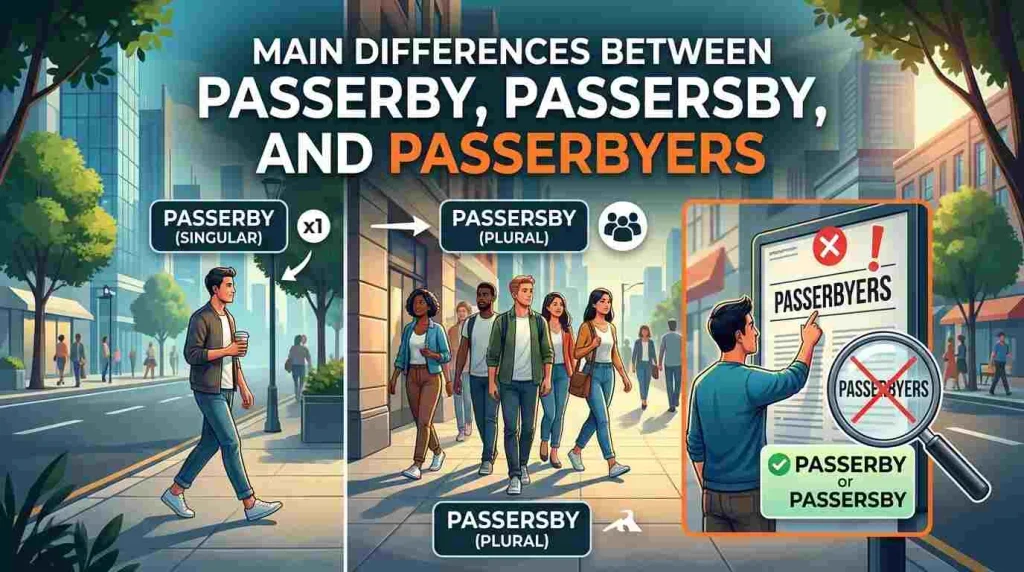
| Feature | Passerby | Passersby | Passerbyers |
| Meaning | One person passing by | Multiple people passing by | No accepted meaning |
| Number | Singular | Plural | Incorrect |
| Grammar | Correct noun | Correct plural noun | Incorrect formation |
| Dictionary Entry | Yes | Yes | No |
| Formal Writing | Yes | Yes | No |
| Everyday Speech | Yes | Yes | Avoid |
Why Is the Plural “Passersby”?
Many compound nouns have unusual plural forms.
Instead of making the last word plural, English sometimes pluralizes the main noun.
Examples include:
| Singular | Plural |
| Mother-in-law | Mothers-in-law |
| Attorney general | Attorneys general |
| Passerby | Passersby |
The important noun is passer, so it becomes passers, while by stays the same.
Common Synonyms
Depending on the context, you can replace passerby or passersby with:
- Pedestrian
- Witness
- Onlooker
- Bystander
- Observer
- Walker
- Spectator
Each synonym has slightly different meanings, so choose carefully.
Grammar Guide
How Each Term Is Used in Sentences
Passerby
Pattern:
A/The + passerby + verb
Examples:
- A passerby smiled.
- The passerby reported the theft.
Passersby
Pattern:
Several/Many/Few + passersby + plural verb
Examples:
- Many passersby applauded.
- Several passersby stopped.
Passerbyers
There is no correct sentence because this word is incorrect.
Common Mistakes Learners Make
Many English learners make these mistakes:
❌ Passerbyers were waiting.
✅ Passersby were waiting.
❌ Two passerby arrived.
✅ Two passersby arrived.
❌ A passersby helped me.
✅ A passerby helped me.
❌ Many passerby watched.
✅ Many passersby watched.
❌ One passersby waved.
✅ One passerby waved.
Simple Rules to Remember
- Use passerby for one person.
- Use passersby for more than one person.
- Never use passerbyers.
- The plural changes passer, not by.
- Remember that compound nouns often have irregular plurals.
Quick Tips for Writing and Speaking
- Count the number of people first.
- If there is one person, use passerby.
- If there are many people, use passersby.
- Avoid creating new plural forms.
- When unsure, check a reliable dictionary.
When to Use Each One
Use Passerby
- Referring to one stranger.
- News reporting.
- Storytelling.
- Daily conversation.
- Academic writing.
Use Passersby
- Talking about crowds.
- Public events.
- News articles.
- Witness reports.
- General descriptions.
Do Not Use Passerbyers
It is never appropriate in formal or informal English.
When NOT to Use Each One
Do Not Use Passerby
- When talking about multiple people.
- As a plural noun.
Incorrect:
- Five passerby helped.
Correct:
- Five passersby helped.
Do Not Use Passersby
- When referring to one individual.
Incorrect:
- A passersby smiled.
Correct:
- A passerby smiled.
Do Not Use Passerbyers
Never use this word in any context because it is not standard English.
Which One to Use (Decision Guide)
Ask yourself these questions:
Am I talking about one person?
✅ Use passerby
Am I talking about several people?
✅ Use passersby
Am I thinking of using passerbyers?
❌ Don’t. Replace it with passersby.
Quick Decision Table
| Situation | Correct Word |
| One person walking past | Passerby |
| Many people walking past | Passersby |
| Formal writing | Passerby / Passersby |
| Academic English | Passerby / Passersby |
| Passerbyers | Never |
Real-World Practical Examples
Passerby Examples
- A passerby found my wallet.
- A passerby gave directions to the tourists.
- One passerby reported the fire.
- A passerby complimented the student’s artwork.
- A passerby noticed the broken traffic light.
Passersby Examples
- Passersby watched the fireworks.
- Several passersby donated money to the charity.
- Curious passersby recorded the performance.
- Passersby admired the new mural.
- Many passersby stopped to ask questions.
Passerbyers Examples
These examples show incorrect usage.
- ❌ Passerbyers watched the game.
- ❌ Several passerbyers gathered.
- ❌ The passerbyers applauded.
- ❌ Passerbyers crossed the road.
- ❌ Many passerbyers smiled.
Each sentence should use passersby instead.
Self-Assessment (Fill in the Blanks)
- I will use ______ when referring to one stranger. The correct word is ______ because it is singular.
- I will use ______ when referring to many pedestrians. The correct word is ______ because it is plural.
- A ______ helped the child. The correct word is ______ because only one person helped.
- Several ______ witnessed the event. The correct word is ______ because more than one person was present.
- ______ is not a standard English word. The correct word is ______ because English uses an irregular plural.
- One ______ called emergency services. The correct word is ______ because the noun is singular.
- Many ______ stopped to watch. The correct word is ______ because the noun is plural.
- The lost tourist asked a ______ for help. The correct word is ______ because only one person was asked.
- The police interviewed several ______. The correct word is ______ because there were multiple witnesses.
- Never write ______ in formal English. The correct word is ______ because it is accepted.
- A ______ picked up the dropped phone. The correct word is ______ because only one individual acted.
- Curious ______ crowded around the magician. The correct word is ______ because several people watched.
- The singular form is ______. The correct word is ______ because it refers to one person.
- The plural form is ______. The correct word is ______ because it refers to many people.
- The dictionary recognizes ______. The correct word is ______ because it is standard English.
- The dictionary recognizes ______ as the plural. The correct word is ______ because it is correct grammar.
- Avoid writing ______ in essays. The correct word is ______ because it is incorrect.
- A news reporter mentioned one ______. The correct word is ______ because only one witness appeared.
- The article described dozens of ______. The correct word is ______ because dozens means many.
- If you mean multiple strangers passing by, write ______. The correct word is ______ because it is the proper plural.
Answers
- passerby, passerby
- passersby, passersby
- passerby, passerby
- passersby, passersby
- passerbyers, passersby
- passerby, passerby
- passersby, passersby
- passerby, passerby
- passersby, passersby
- passerbyers, passersby
- passerby, passerby
- passersby, passersby
- passerby, passerby
- passersby, passersby
- passerby, passerby
- passersby, passersby
- passerbyers, passersby
- passerby, passerby
- passersby, passersby
- passersby, passersby
Final Verdict
The difference between passerby, passersby and passerbyers is straightforward once you know the grammar. Passerby is the correct singular noun for one person passing by, while passersby is the correct plural noun for two or more people. Passerbyers is not a valid English word and should always be avoided in both writing and speech.
Whenever you’re unsure, remember this simple rule: one passerby, many passersby. Mastering this irregular plural will make your English sound more natural, accurate and professional in everyday conversations, academic writing and formal communication.
To avoid more grammar mistakes, check What Happen or What Happened.
Conclusion
Understanding the difference between Passerbyers Vs Passersby Vs Passerby becomes much easier once you know the basic grammar rule behind these terms. Passerby is the correct singular noun used for one person passing by, while passersby is the proper plural form used for two or more people. Although passerbyers may seem logical, it is not a recognized English word and should always be avoided.
Learning this distinction can improve your grammar, strengthen your writing and help you communicate more naturally in conversations, academic work and professional documents. Whenever you encounter these words, simply remember the easy rule: one passerby, many passersby. By using the correct form in the right context, you’ll avoid common mistakes and write with greater confidence. Mastering small grammar details like this makes a big difference in producing clear, polished and accurate English.
FAQs
Is passerby a singular or plural noun?
Passerby is a singular noun that refers to one person who is passing by a place. If you are talking about a single individual who happens to walk by, passerby is the correct choice. For more than one person, you should use passersby instead.
Is passersby the correct plural of passerby?
Yes. Passersby is the standard and grammatically correct plural form of passerby. The word follows an irregular plural pattern where the main noun, passer, becomes plural while by remains unchanged. This form is accepted in both British and American English.
Is passerbyers a real English word?
No. Passerbyers is not a recognized English word and does not appear in standard dictionaries. It is a common mistake made by learners who try to form a regular plural. The correct plural is always passersby.
Why doesn’t passerby become passerbys?
English has many compound nouns with irregular plural forms. In passerby, the word passer is the main noun, so it changes to passers, while by stays the same. That’s why the correct plural is passersby, not passerbys.
Can I use passerby in formal writing?
Yes. Passerby is perfectly acceptable in formal writing, including academic papers, news reports, business documents and professional communication. Just make sure you use passersby whenever you need the plural form.
What is the easiest way to remember the correct plural?
A simple memory trick is to remember that the person is the passer, so only that part becomes plural. Think of it as one passerby and many passersby. Avoid adding -ers or -s to the end of the whole word.
Are passerby and bystander the same?
Not exactly. A passerby is someone who is simply passing a place, while a bystander is someone present at an event, often observing it without taking part. Sometimes the same person can be both, depending on the situation.
Is passersby used in everyday conversation?
Yes. Native English speakers regularly use passersby in conversations, news articles, books and online writing when referring to multiple people passing by. It is the natural and widely accepted plural form.
What are common mistakes with passerby and passersby?
The most common mistakes include using passerby for multiple people, using passersby for one person and writing the incorrect form passerbyers. Checking whether you’re talking about one or several people will help you choose the right word.
How can I use passerby and passersby correctly in sentences?
Use passerby when referring to one individual, such as: A passerby offered assistance. Use passersby for two or more people, such as: Several passersby watched the performance. Matching the noun to the number of people keeps your grammar accurate.