
Many English learners confuse than and then because they look and sound similar. However, these two words have completely different meanings and grammatical functions. Knowing when to use than vs then will improve your writing, speaking, and overall English accuracy while helping you avoid one of the most common grammar mistakes.
Comparison Overview
Although than vs then differ by only one letter, they serve entirely different purposes in English grammar.
- Than is mainly used for comparisons.
- Then is mainly used to refer to time, sequence, or the next step.
Understanding this simple distinction makes it much easier to choose the correct word in any sentence.
| Feature | Than | Then |
| Primary Use | Comparison | Time or sequence |
| Part of Speech | Conjunction, Preposition | Adverb, Adjective, Noun |
| Answers | Compared to what? | When? What happened next? |
| Example | She is taller than me. | We ate dinner, then watched TV. |
Definition of Than
Than is a word used when comparing two or more people, things, actions, or ideas. It introduces the second part of a comparison.
Core Meaning
It means “compared with” or “in comparison to.”
Purpose
Its main purpose is to show differences in size, quality, amount, speed, ability, or preference.
Examples
- Cats are smaller than dogs.
- I would rather read than watch television.
- This phone is cheaper than that one.
- She is more experienced than her coworker.
- Learning English is easier than learning several languages at once.
Definition of Then
Then refers to time, order, or sequence. It tells readers what happens next or refers to a particular moment.
Core Meaning
It means “at that time,” “afterward,” or “next.”
Purpose
Its purpose is to show chronological order or the next action.
Examples
- Finish your homework, then play games.
- We arrived early and then checked into the hotel.
- Back then, life was very different.
- Mix the ingredients, then bake the cake.
- I’ll call you, and then we’ll discuss everything.
Main Differences Between Than and Then
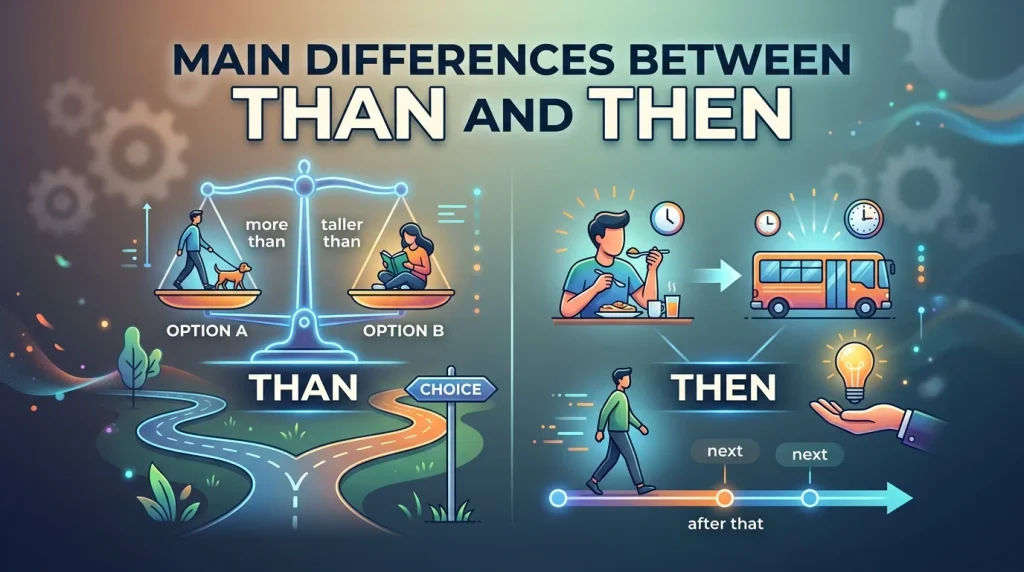
Although the words look alike, their meanings and grammar are completely different.
| Aspect | Than | Then |
| Meaning | Comparison | Time or sequence |
| Function | Compares two things | Shows order or timing |
| Used After | Comparative adjectives and adverbs | Actions, events, instructions |
| Answers | Compared with what? | When? What’s next? |
| Example | Faster than light | Eat first, then sleep |
Key Difference
Use than whenever you’re making a comparison.
Use then whenever you’re talking about time or the next event.
Why People Confuse Than vs Then
Several reasons make these words easy to mix up.
- They differ by only one letter.
- Their pronunciation is similar.
- They’re both very common in English.
- Spellcheck sometimes misses the mistake because both are correctly spelled words.
- Fast typing often causes accidental substitution.
Easy Memory Trick
Here’s a simple way to remember them.
Than = Comparison
The word comparison contains the letter A, just like than.
Then = Time
The word time relates to then, which contains the letter E, reminding you of an event or the next event.
Grammar Guide
Parts of Speech
| Word | Grammar Role |
| Than | Conjunction, Preposition |
| Then | Adverb, Adjective, Noun |
How each term is used in sentences
Using “Than”
Pattern:
- Subject + comparative adjective + than + object
Examples:
- My house is bigger than yours.
- Water is heavier than oil.
- She speaks more clearly than I do.
- I’d rather walk than drive.
- This route is shorter than the other.
Using “Then”
Pattern:
- Action 1 + then + Action 2
Examples:
- Wake up, then brush your teeth.
- We talked and then left.
- Finish the report, then email it.
- He smiled, then continued speaking.
- First read the instructions, then begin.
Common mistakes learners make
❌ She is smarter than me.
✅ She is smarter than me.
❌ Finish dinner than wash the dishes.
✅ Finish dinner then wash the dishes.
❌ Back than, we didn’t have smartphones.
✅ Back then, we didn’t have smartphones.
❌ I’d rather sleep than study.
✅ I’d rather sleep than study.
Simple rules to remember
- Use than after comparative words.
- Use then for time.
- If you’re comparing, choose than.
- If something happens next, choose then.
- Ask yourself: “Am I comparing or sequencing?”
Quick tips for writing and speaking
- Double-check comparisons before submitting assignments.
- Read the sentence aloud.
- Replace then with next. If it still makes sense, use then.
- Replace than with compared to. If it works, use than.
- Proofread carefully because spellcheck may not catch the mistake.
When to Use Each One
Use “Than” when
- Comparing two people
- Comparing objects
- Comparing prices
- Comparing abilities
- Showing preference
- Comparing measurements
- Discussing statistics
Examples
- She is taller than her brother.
- Coffee is stronger than tea.
Use “Then” when
- Giving instructions
- Describing events in order
- Talking about history
- Referring to the future
- Explaining processes
- Telling stories
Examples
- Wash the vegetables, then cook them.
- Life was simpler back then.
When NOT to Use Each One
Do not use “Than”
- To describe time
- For instructions
- For chronological order
- To describe historical periods
Incorrect:
- Eat dinner than sleep.
Correct:
- Eat dinner then sleep.
Do not use “Then”
- After comparative adjectives
- During comparisons
- To express preference
Incorrect:
- This book is better than that one.
Correct:
- This book is better than that one.
Which One to Use (Decision Guide)
Ask yourself these questions.
Are you comparing two things?
→ Use than.
Are you talking about time or what happens next?
→ Use then.
Quick Decision Chart
| If you’re talking about… | Use |
| Bigger or smaller | Than |
| Better or worse | Than |
| More or less | Than |
| Next step | Then |
| Later | Then |
| At that time | Then |
Real-World Practical Examples
Than Examples
Education
- Math is easier than chemistry for me.
Daily Life
- Walking is healthier than driving short distances.
Science
- Iron is heavier than aluminum.
Business
- This supplier is cheaper than our previous one.
Technology
- Fiber internet is faster than DSL.
Then Examples
Education
- Read the chapter, then answer the questions.
Daily Life
- I cooked dinner and then cleaned the kitchen.
Science
- Heat the sample, then record the temperature.
Business
- Approve the budget, then start the project.
Conversation
- We met at the café and then walked home.
Self-Assessment (Fill in the Blanks)
- I will use ______ when comparing two students.
The correct word is ______ because it shows comparison. - I will use ______ when describing the next step.
The correct word is ______ because it shows sequence. - This laptop is faster ______ mine.
The correct word is ______ because it compares speed. - Finish your breakfast, ______ brush your teeth.
The correct word is ______ because it shows order. - She is older ______ her sister.
The correct word is ______ because it compares age. - Back ______, life was much quieter.
The correct word is ______ because it refers to time. - I’d rather study ______ watch television.
The correct word is ______ because it expresses preference. - Mix the ingredients, ______ bake the cake.
The correct word is ______ because it shows the next action. - My bag is lighter ______ yours.
The correct word is ______ because it compares weight. - We visited the museum and ______ had lunch.
The correct word is ______ because it describes sequence. - This road is shorter ______ the highway.
The correct word is ______ because it compares distance. - Finish your work, ______ go home.
The correct word is ______ because it indicates the next step. - She speaks more clearly ______ her brother.
The correct word is ______ because it compares speaking ability. - We finished the meeting and ______ celebrated.
The correct word is ______ because it indicates order. - Water is cleaner ______ the polluted river.
The correct word is ______ because it compares quality. - First install the software, ______ restart your computer.
The correct word is ______ because it gives instructions. - He is stronger ______ I expected.
The correct word is ______ because it compares strength. - We graduated and ______ started our careers.
The correct word is ______ because it shows what happened next. - Reading is more enjoyable ______ scrolling endlessly.
The correct word is ______ because it compares activities. - Save the file, ______ close the application.
The correct word is ______ because it shows sequence.
Answers
- than
- then
- than
- then
- than
- then
- than
- then
- than
- then
- than
- then
- than
- then
- than
- then
- than
- then
- than
- then
Final Verdict
Than vs then may look almost identical, but they have completely different jobs in English. Use than whenever you’re making a comparison between people, objects, ideas, or actions. Use then whenever you’re talking about time, sequence, instructions, or what happens next. A simple way to remember the difference is to ask yourself whether you’re comparing or ordering events. If it’s a comparison, choose than. If it’s about time or the next step, choose then. By practicing with real-life examples and following the grammar rules in this guide, you’ll quickly build the confidence to use both words correctly in writing, conversations, academic work, business communication, and everyday English.
Conclusion
Understanding the difference between than vs then is one of the easiest ways to make your English writing clearer and more accurate. While these two words look similar, they have completely different purposes. Than is used for comparisons, helping you show how one thing differs from another, whereas then refers to time, order, or what happens next.
Keeping this simple distinction in mind can prevent common grammar mistakes in emails, school assignments, professional writing, and everyday conversations. Whenever you’re unsure, ask yourself whether you’re comparing two things or describing a sequence of events. With regular practice and real-world examples, choosing the correct word will soon become second nature. Mastering than vs then not only improves your grammar but also makes your communication more confident, polished, and easy for readers to understand.
FAQs
What is the difference between than and then?
The main difference is their purpose. Than is used to compare people, objects, or ideas, while then refers to time, sequence, or the next step in a process. Remember that comparisons use than, and actions that happen afterward use then.
Is “better then” or “better than” correct?
The correct phrase is better than because the word better creates a comparison. Whenever you compare two things, than should follow the comparative adjective. Better than is a common spelling mistake and is grammatically incorrect.
Can then ever be used for comparisons?
No. Then is not used to compare people, objects, or ideas. It only refers to time, order, or sequence. If your sentence compares one thing with another, you should always use than instead.
Why do people confuse than and then?
People often confuse these words because they are spelled similarly and have similar pronunciation. Since both are common in everyday English, typing or speaking quickly can lead to mistakes. Learning their different meanings makes it much easier to use them correctly.
Is than a conjunction or a preposition?
Than most commonly functions as a conjunction when connecting parts of a comparison. In some modern English usage, it can also function as a preposition. Regardless of its grammatical role, it always introduces a comparison between two or more things.
Is then an adverb?
Yes. Then is most commonly an adverb because it describes when something happens or what happens next. In certain contexts, it can also function as a noun or adjective, but its primary role is indicating time or sequence.
How can I easily remember than vs then?
A simple trick is to associate than with comparison and then with time. If you’re comparing two things, choose than. If you’re talking about what happens next or referring to a point in time, choose then.
Can I use than and then in the same sentence?
Yes. Both words can appear in the same sentence if they serve different purposes. For example: She worked harder than anyone else, then celebrated her success with friends. Here, than compares effort, while then shows what happened afterward.
Are than and then pronounced differently?
Their pronunciation is very similar, especially in casual speech, which is why many learners confuse them. Even though they may sound alike, their meanings and grammatical uses are completely different, so context determines which word is correct.
Why is learning than vs then important?
Knowing the difference between than and then helps you write more accurately and communicate more clearly. Using the correct word avoids misunderstandings, improves grammar in academic and professional writing, and makes your English sound more natural and polished.