
Many English learners get confused between year old vs years old because both phrases relate to age. However, they aren’t used the same way. Understanding the difference helps you write and speak more naturally and accurately. This guide explains the meaning, grammar, usage, and key differences between these two common expressions in simple and easy-to-understand language.
Comparison Overview
Year old and years old both refer to age, but they serve different grammatical functions in a sentence.
- Year old is typically used as part of a compound adjective before a noun.
- Years old is used after a verb to state someone’s or something’s age.
- The choice depends on sentence structure rather than meaning.
- Both expressions describe age, but only one is correct in a given context.
Understanding where each form belongs is essential for proper English grammar and natural communication.
Definition of Year Old
Year old is usually part of a compound adjective that describes a noun.
When used this way, the number and the phrase year-old work together as a single adjective.
Examples:
- A 10-year-old student.
- A 5-year-old dog.
- A 100-year-old building.
In these examples, year-old directly describes the noun that follows it.
Key Purpose
The purpose of year old is to modify or describe a person, animal, object, or thing before the noun appears.
Definition of Years Old
Years old is a phrase used to state age after a linking verb such as is, are, was, or were.
Examples:
- The student is 10 years old.
- The dog is 5 years old.
- The building is 100 years old.
In these examples, years old tells the subject’s age.
Key Purpose
The purpose of years old is to express age as information rather than as an adjective before a noun.
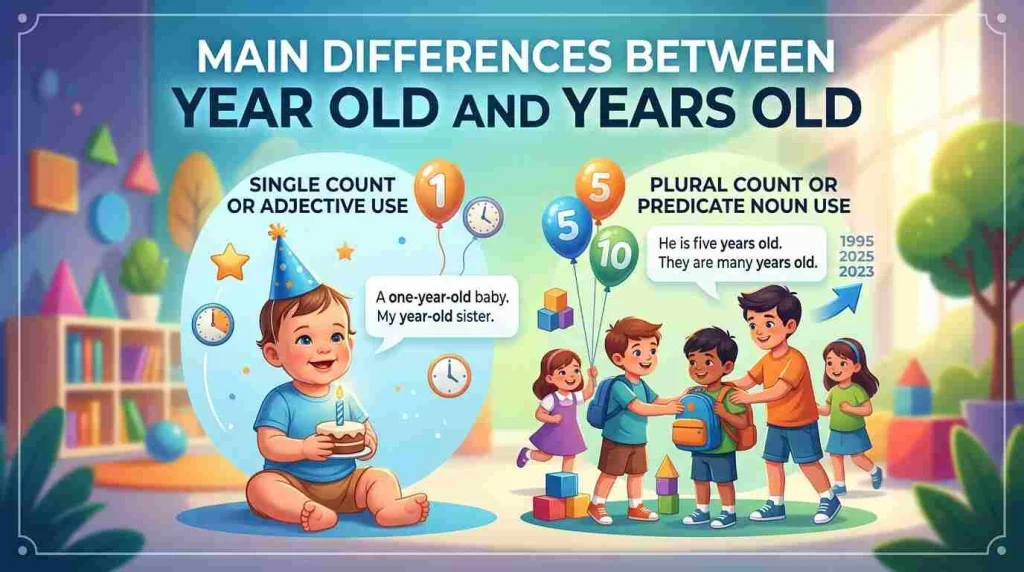
Main Differences Between Year Old and Years Old
| Feature | Year Old | Years Old |
| Grammar Role | Compound adjective | Age expression |
| Position | Before a noun | After a verb |
| Hyphen Needed | Yes | No |
| Example | A 7-year-old child | The child is 7 years old |
| Function | Describes a noun | States age |
| Sentence Placement | Before the noun | After the subject and verb |
Quick Comparison
Year old
- Functions as an adjective.
- Usually includes hyphens.
- Comes before the noun.
- Never stands alone after the verb.
Years old
- Functions as an age expression.
- Does not require hyphens.
- Comes after the verb.
- Cannot directly modify a noun.
Why This Difference Matters
Using the wrong form can make your writing sound unnatural or grammatically incorrect.
Correct:
- A 12-year-old athlete won the race.
- The athlete is 12 years old.
Incorrect:
- A 12 years old athlete won the race.
- The athlete is 12-year-old.
Comparison Table: Correct vs Incorrect Usage
| Correct | Incorrect |
| A 6-year-old cat | A 6 years old cat |
| A 20-year-old company | A 20 years old company |
| She is 6 years old | She is 6 years old |
| The company is 20 years old | The company is 20 years old |
| A 50-year-old tree | A50-year-oldd tree |
Grammar Guide
Understanding the grammar behind these expressions makes them much easier to use correctly.
How Each Term Is Used in Sentences
Using Year Old
Pattern:
Number + year-old + noun
Examples:
- A 4-year-old boy.
- A 30-year-old teacher.
- A 200-year-old bridge.
Using Years Old
Pattern:
Subject + be verb + number + years old
Examples:
- The boy is 4 years old.
- The teacher is 30 years old.
- The bridge is 200 years old.
Common Mistakes Learners Make
Forgetting Hyphens
Incorrect:
- A 10 year old student.
Correct:
- A 10-year-old student.
Using Years Old Before a Noun
Incorrect:
- A 15 years old athlete.
Correct:
- A 15-year-old athlete.
Using Year-Old After a Verb
Incorrect:
- She is 12-year-old.
Correct:
- She is 12 years old.
Mixing Both Structures
Incorrect:
- The dog is 5-year-old years old.
Correct:
- The dog is 5 years old.
Simple Rules to Remember
Rule One
If the age comes before the noun, use:
number + year-old + noun
Example:
- A 9-year-old child.
Rule Two
If the age comes after the verb, use:
number + years old
Example:
- The child is 9 years old.
Rule Three
Always use hyphens in compound adjectives.
Example:
- A 15-year-old building.
Rule Four
Never use hyphens with years old after the verb.
Example:
- The building is 15 years old.
Quick Tips for Writing and Speaking
- Look for the noun first.
- If age comes before the noun, choose year-old.
- If age comes after is, are, was, or were, choose years old.
- Remember that year-old acts like one adjective.
- Read the sentence aloud to check whether it sounds natural.
- Hyphens are important when using year-old.
- Do not use years old directly before a noun.
- Do not use year-old after a linking verb.
Singular vs Plural Rule
One reason learners become confused is that year-old remains singular inside a compound adjective.
Correct:
- A 20-year-old building.
- A 50-year-old tree.
- A 100-year-old castle.
Notice that year stays singular.
However, when expressing age normally, years becomes plural.
Correct:
- The building is 20 years old.
- The tree is 50 years old.
- The castle is 100 years old.
This is one of the most important grammar rules to remember.
Hyphenation Rules
Hyphens play a major role when using year-old.
Use Hyphens
- A 3-year-old child.
- A 40-year-old businessman.
- A 150-year-old monument.
Do Not Use Hyphens
- The child is 3 years old.
- The businessman is 40 years old.
- The monument is 150 years old.
Incorrect hyphenation is one of the most common mistakes in English writing.
Formal vs Informal Usage
Both forms are accepted in formal and informal English.
Formal Writing
- A 25-year-old researcher published the study.
- The researcher is 25 years old.
Informal Conversation
- My sister is 18 years old.
- I have an 18-year-old sister.
The choice depends on sentence structure rather than formality.
Common Contexts Where These Terms Appear
Education
- A 7-year-old student.
- The student is 7 years old.
Healthcare
- A 65-year-old patient.
- The patient is 65 years old.
Business
- A 10-year-old company.
- The company is 10 years old.
Science
- A 2-million-year-old fossil.
- The fossil is 2 million years old.
Journalism
- A 14-year-old witness.
- The witness is 14 years old.
These patterns appear frequently in newspapers, academic writing, business reports, and everyday conversations.
When to Use Each One
Choosing between year-old and years old becomes easy once you know where the age appears in the sentence. The meaning stays the same, but the grammar changes.
Use Year-Old When…
Use year-old before a noun to describe it.
Correct examples:
- We adopted a 2-year-old cat.
- She is raising a 6-year-old son.
- They restored a 150-year-old church.
- The museum displayed a 3,000-year-old artifact.
- A 10-year-old company won the award.
Use Years Old When…
Use years old after a linking verb such as is, are, was, or were to state age.
Correct examples:
- The cat is 2 years old.
- Her son is 6 years old.
- The church is 150 years old.
- The artifact is 3,000 years old.
- The company is 10 years old.
When NOT to Use Each One
Avoid using these expressions in the wrong sentence structure.
Do Not Use Years Old Before a Noun
❌ A 12 years old student
✅ A 12-year-old student
Do Not Use Year-Old After a Verb
❌ The student is 12-year-old.
✅ The student is 12 years old.
Do Not Remove the Hyphens
❌ A 5 year old child
✅ A 5-year-old child
Do Not Make “Year” Plural in a Compound Adjective
❌ A 30-years-old building
✅ A 30-year-old building
Avoid Mixing Both Forms
❌ The dog is 5-year-old years old.
✅ The dog is 5 years old.
Which One to Use (Decision Guide)
Use this simple guide whenever you’re unsure.
| If your sentence… | Use |
| Describes a noun before it appears | year-old |
| States someone’s age after a verb | years old |
| Needs a compound adjective | year-old |
| Answers “How old is…?” | years old |
| Appears before a person, place, animal, or thing | year-old |
| Appears after is, are, was, or were | years old |
Easy Trick to Remember
- Before a noun = year-old
- After a verb = years old
If you remember this one rule, you’ll choose the correct form almost every time.
Real-World Practical Examples
Year-Old Examples
Education
- The school welcomed a 5-year-old student on the first day.
Daily Life
- We adopted a 2-year-old puppy from the shelter.
Business
- A 20-year-old startup expanded into international markets.
Technology
- The museum displayed a 40-year-old computer.
Writing
- The novel follows a 12-year-old girl on an unforgettable adventure.
Years Old Examples
Education
- The student is 5 years old.
Daily Life
- My puppy is 2 years old now.
Science
- Scientists believe the fossil is 70 million years old.
Business
- The company is 20 years old this year.
Conversation
- My grandmother is 82 years old.
Self-Assessment (Fill in the Blanks)
Fill in each blank with year-old or years old.
- I will use ______ when referring to a child before the noun. The correct word is ______ because it acts as a compound adjective.
- I will use ______ when stating someone’s age after the verb. The correct word is ______ because it follows a linking verb.
- We adopted a ______ puppy. The correct word is ______ because it modifies the noun.
- The puppy is three ______. The correct word is ______ because it tells the puppy’s age.
- She has a ten-______ brother. The correct word is ______ because it comes before a noun.
- My brother is ten ______. The correct word is ______ because it follows the verb.
- They restored a two-hundred-______ castle. The correct word is ______ because it describes the castle.
- The castle is two hundred ______. The correct word is ______ because it states age.
- A six-______ athlete won the race. The correct word is ______ because it modifies the noun.
- The athlete is six ______. The correct word is ______ because it follows is.
- The museum displayed a fifty-______ artifact. The correct word is ______ because it is an adjective.
- The artifact is fifty ______. The correct word is ______ because it tells age.
- A nine-______ student answered correctly. The correct word is ______ because it comes before the noun.
- The student is nine ______. The correct word is ______ because it follows the verb.
- We visited a one-hundred-______ temple. The correct word is ______ because it modifies the noun.
- The temple is one hundred ______. The correct word is ______ because it expresses age.
- A four-______ kitten needs special care. The correct word is ______ because it describes the noun.
- The kitten is four ______. The correct word is ______ because it follows the verb.
- The report mentioned a fifteen-______ company. The correct word is ______ because it comes before the noun.
- The company is fifteen ______. The correct word is ______ because it states the company’s age.
Answers
- year-old, year-old
- years old, years old
- year-old, year-old
- years old, years old
- year-old, year-old
- years old, years old
- year-old, year-old
- years old, years old
- year-old, year-old
- years old, years old
- year-old, year-old
- years old, years old
- year-old, year-old
- years old, years old
- year-old, year-old
- years old, years old
- year-old, year-old
- years old, years old
- year-old, year-old
- years old, years old
Final Verdict
Although year-old and years old both describe age, they are not interchangeable. Use year-old as a hyphenated compound adjective before a noun, such as a 10-year-old student. Use years old after a linking verb to state age, such as the student is 10 years old. Remembering this simple distinction will help you write more accurate, natural, and professional English in essays, conversations, emails, reports, and everyday communication. Once you know whether you’re describing a noun or stating an age, choosing the correct form becomes straightforward.
Conclusion
Understanding the difference between Year Old Vs Years Old is essential for writing and speaking English correctly. Although both expressions describe age, they serve different grammatical purposes. Year-old is a hyphenated compound adjective that comes before a noun, while years old follows a linking verb to state someone’s or something’s age. Learning this simple distinction helps you avoid common grammar mistakes and makes your sentences sound more natural and professional.
Whether you are writing essays, emails, articles, business documents, or having everyday conversations, using the correct form improves clarity and confidence. A good rule to remember is that if the age describes a noun, choose year-old. If the age completes the sentence after a verb like is or are, choose years old. With regular practice, you’ll use both expressions accurately and communicate more effectively in every situation.
FAQs
What is the difference between year-old and years old?
The main difference is grammatical function. Year-old is a hyphenated compound adjective placed before a noun, while years old is used after a linking verb to state age. Although both describe age, they cannot be used interchangeably because they appear in different sentence structures.
Is year-old always hyphenated?
Yes. When year-old appears before a noun as a compound adjective, it should always be hyphenated. The hyphens connect the words into a single descriptive unit, making the sentence easier to read and grammatically correct in both formal and informal writing.
When should I use years old?
Use years old after linking verbs such as is, are, was, or were when stating the age of a person, animal, object, or place. It functions as part of the predicate rather than describing a noun directly.
Why is year singular in year-old?
In a compound adjective, the noun remains singular even when referring to multiple units of time. That is why English uses year-old instead of years-old before a noun. This rule applies to many similar compound adjectives in English grammar.
Can I write ten years old child?
No. That structure is incorrect because years old cannot directly modify a noun. The correct form is ten-year-old child. If you want to use years old, rewrite the sentence as The child is ten years old.
Is years-old with hyphens correct?
No. Years old should not be hyphenated when it appears after a verb. Hyphens are only used in the compound adjective year-old before a noun. Avoid writing years-old unless it forms part of a larger compound adjective in rare editorial contexts.
Are these grammar rules the same in American and British English?
Yes. Both American English and British English follow the same grammar rules for year-old and years old. The placement, hyphenation, and sentence structure remain consistent, making these forms universally accepted in standard English.
Can I use year-old for animals and objects?
Absolutely. Year-old is commonly used for people, animals, buildings, companies, trees, fossils, and many other nouns. It simply describes age before the noun, regardless of whether the subject is living or non-living.
What is the easiest way to remember Year Old Vs Years Old?
A simple memory trick is to look at the sentence structure. If the age comes before a noun, use year-old. If the age comes after a linking verb like is or are, use years old. This rule works in almost every situation.
Why do learners confuse Year Old Vs Years Old?
Many learners focus on the meaning instead of the grammar. Since both expressions describe age, they seem interchangeable at first. However, understanding their different grammatical roles and practicing common sentence patterns quickly removes this confusion and improves writing accuracy.