
Choosing between neither vs either can be confusing because both words are used when talking about two people, things, or choices. However, they have opposite meanings and different grammatical uses. Understanding when to use each one correctly will help you write and speak more naturally while avoiding common English mistakes.
Comparison Overview
Neither vs either are common English determiners, pronouns, conjunctions, and adverbs used when referring to two people, objects, ideas, or options.
- Either usually means one or the other of two choices.
- Neither means not one and not the other.
Although they often appear in similar sentence structures, they express completely different meanings. Knowing the distinction is essential for clear communication in both spoken and written English.
| Feature | Neither | Either |
| Basic Meaning | Neither one nor the other | One or the other |
| Refers To | Two people or things | Two people or things |
| Indicates | Negative | Positive/Choice |
| Common Pair | Neither…nor | Either…or |
| Singular or Plural | Usually singular | Usually singular |
Definition of Neither
Neither means not one and not the other when talking about two people, objects, ideas, or choices.
It is used to express a negative meaning without requiring another negative word in the sentence.
Examples:
- Neither answer is correct.
- Neither student passed the exam.
- Neither option works for me.
The word can function as:
- Determiner
- Pronoun
- Conjunction
- Adverb
Its main purpose is to reject both available choices.
Definition of Either
Either means one or the other of two people, objects, or choices.
It is used when either option is acceptable or when referring to one of two possibilities.
Examples:
- Either road will take you there.
- You can choose either book.
- Either answer is acceptable.
Like neither, it can work as:
- Determiner
- Pronoun
- Conjunction
- Adverb
Its primary purpose is to present or refer to one of two alternatives.
Main Differences Between Neither vs Either
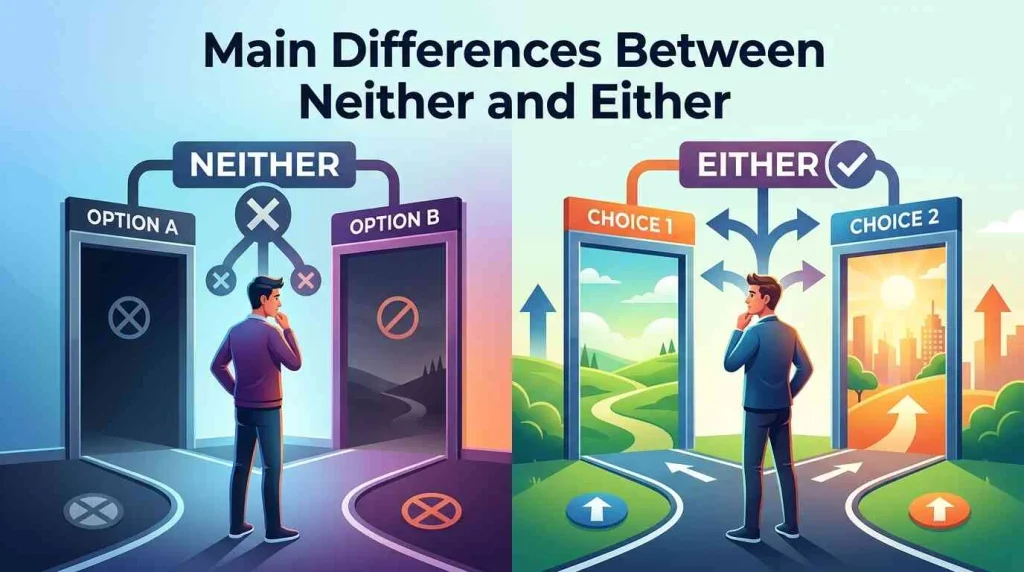
Although both words refer to two things, they communicate opposite ideas.
| Aspect | Neither | Either |
| Meaning | Neither of the two | One of the two |
| Sentence Type | Negative | Positive or neutral |
| Common Structure | Neither…nor | Either…or |
| Accepts Both Choices? | No | Yes |
| Rejects Both? | Yes | No |
| Refers To | Two items | Two items |
Key Differences
- Neither excludes both choices.
- Either allows one of the two choices.
- Neither creates a negative meaning.
- Either expresses choice or possibility.
- Neither is commonly paired with nor.
- Either is commonly paired with or.
Neither vs Either in Common Expressions
Certain fixed expressions make these words easier to remember.
| Expression | Meaning | Example |
| Neither…nor | Both are not true | Neither John nor Mary came. |
| Either…or | One choice only | Either tea or coffee is fine. |
| Me neither | I don’t either | “I don’t like spinach.” “Me neither.” |
| Me neither (informal) | I don’t either (mainly American English) | “I can’t swim.” “Me neither.” |
Grammar Guide
Both neither and either belong to several parts of speech depending on how they are used.
They may function as:
- Determiners
- Pronouns
- Conjunctions
- Adverbs
They generally refer to two people or things and usually take a singular verb, although agreement can vary in compound subjects.
How Each Term Is Used in Sentences
Neither
Pattern:
- Neither + singular noun + singular verb
Example:
- Neither student was absent.
Pattern:
- Neither of + plural noun/pronoun
Example:
- Neither of the books is interesting.
Pattern:
- Neither…nor
Example:
- Neither Sarah nor Tom is coming.
Either
Pattern:
- Either + singular noun + singular verb
Example:
- Either solution works.
Pattern:
- Either of + plural noun/pronoun
Example:
- Either of these dresses looks beautiful.
Pattern:
- Either…or
Example:
- Either Alex or Emma will lead the meeting.
Common Mistakes Learners Make
Mistake 1
❌ Neither of them aren’t ready.
✅ Neither of them is ready.
Mistake 2
❌ Either both options are correct.
✅ Either option is correct.
Mistake 3
❌ Neither…or
✅ Neither…nor
Mistake 4
❌ Either…nor
✅ Either…or
Mistake 5
❌ I don’t like neither.
✅ I like neither.
Simple Rules to Remember
- Neither = not both.
- Either = one of two.
- Use nor after neither.
- Use or after either.
- Avoid double negatives with neither.
- Both words usually refer to only two choices.
Quick Tips for Writing and Speaking
- Use either when giving someone a choice.
- Use neither when rejecting both options.
- Keep verbs singular in most formal situations.
- Match either with or.
- Match neither with nor.
- Read the sentence aloud to check if the meaning sounds logical.
When to Use Each One
Use Neither When
- Both choices are incorrect.
- You reject two options.
- Two people did not do something.
- Nothing from two possibilities applies.
- Expressing negative meaning.
Examples:
- Neither movie was interesting.
- Neither child wanted dessert.
- Neither answer is correct.
Use Either When
- One of two options is acceptable.
- Giving someone a choice.
- Referring to one possibility.
- Talking about alternatives.
- Making decisions.
Examples:
- Either chair is comfortable.
- You may choose either dessert.
- Either answer will receive credit.
When NOT to Use Each One
Do Not Use Neither
- When at least one option is acceptable.
- When talking about more than two choices.
- With another unnecessary negative word.
- Instead of “either.”
Incorrect:
- Neither of the three books.
Better:
- None of the three books.
Do Not Use Either
- When rejecting both choices.
- When talking about more than two alternatives.
- Instead of “neither.”
- When no choice exists.
Incorrect:
- Either answer is wrong.
Better:
- Neither answer is correct.
Which One to Use (Decision Guide)
Ask yourself these questions:
| Question | Use |
| Are there only two choices? | Either or Neither |
| Are both choices rejected? | Neither |
| Is one choice acceptable? | Either |
| Are you giving alternatives? | Either |
| Are you saying both are not true? | Neither |
| Are you using “or”? | Either |
| Are you using “nor”? | Neither |
A simple memory trick:
- Either = One
- Neither = None
Real-World Practical Examples
Neither Examples
- Education: Neither student completed the assignment.
- Daily Life: Neither restaurant was open.
- Science: Neither experiment produced the expected results.
- Business: Neither proposal met the company’s requirements.
- Technology: Neither device connected to Wi-Fi.
Either Examples
- Education: Either answer will receive full marks.
- Daily Life: You can sit in either seat.
- Science: Either method produces similar results.
- Business: Either supplier can deliver the products.
- Technology: Either browser supports the website.
Self-Assessment (Fill in the Blanks)
- I will use ______ when referring to one acceptable choice between two options. The correct word is ______ because it shows one of two possibilities.
- I will use ______ when both available choices are rejected. The correct word is ______ because neither option is acceptable.
- I can choose ______ route to reach school. The correct word is ______ because both routes are possible.
- ______ candidate met the requirements. The correct word is ______ because both failed.
- You may select ______ color. The correct word is ______ because one choice is enough.
- ______ of the answers is correct. The correct word is ______ because both answers are wrong.
- We can watch ______ movie tonight. The correct word is ______ because both are acceptable.
- ______ teacher attended the meeting. The correct word is ______ because both were absent.
- Bring ______ notebook tomorrow. The correct word is ______ because either one works.
- ______ solution solved the problem. The correct word is ______ because both failed.
- You can call on ______ day. The correct word is ______ because both days are suitable.
- ______ player scored a goal. The correct word is ______ because both failed to score.
- I like ______ option equally. The correct word is ______ because one may be chosen.
- ______ road leads to the museum. The correct word is ______ because both roads do.
- ______ explanation answered the question. The correct word is ______ because both explanations failed.
- We can travel by ______ train. The correct word is ______ because both choices are available.
- ______ employee arrived late. The correct word is ______ because both arrived on time? (Use the appropriate negative form if neither did.)
- You may borrow ______ pencil. The correct word is ______ because one of the two is fine.
- ______ team deserved to lose according to the coach. The correct word is ______ because both performed well? (Choose the word that best fits the intended meaning.)
- ______ of the two computers can handle the software. The correct word is ______ because both are capable.
Answers
- Either
- Neither
- Either
- Neither
- Either
- Neither
- Either
- Neither
- Either
- Neither
- Either
- Neither
- Either
- Either
- Neither
- Either
- Neither
- Either
- Neither
- Either
Final Verdict
Neither and either are small words with a big impact on meaning. While both refer to two people, things, or choices, they serve opposite purposes. Use either when one of two options is possible, acceptable, or available. Use neither when you want to say that both options are rejected or not true. Remember the common pairings—either…or and neither…nor—and avoid double negatives when using neither. By understanding their meanings, grammatical roles, and common sentence patterns, you’ll be able to use both words confidently in everyday conversations, academic writing, business communication, and professional English. With regular practice and the examples in this guide, choosing between neither vs either will become simple and natural.
Conclusion
Understanding the difference between neither vs either is an important step toward improving your English grammar and communication skills. Although these two words are often confused, they have opposite meanings and are used in different situations. Either refers to one of two choices, while neither means not one and not the other. Learning when to use each word correctly helps you write more clearly, speak more confidently, and avoid common grammar mistakes.
Whether you’re completing school assignments, writing professional emails, or having everyday conversations, mastering these terms will make your English sound more natural and accurate. The easiest way to remember the difference is that either offers a choice, while neither rejects both options. By practicing the grammar rules, sentence patterns, and examples covered in this guide, you’ll quickly become comfortable using both words correctly in any context.
FAQs
What is the difference between neither and either?
The main difference is their meaning. Either refers to one of two choices or possibilities, while neither means not one and not the other. Both words refer to two people or things, but one expresses a positive choice, and the other expresses a negative idea.
Is neither a negative word?
Yes. Neither is a negative word because it means that both of the two options are excluded. Since it already carries a negative meaning, you should not add another negative word like “not” in the same clause, as this creates a double negative.
When should I use either?
Use either when talking about one of two possible choices. It is appropriate when both options are available and selecting either one is acceptable. It commonly appears in phrases like either…or to introduce alternatives in speech and writing.
Can neither and either be used as pronouns?
Yes. Both words can function as pronouns. For example, “Either is acceptable.” means one of the two options is acceptable, while “Neither is correct.” means both options are incorrect. Their role depends on the sentence structure and context.
What is the difference between either…or and neither…nor?
Either…or is used to present two alternatives where one option may be chosen. Neither…nor is used to state that both alternatives are not true or not possible. These paired conjunctions help connect words, phrases, or clauses correctly.
Can neither and either refer to more than two things?
Generally, no. Both neither and either are used when referring to exactly two people, objects, or choices. If you need to talk about more than two items, words like none or any are usually more appropriate depending on the meaning.
Which verb should follow neither and either?
In formal English, neither and either usually take a singular verb because they refer to one person or thing at a time. However, verb agreement can sometimes depend on sentence structure, especially when using either…or or neither…nor with compound subjects.
Why do learners confuse neither and either?
Many learners confuse these words because they appear in similar sentence patterns and both refer to two choices. The key difference is that either expresses a choice between two options, while neither rejects both options entirely.
Is it correct to say “Me either” and “Me neither”?
Both expressions are commonly heard in conversation. “Me neither” is traditionally considered the standard response to a negative statement. “Me either” is also widely used in informal American English, although it is less formal than “Me neither.”
How can I remember the difference between neither and either?
A simple memory trick is to remember that either means one of two, while neither means none of the two. Also, pair either with or and neither with nor. Regular practice with examples will help make the distinction easy to remember.