
When talking about events that happen once every 12 months, people often use annual vs yearly vs every year interchangeably. Although they share a similar meaning, they are not always used in the same way. Understanding the differences between these terms helps you write and speak more naturally while avoiding common grammar mistakes. This guide explains each term in simple language with examples and practical tips.
Comparison Overview
Annual vs yearly vs every year all describe something that happens once a year. However, they differ in grammar, style, and the situations where they sound most natural.
| Term | Part of Speech | Meaning | Best Used For |
| Annual | Adjective | Happening once a year | Formal writing, official events, reports |
| Yearly | Adjective or Adverb | Happening once every year | Everyday writing and conversation |
| Every Year | Adverbial Phrase | Once each year | Simple, natural speech and writing |
Definition of Annual
Annual is an adjective that describes something occurring once every year. It is commonly used in formal, academic, business, and official contexts.
Examples include:
- Annual meeting
- Annual report
- Annual budget
- Annual conference
- Annual celebration
The word emphasizes that something is scheduled as a regular yearly event.
Definition of Yearly
Yearly is an adjective and can also function as an adverb. It means once every year.
As an adjective:
- Yearly subscription
- Yearly income
As an adverb:
- We travel yearly.
Compared to annual, yearly sounds slightly less formal and is common in everyday English.
Definition of Every Year
Every year is an adverbial phrase that simply means once each year.
Unlike annual and yearly, it does not modify nouns directly. Instead, it describes how often an action happens.
Examples:
- We visit our grandparents every year.
- The festival takes place every year.
- She updates her resume every year.
It is the most conversational and beginner-friendly option.
Main Differences Between Annual vs Yearly vs Every Year
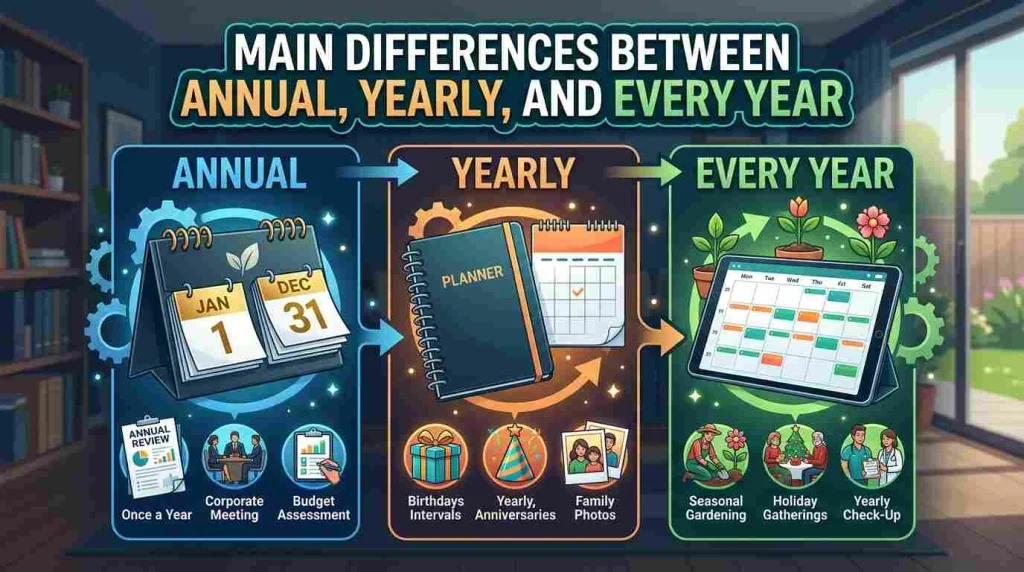
| Feature | Annual | Yearly | Every Year |
| Grammar | Adjective | Adjective or Adverb | Adverbial phrase |
| Formality | Formal | Neutral | Informal to Neutral |
| Modifies nouns | Yes | Yes | No |
| Modifies verbs | No | Yes (as adverb) | Yes |
| Common in official documents | Yes | Sometimes | Rarely |
| Common in conversation | Sometimes | Yes | Very common |
Key Differences
- Annual mainly describes nouns.
- Yearly can describe nouns or actions.
- Every year describes how often an action happens.
- Annual is preferred in professional and formal writing.
- Every year sounds the most natural in everyday conversation.
Annual vs Yearly vs Every Year: Comparison Table
| Situation | Best Choice |
| Business report | Annual |
| School magazine | Annual |
| Family vacation | Every year |
| Casual conversation | Every year |
| Personal diary | Yearly or every year |
| Scientific report | Annual |
| Financial planning | Annual |
| General writing | Yearly |
Which Sounds More Natural?
Although all three can express similar ideas, native English speakers often choose them based on style.
- Annual sounds official.
- Yearly sounds neutral.
- Every year sounds natural and conversational.
Examples:
- Annual performance review ✔
- Yearly performance review ✔
- Performance review every year ✔
All are correct, but each has a different tone.
Grammar Guide
Parts of Speech
| Term | Grammar Role |
| Annual | Adjective |
| Yearly | Adjective or Adverb |
| Every Year | Adverbial Phrase |
How Each Term Is Used in Sentences
Annual
Pattern:
Annual + Noun
Examples:
- The company published its annual report.
- We attended the annual conference.
- The annual festival attracts thousands.
Yearly
Patterns:
Yearly + Noun
or
Verb + Yearly
Examples:
- They pay a yearly fee.
- We review our goals yearly.
- She receives yearly bonuses.
Every Year
Pattern:
Verb + Every Year
Examples:
- We celebrate every year.
- Birds migrate every year.
- Students compete every year.
Common Mistakes Learners Make
Mistake 1
❌ Every year report
✔ Annual report
✔ Yearly report
Mistake 2
❌ The annual happens in July.
✔ The annual meeting happens in July.
Mistake 3
❌ We annual visit Paris.
✔ We visit Paris every year.
✔ We visit Paris yearly.
Mistake 4
❌ Annually report (incorrect structure)
✔ Annual report
✔ Report annually
Simple Rules to Remember
- Use annual before nouns.
- Use yearly before nouns or after verbs.
- Use every year to describe repeated actions.
- Choose annual in formal situations.
- Choose every year for everyday conversation.
Quick Tips for Writing and Speaking
- Business writing usually prefers annual.
- Conversations often prefer every year.
- Both annual and yearly are grammatically correct before nouns.
- Use whichever best matches the tone of your writing.
- Avoid mixing styles within the same sentence unless necessary.
When to Use Each One
Use Annual When
- Writing business reports
- Talking about official events
- Describing recurring conferences
- Referring to formal publications
- Writing academic documents
Examples:
- Annual audit
- Annual budget
- Annual review
Use Yearly When
- Writing everyday English
- Describing regular payments
- Talking about habits
- Referring to recurring events casually
- Writing blogs or personal content
Use Every Year When
- Speaking naturally
- Explaining repeated activities
- Writing simple English
- Teaching beginners
- Describing traditions
When NOT to Use Each One
Do not use annual:
- As an adverb after verbs.
❌ We annual travel.
✔ We travel every year.
✔ We travel yearly.
Do not use yearly:
- When an organization officially uses “annual.”
Example:
Most companies write Annual Report, not Yearly Report.
Do not use every year:
- Directly before nouns.
❌ Every year meeting
✔ Annual meeting
✔ Yearly meeting
Which One to Use (Decision Guide)
Choose Annual if:
- You are writing formally.
- You are describing official events or documents.
- You need a professional tone.
Choose Yearly if:
- You want neutral English.
- You are describing repeated events in writing or speech.
- You need either an adjective or adverb.
Choose Every Year if:
- You are speaking naturally.
- You are teaching beginners.
- You are describing how often something happens.
Real-World Practical Examples
Annual Examples
- The company released its annual report in March.
- Our school hosts an annual science fair.
- The annual conference attracted experts worldwide.
- The city organizes an annual marathon.
- Employees complete an annual performance review.
Yearly Examples
- We renew our insurance yearly.
- She receives a yearly bonus.
- The software requires a yearly subscription.
- Farmers monitor rainfall yearly.
- The museum updates its exhibits yearly.
Every Year Examples
- We plant trees every year.
- My family visits the beach every year.
- Students celebrate graduation every year.
- Scientists conduct the survey every year.
- The festival returns every year.
Self-Assessment (Fill in the Blanks)
- I will use ______ when referring to an official company report. The correct word is ______ because it modifies a formal noun.
- I will use ______ when describing a family vacation that happens once each year. The correct word is ______ because it describes an action.
- I pay a ______ membership fee. The correct word is ______ because it modifies a noun.
- We celebrate this festival ______. The correct word is ______ because it modifies a verb.
- The school publishes an ______ magazine. The correct word is ______ because it is an adjective before a noun.
- We travel abroad ______. The correct word is ______ because it describes frequency.
- She receives a ______ salary review. The correct word is ______ because it modifies a noun.
- The company holds an ______ shareholders’ meeting. The correct word is ______ because it is formal.
- Birds migrate ______. The correct word is ______ because it expresses repeated action.
- They renew the contract ______. The correct word is ______ because it shows frequency.
- The ______ budget was approved. The correct word is ______ because it is an official document.
- We attend the event ______. The correct word is ______ because it modifies the verb.
- The charity organizes an ______ fundraiser. The correct word is ______ because it is formal.
- I update my résumé ______. The correct word is ______ because it expresses regular repetition.
- The university released its ______ statistics. The correct word is ______ because it modifies a noun.
- We clean the air conditioner ______. The correct word is ______ because it describes frequency.
- The ______ awards ceremony was televised. The correct word is ______ because it is an official event.
- They review the policy ______. The correct word is ______ because it modifies an action.
- We enjoy this tradition ______. The correct word is ______ because it sounds natural in conversation.
- The ______ conference begins tomorrow. The correct word is ______ because it describes a recurring formal event.
Answers
- Annual
- Every year
- Yearly
- Every year
- Annual
- Yearly
- Yearly
- Annual
- Every year
- Yearly
- Annual
- Every year
- Annual
- Every year
- Annual
- Yearly
- Annual
- Yearly
- Every year
- Annual
Final Verdict
Annual, yearly, and every year all describe something that happens once every 12 months, but each has its own preferred use. Annual is the best choice for formal documents, business communication, academic writing, and official events because it functions as an adjective modifying nouns. Yearly is more flexible since it can be used as both an adjective and an adverb, making it suitable for both written and spoken English. Every year is the most natural and conversational option, ideal for describing repeated actions in everyday speech. By understanding the grammar and context behind each term, you can confidently choose the right expression for any situation. When in doubt, use annual for formal nouns, yearly for general-purpose writing, and every year when talking about actions or habits in simple, natural English.
Conclusion
Understanding the difference between Annual Vs Yearly Vs Every Year can make your writing clearer, more accurate, and more natural. While all three expressions refer to something that happens once every twelve months, they are used in slightly different ways. Annual is the preferred choice for formal writing and official events, yearly works well in both everyday and professional contexts, and every year is the most conversational option for describing recurring actions.
Knowing when to use each term helps you avoid common grammar mistakes and communicate with confidence in school, business, academic writing, and daily conversations. Instead of treating these expressions as completely interchangeable, consider the sentence structure, level of formality, and the message you want to convey. With a little practice, choosing between annual vs yearly vs every year becomes simple, allowing your English to sound more fluent, polished, and natural in every situation.
FAQs
What is the difference between annual and yearly?
Annual is mainly an adjective used before nouns in formal contexts, such as annual report or annual meeting. Yearly can be used as both an adjective and an adverb, making it more flexible in everyday English. Both generally mean something happens once every year, but annual sounds more formal.
Are annual and every year the same?
They have nearly the same meaning because both describe something occurring once each year. However, annual modifies nouns, while every year is an adverbial phrase that modifies verbs. For example, you say annual conference, but we attend the conference every year.
Which is more formal: annual or yearly?
Annual is generally considered more formal than yearly. It is commonly used in business documents, academic writing, government publications, and official announcements. Yearly is perfectly correct but has a slightly more casual tone that fits everyday communication.
Can yearly be used as an adverb?
Yes. Yearly can function as an adverb to describe how often an action happens. For example, we review our goals yearly. It can also be used as an adjective before nouns, such as yearly subscription or yearly budget.
Is every year grammatically correct?
Yes, every year is completely grammatically correct. It is an adverbial phrase used to show frequency. It naturally follows a verb, as in: We visit our grandparents every year. It should not be placed directly before a noun like an adjective.
Can I say annual report and yearly report?
Yes, both expressions are grammatically correct. However, annual report is far more common because organizations, businesses, and institutions traditionally use this phrase in official communication. Yearly report is understandable but appears less frequently in formal writing.
When should I use every year instead of annual?
Use every year when talking about actions or habits in everyday speech and writing. For example, we go camping every year. Use annual when describing formal events, documents, or scheduled activities, such as an annual conference or annual performance review.
Do annual, yearly, and every year always mean the same thing?
In most situations, they all indicate something happens once within twelve months. The main difference lies in grammar and style rather than meaning. Choosing the right one depends on whether you need an adjective, an adverb, or a more formal or conversational tone.
Which expression is best for business writing?
For business writing, annual is usually the best choice because it sounds professional and is widely accepted in formal documents. Phrases like annual report, annual budget, and annual meeting are standard expressions in corporate and organizational communication.
How can I easily remember the difference?
A simple way to remember is that annual usually comes before a noun, yearly can describe either a noun or a verb, and every year describes how often an action happens. Thinking about the sentence structure first will help you choose the correct expression naturally.