
Many English learners confuse piece of mind and peace of mind because they sound almost identical. However, only one of these expressions is correct in standard English. Understanding the difference helps you avoid common writing mistakes and communicate more clearly in both formal and everyday situations.
Comparison Overview
Although piece of mind and peace of mind are pronounced the same, they have completely different meanings in English.
| Feature | Piece of Mind | Peace of Mind |
| Correct English expression | ❌ No (in most contexts) | ✅ Yes |
| Meaning | Usually a mistaken spelling | A feeling of calm, confidence, or freedom from worry |
| Part of speech | Not an accepted idiom | Noun phrase (idiom) |
| Common usage | Incorrect | Very common |
| Example | ❌ “This gives me a piece of mind.” | ✅ “This gives me peace of mind.” |
The confusion happens because piece and peace are homophones; they sound the same but have different spellings and meanings.
Definition of Piece Of Mind
Piece of mind is generally not a correct English expression. It is almost always a spelling mistake made when someone intends to write peace of mind.
The word piece means a part or portion of something, such as:
- A piece of cake
- A piece of paper
- A piece of advice
When combined with “of mind,” it does not form a recognized English idiom.
Core Meaning
- Refers to a physical or abstract part of something.
- Does not mean calmness or reassurance.
Definition of Peace of Mind
Peace of mind is a common English idiom that means a feeling of calm, security, confidence, or freedom from worry.
People experience peace of mind when they know everything is under control or when they no longer have something to worry about.
Core Meaning
- Calmness
- Mental comfort
- Freedom from stress
- Confidence that everything is okay
Examples:
- Buying insurance gave her peace of mind.
- Knowing my family is safe gives me peace of mind.
- Backing up my files gives me peace of mind.
Main Differences Between Piece Of Mind and Peace of Mind
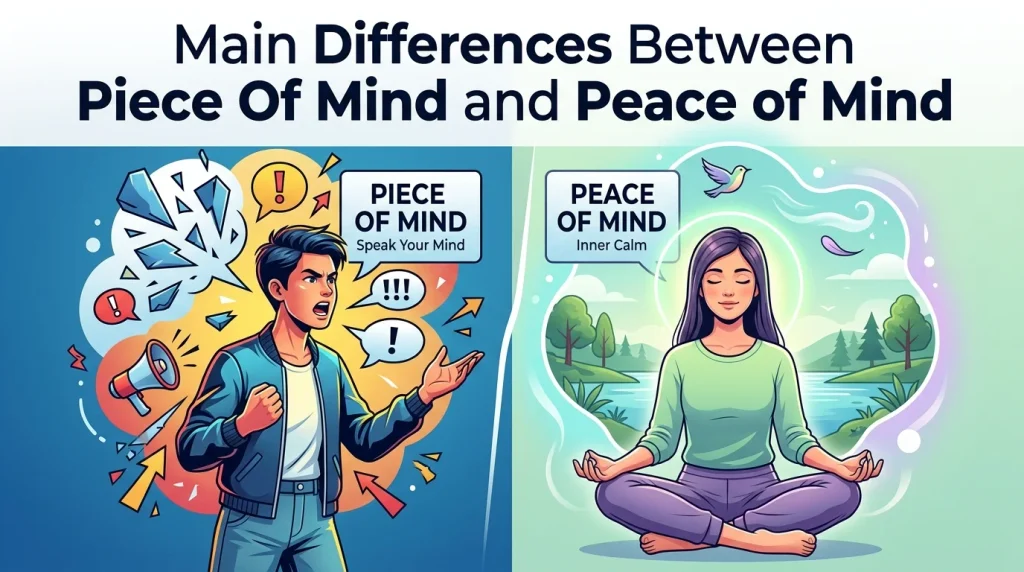
| Feature | Piece Of Mind | Peace of Mind |
| Spelling | Incorrect (usually) | Correct |
| Meaning | No accepted idiomatic meaning | Feeling relaxed and worry-free |
| Usage | Mistake | Correct expression |
| Dictionary recognition | Not recognized as an idiom | Recognized idiom |
| Formal writing | Avoid | Recommended |
| Everyday speech | Avoid | Frequently used |
Key Difference
Think of it this way:
- Piece = a part of something
- Peace = calmness and freedom from worry
If you are talking about feeling relaxed, always choose peace of mind.
Why People Confuse These Terms
The confusion exists because:
- They sound identical.
- English contains many homophones.
- Spell checkers sometimes fail to recognize the intended phrase.
- Many people learn the phrase by hearing it rather than reading it.
Remember:
If you’re talking about feeling calm, the correct word is always peace.
Comparison Table
| Situation | Correct Phrase |
| Feeling relaxed | Peace of mind |
| Less stress | Peace of mind |
| Security | Peace of mind |
| Confidence | Peace of mind |
| Calm emotions | Peace of mind |
| Portion of an object | Piece |
| Piece of cake | Piece |
| Piece of paper | Piece |
Grammar Guide
How Each Term Is Used in Sentences
Piece
Used as a noun meaning a part or portion.
Pattern:
- Piece + of + noun
Examples:
- I need a piece of paper.
- She ate a piece of chocolate.
Peace of Mind
Used as a noun phrase.
Pattern:
- Gives + someone + peace of mind
- Brings + peace of mind
- Provides + peace of mind
Examples:
- Good planning gives peace of mind.
- Insurance provides peace of mind.
Common Mistakes Learners Make
Common mistakes include:
- ❌ Piece of mind
- ❌ Pieces of mind
- ❌ Peace in mind
- ❌ Piece for mind
Correct version:
- ✅ Peace of mind
Simple Rules to Remember
- Peace = calm
- Piece = part
Ask yourself:
“Am I talking about feeling relaxed?”
If yes, choose peace.
Quick Tips for Writing and Speaking
- Read the sentence aloud.
- Think about the meaning before choosing the spelling.
- Remember that peace of mind is a fixed idiom.
- Avoid replacing peace with piece.
When to Use Each One
Use peace of mind when talking about:
- Emotional comfort
- Safety
- Security
- Confidence
- Reduced stress
- Feeling relaxed
Examples:
- Travel insurance gives me peace of mind.
- Password protection gives users peace of mind.
- Saving money brings peace of mind.
Use peace only when referring to an actual part of something.
Examples:
- A piece of cake
- A piece of furniture
- A piece of music
When NOT to Use Each One
Do not use piece of mind when discussing:
- Feeling calm
- Mental comfort
- Security
- Confidence
- Emotional relief
Incorrect:
- ❌ I finally have a piece of mind.
Correct:
- ✅ I finally have peace of mind.
Likewise, don’t replace piece with peace when talking about physical objects.
Incorrect:
- ❌ A peace of pizza
Correct:
- ✅ A piece of pizza
Which One to Use (Decision Guide)
Use this quick guide:
| If you mean… | Use |
| Calmness | Peace of mind |
| No worries | Peace of mind |
| Emotional comfort | Peace of mind |
| Security | Peace of mind |
| Portion of something | Piece |
Decision Rule
Ask:
“Am I talking about calm feelings?”
- Yes → Peace of mind
- No → Use piece only if referring to a part of something.
Real-World Practical Examples
Piece Of Mind Examples
These examples illustrate why the phrase is incorrect in this context:
- ❌ The warranty gives me piece of mind.
- ❌ I finally found peace of mind after the exam.
- ❌ Good savings bring peace of mind.
- ❌ This app provides peace of mind.
- ❌ Parents want peace of mind when children travel.
Each sentence should use peace of mind instead.
Peace of Mind Examples
- Education: Studying early gave me peace of mind before the exam.
- Daily life: Locking the door gave me peace of mind.
- Business: A signed contract brings peace of mind.
- Technology: Automatic backups provide peace of mind.
- Science: Reliable test results give researchers peace of mind.
Self-Assessment (Fill in the Blanks)
- I will use ______ when referring to feeling calm. The correct word is ______ because it means freedom from worry.
- I will use ______ after buying insurance. The correct word is ______ because insurance reduces stress.
- I will use ______ when talking about emotional comfort. The correct word is ______ because it is the correct idiom.
- I will use ______ when I feel relaxed. The correct word is ______ because it means mental calmness.
- I will use ______ after completing my project. The correct word is ______ because I am no longer worried.
- I will use ______ when discussing security. The correct word is ______ because it refers to reassurance.
- I will use ______ after saving my work. The correct word is ______ because backups reduce worry.
- I will use ______ when describing confidence. The correct word is ______ because it expresses emotional relief.
- I will use ______ when speaking about stress-free living. The correct word is ______ because it is the accepted phrase.
- I will use ______ after confirming my reservation. The correct word is ______ because it means reassurance.
- I will use ______ when referring to a slice of pizza. The correct word is ______ because it means a part of something.
- I will use ______ when talking about a sheet of paper. The correct word is ______ because it refers to a portion.
- I will use ______ when describing part of a puzzle. The correct word is ______ because it means one section.
- I will use ______ when mentioning a fragment of glass. The correct word is ______ because it means a part.
- I will use ______ when referring to a section of music. The correct word is ______ because it means one composition.
- I will use ______ when describing freedom from anxiety. The correct word is ______ because it is the correct idiom.
- I will use ______ when discussing mental comfort. The correct word is ______ because it refers to emotional calm.
- I will use ______ after installing a home security system. The correct word is ______ because it reduces worry.
- I will use ______ when writing professionally about reassurance. The correct word is ______ because it is grammatically correct.
- I will use ______ when I want to express calm confidence. The correct word is ______ because it means freedom from worry.
Answers
- Peace of mind — peace of mind
- Peace of mind — peace of mind
- Peace of mind — peace of mind
- Peace of mind — peace of mind
- Peace of mind — peace of mind
- Peace of mind — peace of mind
- Peace of mind — peace of mind
- Peace of mind — peace of mind
- Peace of mind — peace of mind
- Peace of mind — peace of mind
- Piece — piece
- Piece — piece
- Piece — piece
- Piece — piece
- Piece — piece
- Peace of mind — peace of mind
- Peace of mind — peace of mind
- Peace of mind — peace of mind
- Peace of mind — peace of mind
- Peace of mind — peace of mind
Final Verdict
Although peace of mind and piece of mind sound exactly alike, they are not interchangeable. Peace of mind is the only correct idiomatic expression when referring to calmness, reassurance, confidence, or freedom from worry. In contrast, piece of mind is almost always a spelling mistake because piece means a part or portion of something, not emotional comfort. Whenever you want to describe feeling relaxed, secure, or free from anxiety, always use peace of mind. Reserve piece for situations involving physical or abstract parts, such as a piece of paper or a piece of cake. Remember this simple rule: peace brings calm, while piece is a part. Keeping this distinction in mind will improve your writing and help you avoid a very common English mistake.
Conclusion
Understanding the difference between Piece of Mind or Peace of Mind is easier once you know what each word means. While the two phrases sound the same, only peace of mind is the correct and widely accepted expression when talking about feeling calm, reassured, or free from worry. The phrase piece of mind is almost always a spelling mistake because piece refers to a part of something rather than emotional comfort. By remembering that peace relates to calmness and piece refers to a portion, you’ll avoid one of the most common English writing errors. Whether you’re writing emails, essays, business documents, or everyday messages, choosing the correct phrase makes your communication clearer and more professional. With a little practice, you’ll confidently know when to use peace of mind and recognize why piece of mind should be avoided in almost every context.
FAQs
Is “piece of mind” ever correct?
In standard English, piece of mind is generally considered incorrect when someone means emotional calm or reassurance. It is almost always a misspelling of peace of mind. Unless you are intentionally referring to an actual “piece” belonging to a mind in a fictional or creative context, avoid using this phrase.
What does “peace of mind” mean?
Peace of mind means feeling calm, secure, and free from worry or anxiety. It describes a state where you feel confident that everything is under control. People often use this phrase when talking about safety, financial security, insurance, planning, or making decisions that reduce stress.
Why do people confuse “piece of mind” and “peace of mind”?
People confuse these expressions because piece and peace are homophones, meaning they sound the same but have different spellings and meanings. Many learners hear the phrase in conversation before seeing it written, leading to the common spelling mistake.
Is “peace of mind” an idiom?
Yes. Peace of mind is a well-known English idiom. It refers to mental comfort, reassurance, and freedom from worry rather than a literal meaning. The phrase is commonly used in everyday conversations, professional writing, advertising, and academic contexts.
How can I remember the correct spelling?
A simple trick is to connect peace with words like calm, quiet, and relaxed. If your sentence is about feeling safe or free from stress, choose peace of mind. Remember that piece means a part or portion of something, not emotional comfort.
Can I use “peace of mind” in formal writing?
Absolutely. Peace of mind is appropriate for formal and informal writing. It appears in business documents, academic papers, legal agreements, marketing materials, healthcare information, and everyday communication whenever you want to describe reassurance or reduced anxiety.
Is “peace of mind” a noun or a verb?
Peace of mind functions as a noun phrase. It names a feeling or emotional state rather than describing an action. You can use it as the subject or object of a sentence, such as “Peace of mind is important” or “The warranty gives customers peace of mind.”
What are some common examples of “peace of mind”?
Common examples include buying insurance for peace of mind, locking your home before traveling, saving important files with cloud backups, planning finances, and receiving good medical test results. In each case, the phrase refers to feeling secure and less worried.
Should I correct “piece of mind” if I see it in writing?
Yes. If the writer intends to express reassurance or emotional calm, piece of mind should be corrected to peace of mind. Making this correction improves grammatical accuracy, professionalism, and clarity while preventing readers from being distracted by a common spelling error.
Which phrase should I always use?
Whenever you’re talking about calmness, confidence, reassurance, or freedom from worry, always use peace of mind. Reserve the word piece only for situations where you mean a portion or part of something, such as a piece of cake or a piece of paper.