
Many people use serpent and snake as if they mean the same thing. While they both refer to the same type of reptile in many situations, their meanings, tone and usage are not always identical.
Understanding the difference helps you choose the right word in writing, conversation, literature and formal communication. Many similar words confuse learners, just like Imply vs Infer.
Comparison Overview
Although serpent and snake both describe long, legless reptiles, they are used in different contexts. Snake is the everyday, scientific and commonly accepted word. Serpent is more literary, poetic, historical or symbolic. Knowing the distinction improves both grammar and vocabulary.
| Feature | Serpent | Snake |
| Primary Meaning | A snake, often in literary or symbolic contexts | A legless reptile |
| Common Usage | Literature, religion, mythology | Everyday speech, science |
| Tone | Formal, poetic, dramatic | Neutral, common |
| Scientific Use | Rare | Standard |
| Symbolism | Wisdom, temptation, evil, mystery | Usually refers to the animal itself |
Definition of Serpent
A serpent is another word for a snake, but it is mainly used in literature, mythology, religion and older forms of English. The word often carries symbolic meanings such as temptation, wisdom, danger or mystery.
People commonly encounter the word serpent in religious texts, fantasy novels, poems and historical writings rather than everyday conversation.
Examples:
- The serpent tempted Eve in the garden.
- A golden serpent was carved into the temple wall.
- The legend spoke of a giant sea serpent.
- The serpent became a symbol of wisdom.
- The knight battled the mythical serpent.
Definition of Snake
A snake is a long, limbless reptile belonging to the suborder Serpentes. It is the standard word used in science, education, news reports and everyday speech.
The word simply refers to the animal without adding symbolic or literary meaning.
Examples:
- We saw a snake in the grass.
- The snake slithered across the road.
- Some snakes are venomous.
- A pet snake requires special care.
- Scientists discovered a new snake species.
Main Differences Between Serpent and Snake
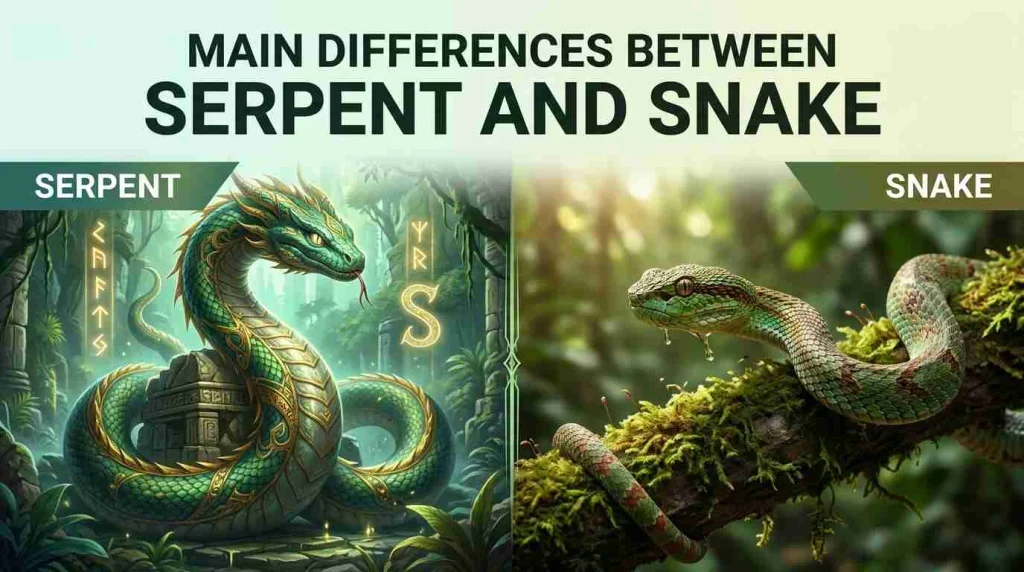
Although the two words often refer to the same animal, they differ in style, purpose and context.
Just like serpent and snake, the difference between Accept vs Except also confuses many people.
| Aspect | Serpent | Snake |
| Meaning | Usually the same animal but with symbolic or literary emphasis | The actual reptile |
| Style | Formal, poetic, historical | Everyday language |
| Grammar | Noun | Noun |
| Literature | Very common | Common |
| Science | Rare | Standard term |
| Religion | Frequently used | Less common |
| Conversation | Rare | Very common |
Key Differences
- Snake is the normal word for the reptile.
- Serpent is often used for dramatic or symbolic effect.
- Scientific books almost always use snake.
- Religious texts often prefer serpent.
- Fiction may use serpent to create mystery or grandeur.
Serpent vs Snake in Literature and Symbolism
The biggest distinction appears in literature and symbolism.
Serpent
- Represents temptation.
- Symbolizes wisdom in some cultures.
- Appears in myths and legends.
- Used in fantasy stories.
- Creates a dramatic tone.
Snake
- Describes the real animal.
- Used in wildlife documentaries.
- Appears in biology textbooks.
- Common in news reports.
- Used in everyday conversations.
Comparison Table
| Category | Serpent | Snake |
| Everyday English | Rare | Yes |
| Biology | No | Yes |
| Mythology | Yes | Sometimes |
| Religious Texts | Very Common | Less Common |
| Poetry | Very Common | Sometimes |
| Children’s Books | Sometimes | Very Common |
| Scientific Research | Rare | Standard |
| Formal Writing | Sometimes | Yes |
Grammar Guide
Both serpent and snake are countable nouns.
| Word | Part of Speech |
| Serpent | Countable noun |
| Snake | Countable noun |
How Each Term Is Used in Sentences
Serpent
Pattern:
The serpent + verb
Examples:
- The serpent guarded the treasure.
- The serpent symbolized temptation.
- A serpent appeared in the legend.
Snake
Pattern:
The snake + verb
Examples:
- The snake crossed the trail.
- A snake lives near the river.
- The snake shed its skin.
Common Mistakes Learners Make
- Using serpent in ordinary conversations instead of snake.
- Thinking the two words always have different meanings.
- Using serpent in scientific writing.
- Assuming every snake in literature should be called a snake instead of a serpent.
- Forgetting that serpent often carries symbolic meaning.
Simple Rules to Remember
- Use snake for everyday English.
- Use snake in science.
- Use serpent in myths and legends.
- Use serpent in religious or poetic writing.
- Choose the word based on the tone you want.
Quick Tips for Writing and Speaking
- Writing a biology report? Use snake.
- Writing a fantasy novel? Serpent may sound stronger.
- Talking with friends? Use snake.
- Reading mythology? Expect to see serpent.
- When unsure, snake is usually the safest choice.
When to Use Each One
Use Serpent When:
- Writing poetry.
- Writing fantasy fiction.
- Discussing mythology.
- Referring to biblical stories.
- Creating a dramatic or symbolic tone.
Use Snake When:
- Talking about wildlife.
- Studying biology.
- Describing a real reptile.
- Writing educational material.
- Having everyday conversations.
When NOT to Use Each One
Avoid Using Serpent
- In elementary science lessons.
- In wildlife identification guides.
- During casual conversations unless you want a literary effect.
- In technical zoology papers.
- When simple language is preferred.
Avoid Using Snake
- When quoting religious texts that specifically say serpent.
- When writing highly poetic descriptions.
- When emphasizing symbolism instead of the actual animal.
- In historical translations where serpent is traditional.
- When a literary tone is important.
Which One to Use (Decision Guide)
Use this simple guide:
- Talking about the real reptile? → Snake
- Writing about biology? → Snake
- Referring to mythology? → Serpent
- Discussing the Bible? → Serpent
- Writing fantasy? → Serpent
- Speaking casually? → Snake
- Writing a wildlife article? → Snake
- Creating dramatic imagery? → Serpent
Real-World Practical Examples
Serpent Examples
- Religion: The serpent tempted Adam and Eve.
- Literature: The hero defeated the giant serpent.
- Fantasy: A fire serpent guarded the cave.
- History: Ancient cultures worshipped the serpent.
- Art: The painting featured a coiled serpent.
Snake Examples
- Education: Students learned about snake habitats.
- Daily Life: We found a snake near the fence.
- Science: Scientists studied snake venom.
- Technology: The robot moved like a snake.
- Conversation: Be careful—the snake is still nearby.
Self-Assessment (Fill in the Blanks)
- I will use ______ when referring to a reptile in a biology class. The correct word is ______ because it is the scientific and common term.
- I will use ______ when describing the creature in the Garden of Eden. The correct word is ______ because it is the traditional biblical term.
- I will use ______ when talking about my pet reptile. The correct word is ______ because it is everyday English.
- I will use ______ in a fantasy novel. The correct word is ______ because it creates a dramatic tone.
- I will use ______ in a wildlife documentary. The correct word is ______ because it is the standard zoological term.
- I will use ______ in a poem about ancient legends. The correct word is ______ because it sounds more literary.
- I will use ______ when discussing venomous reptiles. The correct word is ______ because it is scientifically accurate.
- I will use ______ when referring to a mythical sea creature. The correct word is ______ because myths often use this term.
- I will use ______ during a casual conversation. The correct word is ______ because it is commonly spoken.
- I will use ______ in a biology textbook. The correct word is ______ because it is the accepted scientific word.
- I will use ______ in a religious story. The correct word is ______ because it carries symbolic meaning.
- I will use ______ while explaining reptiles to children. The correct word is ______ because it is easier to understand.
- I will use ______ in a newspaper wildlife report. The correct word is ______ because it is the standard term.
- I will use ______ in a medieval legend. The correct word is ______ because it suits historical storytelling.
- I will use ______ in an animal encyclopedia. The correct word is ______ because it refers to the actual reptile.
- I will use ______ when emphasizing symbolism. The correct word is ______ because it has literary associations.
- I will use ______ in a scientific presentation. The correct word is ______ because it is technically correct.
- I will use ______ in a fairy tale. The correct word is ______ because it sounds more magical.
- I will use ______ while identifying wildlife outdoors. The correct word is ______ because it is the everyday name.
- I will use ______ in a zoology research paper. The correct word is ______ because scientists use this term.
Answers
- Snake — Snake
- Serpent — Serpent
- Snake — Snake
- Serpent — Serpent
- Snake — Snake
- Serpent — Serpent
- Snake — Snake
- Serpent — Serpent
- Snake — Snake
- Snake — Snake
- Serpent — Serpent
- Snake — Snake
- Snake — Snake
- Serpent — Serpent
- Snake — Snake
- Serpent — Serpent
- Snake — Snake
- Serpent — Serpent
- Snake — Snake
- Snake — Snake
Final Verdict
Although serpent and snake can refer to the same animal, they are not always interchangeable. Snake is the standard word used in everyday speech, education, science and journalism because it clearly identifies the reptile without additional meaning. Serpent, on the other hand, is preferred in literature, mythology, religion and symbolic writing, where it often conveys mystery, temptation, wisdom or dramatic imagery.
If your goal is accuracy in daily communication or scientific contexts, choose snake. If you want a more poetic, historical or symbolic tone, serpent is the better option. Understanding the context, audience and purpose of your writing will help you confidently select the correct word every time.
To learn another confusing pair, check Adapt vs Adopt.
Conclusion
Understanding the difference between Serpent Vs Snake is easier once you recognize that the two words often refer to the same reptile but are used in different contexts. Snake is the everyday, scientific and most commonly accepted term, making it the right choice for conversations, education and factual writing. Serpent, on the other hand, adds a literary, historical or symbolic touch and is frequently found in mythology, religious texts and creative storytelling.
Choosing the correct word depends less on the animal itself and more on the tone and purpose of your writing. By learning when each term is appropriate, you can communicate more clearly and confidently, whether you’re writing an essay, reading classic literature, or discussing wildlife. Keep this simple distinction in mind, and you’ll be able to use both serpent and snake accurately in any situation while improving both your vocabulary and grammar skills.
FAQs
Is there a real difference between serpent and snake?
Yes. Both words can refer to the same legless reptile, but snake is the standard term used in everyday language and science. Serpent is more common in literature, mythology, religious writings and symbolic contexts, where it often creates a more dramatic or poetic effect.
Is serpent an old-fashioned word?
In many situations, yes. Serpent is considered more formal or traditional than snake. It appears frequently in older books, religious texts, legends and poetry, while modern conversations and scientific writing almost always use snake instead.
Which word should I use in everyday conversation?
You should usually use snake in everyday conversation. It is the most natural and widely understood term when talking about the animal. Most native English speakers rarely use serpent unless discussing literature, mythology or symbolic meanings.
Is serpent used in scientific writing?
No. Scientific books, biology classes, and wildlife research almost always use snake because it is the accepted common name for the reptile. Serpent is generally avoided in scientific contexts due to its literary and symbolic associations.
Why is the word serpent common in the Bible?
The word serpent appears in many Bible translations because it reflects the traditional language used in religious texts. It also emphasizes symbolism, representing temptation, deception or wisdom, depending on the passage and interpretation.
Are all serpents snakes?
In modern English, yes. A serpent generally refers to a snake. However, the word often carries symbolic or mythical meanings, so readers may think of legendary or supernatural creatures rather than ordinary reptiles.
Can serpent and snake be used interchangeably?
Often they can, especially when referring to the animal itself. However, replacing serpent with snake in religious, poetic or historical writing may change the tone, while using serpent in everyday conversation can sound overly formal.
Which word is better for creative writing?
It depends on the style of your story. Serpent works well in fantasy, mythology, and historical fiction because it creates a mysterious and dramatic atmosphere. Snake is better when you want clear, modern and realistic language.
Is snake always the correct choice in grammar?
From a grammatical perspective, both snake and serpent are correct nouns. The right choice depends on context rather than grammar. Use snake for ordinary communication and serpent when a literary or symbolic tone is more appropriate.
How can I easily remember the difference between serpent and snake?
A simple way to remember is that snake is the everyday word for the reptile, while serpent is the storytelling or symbolic version. If you’re writing about wildlife, choose snake. If you’re writing about myths, legends or religious themes, choose serpent.