
The phrases too many or to many may look almost identical, but they have completely different meanings and grammatical uses. Many English learners confuse them because the only difference is one extra letter. Understanding when to use each phrase will improve your writing, speaking, and overall grammar accuracy.
Comparison Overview
Although too many or to many share similar spelling, they serve different purposes in English.
| Feature | Too Many | To Many |
| Meaning | An excessive number of something | Indicates direction or connection toward a group of people |
| Part of Speech | Adverb too + adjective many | Preposition to + adjective/pronoun many |
| Common Usage | Very common | Less common |
| Expresses | Excessiveness | Direction, recipient, or relationship |
| Example | There are too many cars. | She spoke to many students. |
The biggest difference is that too many expresses more than is needed or desired, while to many simply means toward many people or things.
Definition of Too Many
Too many means an excessive number of countable nouns. It shows that something exists in greater quantity than is desirable, necessary, or acceptable.
It combines:
- Too = excessively
- Many = a large number of countable items
Examples
- There are too many mistakes in this essay.
- We invited too many guests.
- She has too many books to carry.
- There were too many questions on the test.
- The road has too many vehicles today.
Definition of Too Many
To many consists of the preposition to followed by the word many.
It means toward many people, for many people, or addressed to many individuals.
Although grammatically correct, it is much less common than too many.
Examples
- The teacher spoke to many students.
- The email was sent to many employees.
- The announcement was addressed to many families.
- The manager explained the policy to many workers.
- The invitation went to many guests.
Main Differences Between Too Many and To Many
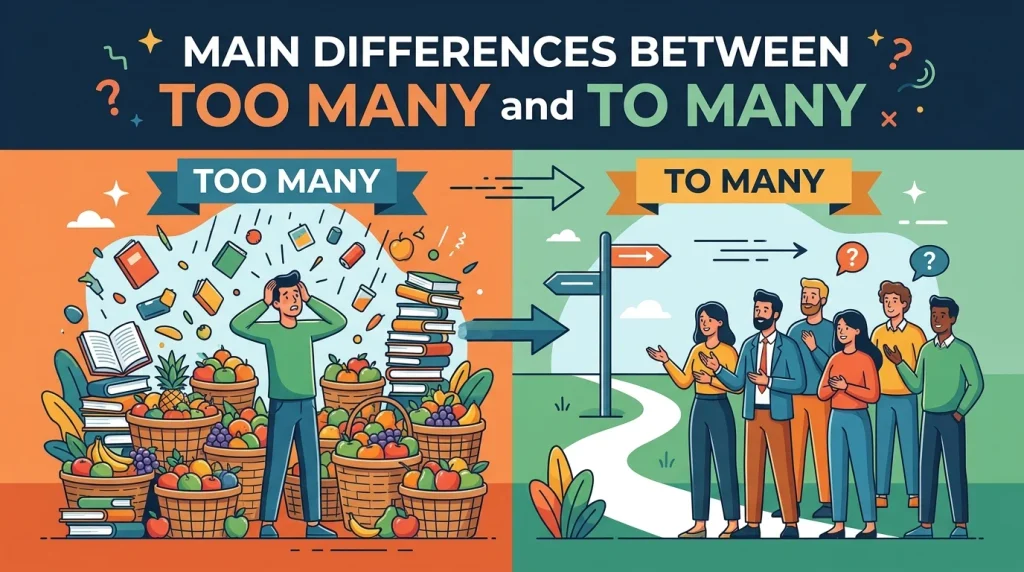
| Aspect | Too Many | To Many |
| Meaning | Excessive quantity | Direction toward many people |
| Grammar | Adverb + adjective | Preposition + adjective/pronoun |
| Function | Describes excess | Shows recipient or direction |
| Commonness | Extremely common | Relatively uncommon |
| Usually Followed By | Countable noun | People or groups |
Key Difference
If you can replace too with excessively, use too many.
If to means toward or for, then too many is correct.
Why These Two Phrases Are Often Confused
The confusion happens because:
- They differ by only one letter.
- They sound the same.
- English pronunciation doesn’t clearly distinguish between to and too.
- Spell check sometimes cannot detect the error because both are valid phrases.
Remember:
- Too = excessively
- To = direction or destination
Common Situations Where Confusion Happens
People frequently confuse these phrases in:
- School assignments
- Emails
- Social media posts
- Business reports
- Academic writing
- Daily conversations
For example:
❌ There are to many people here.
✅ There are too many people here.
Grammar Guide
How Each Term Is Used in Sentences
Too Many
Pattern:
Too many + countable noun
Examples:
- Too many books
- Too many cars
- Too many emails
- Too many students
- Too many questions
Sentence examples:
- We have too many meetings today.
- There are too many cookies left.
To Many
Pattern:
Verb + to many + people/group
Examples:
- Speak to many people.
- Explain to many students.
- Send to many customers.
- Introduce to many visitors.
- Write to many friends.
Sentence examples:
- She explained the project to many employees.
- The notice was mailed to many households.
Common Mistakes Learners Make
Mistake 1
❌ There are too many errors.
✅ There are too many errors.
Mistake 2
❌ I explained the lesson too many students.
✅ I explained the lesson to many students.
Mistake 3
Confusing too with to because they sound identical.
Simple Rules to Remember
- Too = extra
- Too many = more than enough
- To = toward
- Too many = toward many people
Memory trick:
If you mean excessive, use the word with the extra O.
Quick Tips for Writing and Speaking
- Ask yourself if you’re talking about excess.
- If yes, choose too many.
- If you’re indicating direction or recipients, choose too many.
- Read your sentence aloud and think about its meaning rather than pronunciation.
- Proofread carefully because spell-check may not catch this mistake.
When to Use Each One
Use “Too Many” When
- Something is excessive.
- Talking about countable nouns.
- Expressing complaints.
- Describing overcrowding.
- Mentioning more than needed.
Examples:
- Too many visitors
- Too many assignments
- Too many advertisements
Use “Too Many” When
- Referring to recipients.
- Showing direction.
- Speaking to groups.
- Sending messages.
- Addressing audiences.
Examples:
- Talk to many customers.
- Send letters to many families.
- Present the proposal to many investors.
When NOT to Use Each One
Do not use too many when you simply mean “toward many people.”
Example:
❌ She explained it to too many students.
✅ She explained it to many students.
Do not use to many when discussing excessive quantities.
Example:
❌ There are too many mistakes.
✅ There are too many mistakes.
Which One to Use (Decision Guide)
Use this quick guide:
- Are you talking about more than enough? → Too many
- Are you talking about direction or recipients? → Too many
- Is a countable noun following? → Usually Too many
- Is a verb followed by people receiving an action? → Usually too many
Real-World Practical Examples
Too Many Examples
- The classroom has too many students.
- Our company received too many applications.
- Scientists collected too many samples.
- I have too many homework assignments tonight.
- The website displays too many advertisements.
To Many Examples
- The principal spoke to many parents during the meeting.
- The software update was distributed to many users.
- The professor explained the theory to many students.
- The charity sent invitations to many donors.
- The manager presented the new strategy to many employees.
Self-Assessment (Fill in the Blanks)
- I will use ______ when referring to an excessive number of books. The correct word is ______ because it shows excess.
- I will use ______ when speaking toward several employees. The correct word is ______ because it indicates direction.
- There are ______ cars on the road today. The correct word is ______ because the quantity is excessive.
- She sent invitations ______ relatives. The correct word is ______ because it shows recipients.
- We bought ______ apples. The correct word is ______ because there is an excess.
- The coach talked ______ players. The correct word is ______ because it indicates who received the message.
- There are ______ emails in my inbox. The correct word is ______ because there are more than needed.
- The professor explained the lesson ______ students. The correct word is ______ because it refers to recipients.
- There are ______ mistakes in this report. The correct word is ______ because the number is excessive.
- The speech was delivered ______ guests. The correct word is ______ because it shows direction.
- We invited ______ people to the event. The correct word is ______ because there were more than necessary.
- The letter was addressed ______ customers. The correct word is ______ because it indicates recipients.
- The city has ______ traffic lights. The correct word is ______ because the amount feels excessive.
- She presented the report ______ executives. The correct word is ______ because it shows who received it.
- We have ______ meetings today. The correct word is ______ because the number is excessive.
- The teacher gave instructions ______ children. The correct word is ______ because it refers to listeners.
- There are ______ assignments this week. The correct word is ______ because the quantity is greater than desired.
- The announcement was read ______ attendees. The correct word is ______ because it indicates the audience.
- There are ______ toys in this room. The correct word is ______ because there is an excessive quantity.
- The CEO spoke ______ investors. The correct word is ______ because it refers to recipients.
Answers
- too many
- to many
- too many
- to many
- too many
- to many
- too many
- to many
- too many
- to many
- too many
- to many
- too many
- to many
- too many
- to many
- too many
- to many
- too many
- to many
Final Verdict
Although too many and to many differ by only one letter, their meanings are completely different. Too many is used to describe an excessive number of countable things, making it one of the most common expressions in everyday English. To many, on the other hand, combines the preposition to with many and is used when referring to actions directed toward a large group of people. Whenever you’re unsure, ask yourself whether you’re expressing excess or direction. If it’s about having more than necessary, choose too many. If it’s about speaking, sending, explaining, or giving something to many people, use too many. Keeping this simple distinction in mind will help you write and speak English more confidently and accurately.
Conclusion
Understanding the difference between too many and to many is essential for writing and speaking English with confidence. While these phrases look almost identical, they serve completely different grammatical purposes. Too many is used to describe an excessive number of countable things, whereas to many refers to something directed toward a large group of people. Learning this simple distinction can help you avoid one of the most common spelling and grammar mistakes in English.
Whenever you are unsure, think about the meaning of your sentence. If you are expressing excess, choose too many. If you are showing direction, recipients, or communication, too many is the correct choice. With regular practice and by paying attention to context, you’ll find it much easier to use these phrases naturally. Mastering this comparison will make your writing clearer, more accurate, and more professional in everyday conversations, school assignments, and workplace communication.
FAQs
What is the difference between too many and to many?
Too many means an excessive number of countable items, while to many combines the preposition to with many and refers to something directed toward a large group of people. The meaning of the sentence determines which phrase is correct.
Is “to many” grammatically correct?
Yes, to many is grammatically correct when to functions as a preposition. It is commonly used before words like people, students, customers, or employees to indicate direction, recipients, or communication.
Why do people confuse too many and to many?
People often confuse these phrases because they are pronounced the same and differ by only one letter. Since both are valid English expressions, it is easy to make spelling mistakes without carefully considering the sentence’s meaning.
When should I use too many?
Use too many when talking about more countable items than are needed, wanted, or appropriate. It commonly appears with nouns such as books, cars, emails, mistakes, or students to express excess.
Can too many be used with uncountable nouns?
No. Too many is only used with countable nouns. For uncountable nouns like water, money, or information, the correct expression is too much instead of too many.
Is “too many people” correct?
Yes, too many people is completely correct because people is a countable noun. The phrase means there are more people than desired, expected, or comfortable in a particular situation.
How can I remember the difference between too many and to many?
A simple trick is to remember that too has an extra o, just like it expresses something extra or excessive. If your sentence means “more than enough,” use too many. If it means “toward many people,” use to many.
Can I use to many at the beginning of a sentence?
Yes, you can begin a sentence with to many if it naturally fits the sentence structure. For example, To many readers, the ending was surprising. Here, the phrase means “in the opinion of many readers.”
Which phrase is more common in everyday English?
Too many is far more common because people frequently describe excessive amounts in daily conversations and writing. Too many appears less often and is mainly used when discussing communication or direction toward groups of people.
How do I avoid confusing too many and to many in writing?
Always read your sentence for meaning rather than pronunciation. Ask yourself whether you are describing an excessive quantity or indicating direction toward many people. This simple habit will help you choose the correct phrase consistently.