When writing or speaking English, many learners wonder whether they should say “anyone has” or “anyone have.” Although both phrases appear in sentences, they are not interchangeable.
The correct choice depends on grammar, sentence structure and whether the sentence is a statement or a question. Understanding this difference will help you communicate more naturally and avoid common grammar mistakes.
Comparison Overview
The phrases “anyone has” and “anyone have” both include the indefinite pronoun anyone, but they are used in different grammatical structures.
- Anyone has is used when has is the main verb in a statement.
- Anyone have is commonly used after helping verbs such as does, did, will, can, should or in certain subjunctive constructions.
- Choosing the correct form depends on whether the verb is acting as the main verb or follows an auxiliary verb.
| Feature | Anyone Has | Anyone Have |
| Main use | Statements | Questions, negatives, modal verbs |
| Main verb | Yes | No (base verb after auxiliary) |
| Grammar | Third-person singular | Base verb form |
| Common example | Anyone has the right to apply. | Does anyone have a pen? |
Definition of Anyone Has
Anyone has is a combination of the indefinite pronoun anyone and the third-person singular verb has.
Since anyone is grammatically singular, it takes singular verbs. Therefore, has is the correct present-tense verb when it is the main verb of the sentence.
Purpose
It expresses possession, experience or a state in affirmative statements.
Examples:
- Anyone has the opportunity to succeed if given support.
- Anyone has the right to ask questions.
- Anyone has access to the public library.
- Anyone has responsibilities in a team.
- Anyone has a chance to improve.
Note: Although grammatically possible, native speakers often prefer more natural alternatives such as “Anyone can have…” or “Everyone has…” depending on the context.
Definition of Anyone Have
Anyone have uses the base form of have after an auxiliary verb such as does, did, can, could, will, would, should, or may.
Here, have is not conjugated because the auxiliary verb carries the tense.
Purpose
It is mainly used in questions, negative sentences, and sentences with modal verbs.
Examples:
- Does anyone have a charger?
- Did anyone have any questions?
- Can anyone have access?
- Will anyone have enough time?
- Should anyone have concerns, please contact us.
Main Differences Between Anyone Has and Anyone Have
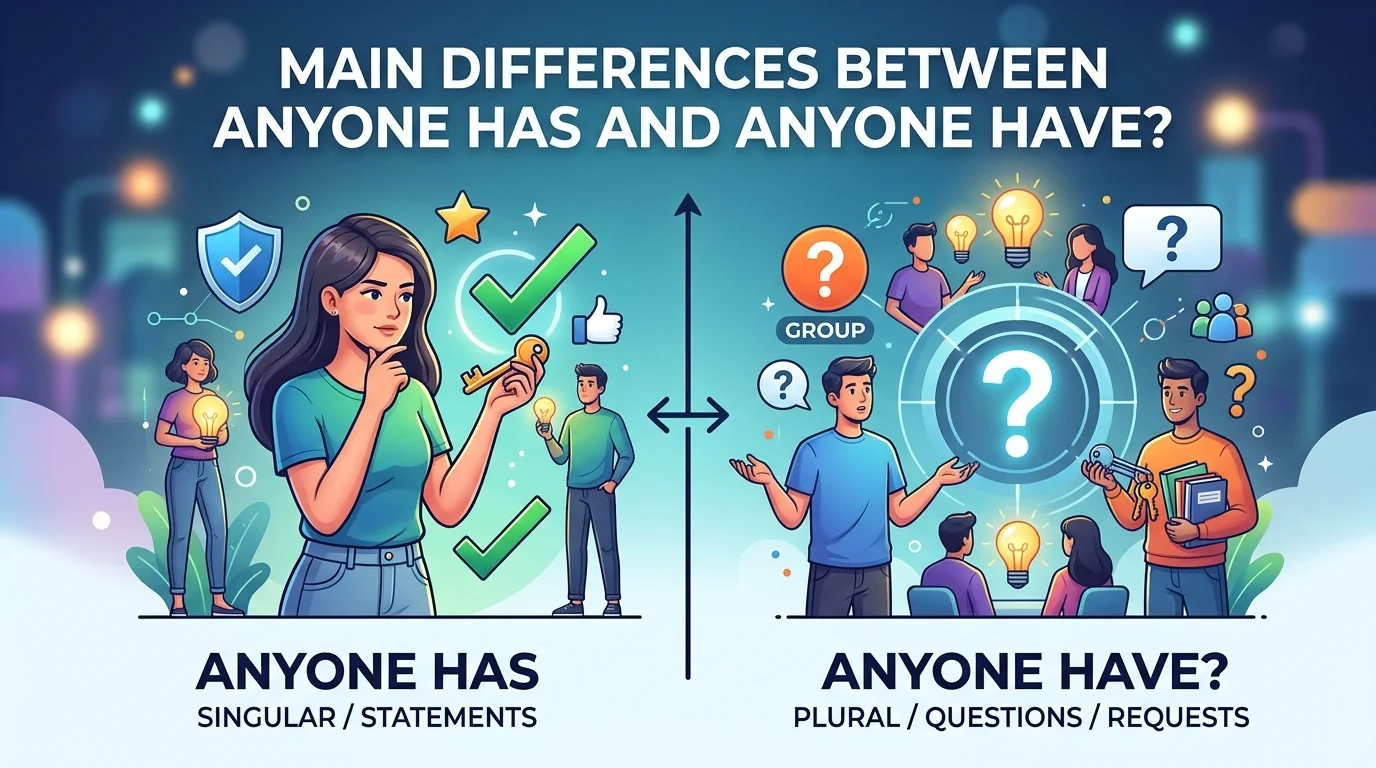
| Aspect | Anyone Has | Anyone Have |
| Verb type | Main verb | Base verb after auxiliary |
| Sentence type | Statements | Questions, negatives, modal constructions |
| Subject agreement | Singular | Base verb required after auxiliary |
| Grammar rule | Anyone + has | Auxiliary + anyone + have |
| Example | Anyone has permission. | Does anyone have permission? |
Key Differences
- Anyone has follows normal subject-verb agreement.
- Anyone have only appears after helping verbs.
- Using “Does anyone has” is incorrect.
- Using “Anyone have” without an auxiliary is usually incorrect in standard English.
Statement vs Question Usage
Many learners confuse these forms because statements and questions use different verb structures.
| Statement | Question |
| Anyone has a ticket. | Does anyone have a ticket? |
| Anyone has experience. | Does anyone have experience? |
| Anyone has permission. | Does anyone have permission? |
Notice how it has changes to have after does.
Common Sentence Patterns
Pattern 1: Statement
Anyone + has + noun
Example:
- Anyone can learn.
Pattern 2: Question
Does + anyone + have + noun?
Example:
- Does anyone have a notebook?
Pattern 3: Modal Verb
Modal + anyone + have
Examples:
- Can anyone have access?
- Should anyone have questions?
Grammar Guide
Understanding grammar makes choosing the correct phrase much easier.
How Each Term Is Used in Sentences
Anyone Has
Pattern:
Anyone + has + noun/object
Examples:
- Anyone has rights.
- Anyone has responsibilities.
- Anyone has opportunities.
Anyone Have
Pattern:
Auxiliary + anyone + have
Examples:
- Does anyone have a map?
- Can anyone have this seat?
- Will anyone have enough money?
Common Mistakes Learners Make
Incorrect:
- Does anyone has a pen?
- Anyone have a question?
- Did anyone have lunch?
Correct:
- Does anyone have a pen?
- Does anyone have a question?
- Did anyone have lunch?
Simple Rules to Remember
- Anyone is singular.
- Singular subjects use has.
- After does, always use have.
- After modal verbs, always use have.
- Never write Does anyone has.
Quick Tips for Writing and Speaking
- Check whether there is a helping verb.
- If no auxiliary appears, use has.
- If an auxiliary appears, use have.
- Read the sentence aloud to check whether it sounds natural.
- Remember: Does + have, never Does + has.
When to Use Each One
Use “Anyone Has” When:
- Writing affirmative statements.
- Showing possession.
- Describing someone’s condition.
- Following normal subject-verb agreement.
- No helping verb is present.
Examples:
- Anyone can learn.
- Anyone has rights.
- Anyone has responsibilities.
Use “Anyone Have” When:
- Asking questions.
- Using modal verbs.
- Using helping verbs.
- Forming negative statements.
Examples:
- Does anyone have a pencil?
- Can anyone have access?
- Will anyone have enough time?
When NOT to Use Each One
Do Not Use “Anyone Has”
- After does
- After did
- After can
- After will
- After should
Incorrect:
- Does anyone have a key?
Correct:
- Does anyone have a key?
Do Not Use “Anyone Have”
- As the main verb in a simple present statement.
Incorrect:
- Anyone have permission?
Correct:
- Anyone has permission.
Which One to Use (Decision Guide)
Use this simple guide:
- Is it a statement?
- ✅ Use Anyone has.
- Is it a question?
- ✅ Use Anyone have after does.
- Is there a modal verb?
- ✅ Use have.
- Is there no helping verb?
- ✅ Use has.
- Unsure?
- Look for an auxiliary verb first.
Real-World Practical Examples
Anyone Has Examples
Education
- Anyone has the opportunity to join the club.
Daily Life
- Anyone has the right to ask for help.
Business
- Anyone has access after registration.
Technology
- Anyone with an account can log in.
Writing
- Anyone has permission to submit feedback.
Anyone Has Examples
Education
- Does anyone have today’s homework?
Daily Life
- Does anyone have a phone charger?
Science
- Does anyone have data from the experiment?
Business
- Does anyone have the meeting agenda?
Conversation
- Does anyone have any ideas?
Self-Assessment (Fill in the Blanks)
- I will use ______ when referring to a simple present statement. The correct word is ______ because it agrees with the singular subject.
- I will use ______ after “does.” The correct word is ______ because auxiliary verbs require the base form.
- I will use ______ in “Does anyone _____ a pen?” The correct word is ______ because does is already conjugated.
- I will use ______ in “Anyone _____ permission to enter.” The correct word is ______ because it is a statement.
- I will use ______ after “can.” The correct word is ______ because modal verbs use the base verb.
- I will use ______ after “will.” The correct word is ______ because future tense uses the base verb.
- I will use ______ after “did.” The correct word is ______ because past auxiliary verbs take the base form.
- I will use ______ when there is no helping verb. The correct word is ______ because of subject-verb agreement.
- I will use ______ in a yes/no question. The correct word is ______ because questions require the base verb.
- I will use ______ in a normal affirmative sentence. The correct word is ______ because anyone is singular.
- Anyone _____ a chance to succeed.
- Does anyone _____ a calculator?
- Can anyone _____ access to the file?
- Anyone _____ enough experience.
- Will anyone _____ extra time?
- Did anyone _____ the answer?
- Anyone _____ permission today.
- Should anyone _____ concerns?
- Anyone _____ a valid reason.
- Does anyone _____ this information?
Answers
- has
- have
- have
- has
- have
- have
- have
- has
- have
- has
- has
- have
- have
- has
- have
- have
- has
- have
- has
- have
Final Verdict
The difference between “anyone has” and “anyone have” comes down to one important grammar rule. Since anyone is a singular pronoun, it takes has when has is the main verb in a statement. However, when the sentence includes a helping verb such as does, did, can, will or should, the main verb changes to its base form, have.
Remember the simple rule: “Anyone has” for straightforward statements and “Does anyone have?” or similar auxiliary constructions for questions and modal expressions. Mastering this distinction will make your English sound more accurate, natural and confident in both writing and everyday conversation.
Conclusion
Understanding the difference between Anyone Has and Anyone Have is essential for writing and speaking grammatically correct English. Although these two phrases look similar, they follow different grammar rules based on sentence structure. Anyone has is used when has serves as the main verb in a statement, while anyone have appears after helping verbs like does, can, will, or should, where the base form have is required. Remembering this simple distinction can help you avoid one of the most common mistakes English learners make.
Whether you’re writing emails, completing school assignments, participating in conversations, or improving your grammar skills, choosing the correct form will make your communication clearer and more professional. With regular practice and attention to sentence patterns, you’ll quickly become confident in knowing exactly when to use Anyone Has and when Anyone Have is the correct grammatical choice.
FAQs
Is “anyone has” grammatically correct?
Yes, anyone has is grammatically correct when has is the main verb in a present-tense statement. Since anyone is treated as a singular indefinite pronoun, it requires the singular verb has. However, this structure is less common in everyday English than sentences using auxiliary verbs.
Is “anyone have” grammatically correct?
Yes, anyone have is correct when it follows a helping verb such as does, did, can, will, or should. In these cases, English grammar requires the base form have instead of has, making phrases like Does anyone have a question? completely correct.
Why does “does anyone have” use “have” instead of “has”?
The helping verb does already shows the present tense and third-person singular agreement. Because of this, the main verb returns to its base form, which is have. That is why Does anyone have is correct, while Does anyone has is incorrect.
Is “Does anyone has” ever correct?
No. Does anyone has is always grammatically incorrect in standard English. After the auxiliary verb does, the main verb must always be in its base form. The correct expression is Does anyone have, regardless of the subject being singular.
Is “anyone” singular or plural?
Anyone is grammatically singular, even though it refers to an unspecified person. Because of this, it takes singular verbs such as is, has, and does. This rule applies in both formal and informal English writing and speaking.
Can I use “anyone have” without a helping verb?
In standard English, anyone have should not be used without a helping verb. A simple present statement requires has instead. For example, Anyone has permission is grammatically correct, while Anyone have permission is generally considered incorrect.
Which form is more common in everyday English?
You’ll most often hear Does anyone have…? because questions are common in conversations. Although Anyone has is grammatically correct in certain contexts, native speakers frequently choose more natural alternatives like Everyone has or Anyone can have, depending on the intended meaning.
How can I remember the difference between “anyone has” and “anyone have”?
A simple trick is to first look for a helping verb. If you see does, did, can, will, or another auxiliary verb, use have. If there is no helping verb and has is the main verb, then anyone has is the correct choice.
Are these grammar rules the same in formal and informal English?
Yes. The grammatical rules for anyone has and anyone have remain the same in formal writing, academic work, business communication and everyday conversation. Following these rules helps make your English sound clear, accurate and professional.
What is the biggest mistake learners make with these phrases?
The most common mistake is writing Does anyone has, which mixes an auxiliary verb with an incorrectly conjugated main verb. Remember that does always requires the base form have, while has is only used when it functions as the main verb in the sentence.