
The words disloyal and unloyal may seem similar because they both describe a lack of loyalty. However, they are not equally common or equally correct in modern English.
Understanding the difference helps you write more naturally, avoid awkward wording and communicate clearly in both formal and informal situations.
Comparison Overview
Both disloyal and unloyal are adjectives related to loyalty, but they are used very differently.
- Disloyal is the standard and widely accepted English word for someone or something that is not loyal.
- Unloyal is a real word, but it is rarely used in modern English and often sounds unnatural to native speakers.
- In almost every situation, disloyal is the better and more natural choice.
| Feature | Disloyal | Unloyal |
| Part of Speech | Adjective | Adjective |
| Common in Modern English | Yes | Rare |
| Accepted in Formal Writing | Yes | Usually No |
| Sounds Natural | Yes | Usually No |
| Best Choice for Most Situations | ✅ Yes | ❌ Usually No |
Definition of Disloyal
Disloyal means not loyal or betraying someone’s trust, support, or commitment.
It often describes a person who betrays friends, family, a company, a country or an organization.
Meaning:
- Faithless
- Unfaithful
- Betraying trust
- Not supportive
Examples:
- He was disloyal to his team.
- She remained loyal while others became disloyal.
- A disloyal employee leaked company information.
Definition of Unloyal
Unloyal also means not loyal, but it is very uncommon in present-day English.
Although dictionaries recognize the word, native speakers almost always prefer disloyal.
Meaning:
- Lacking loyalty
- Not faithful
Examples:
- The sentence “He is unloyal to his friends” is grammatically possible.
- However, “He is disloyal to his friends” sounds much more natural.
Main Differences Between Disloyal and Unloyal
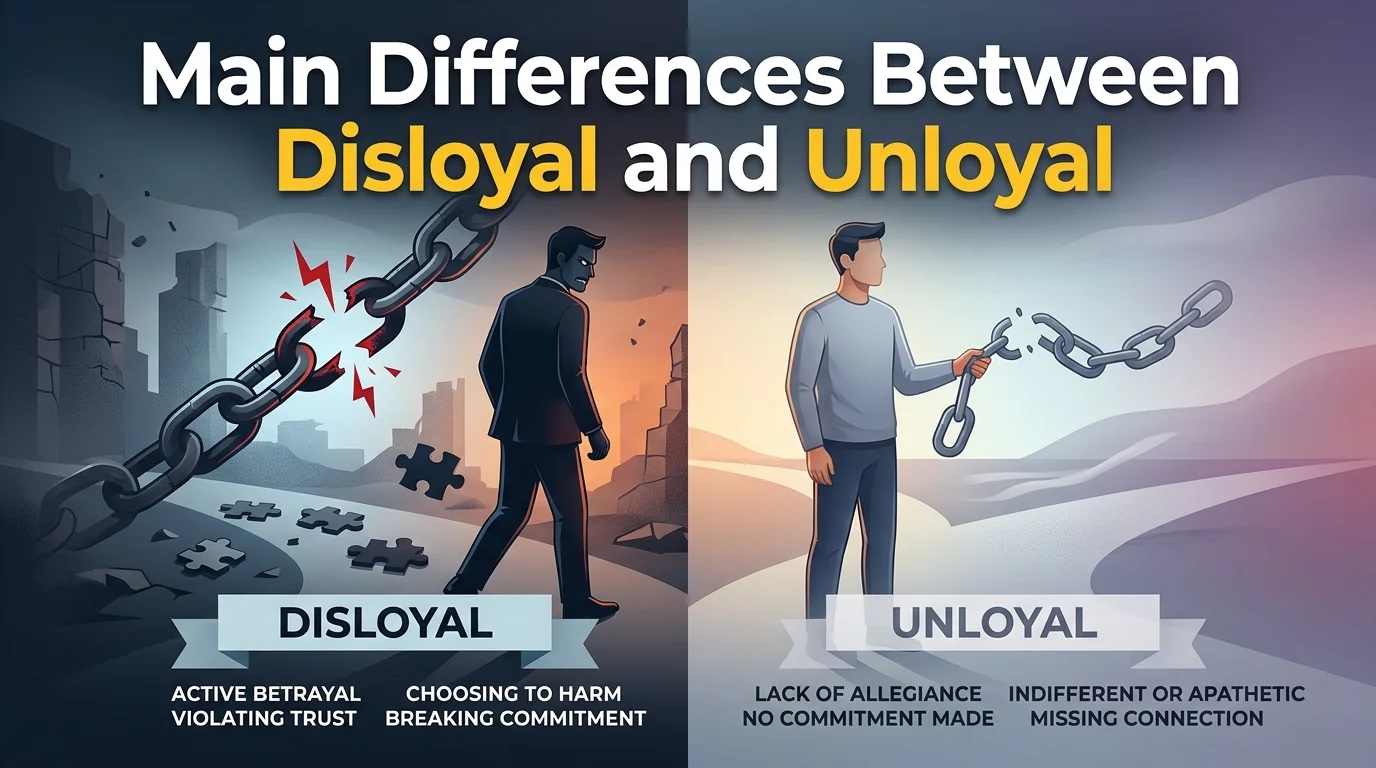
| Aspect | Disloyal | Unloyal |
| Frequency | Very common | Very rare |
| Natural English | Yes | No (usually) |
| Dictionaries | Yes | Yes |
| Formal Writing | Recommended | Avoid |
| Everyday Conversation | Common | Rare |
| Professional Writing | Preferred | Not preferred |
Key Differences
- Disloyal is the standard English word.
- Unloyal exists but is seldom used.
- Native speakers almost always choose disloyal.
- Using unloyal may sound outdated or unnatural.
Why Is “Disloyal” More Common?
English sometimes forms opposites using different prefixes.
Examples include:
| Positive | Common Opposite |
| Loyal | Disloyal |
| Honest | Dishonest |
| Respectful | Disrespectful |
| Obedient | Disobedient |
Although un- is a common negative prefix, English traditionally uses dis- with loyal.
Comparison Table
| Situation | Best Word |
| Academic writing | Disloyal |
| Business communication | Disloyal |
| News articles | Disloyal |
| Daily conversation | Disloyal |
| School essays | Disloyal |
| Creative writing | Mostly Disloyal |
| Historical texts | Sometimes Unloyal |
Grammar Guide
Both words are adjectives.
They describe a noun.
Examples:
- a disloyal friend
- a disloyal employee
- an unloyal supporter (rare)
How Each Term Is Used in Sentences
Disloyal Pattern
Subject + be + disloyal + to + noun
Examples:
- He is disloyal to his country.
- They became disloyal to the company.
- She remained loyal while others were disloyal.
Unloyal Pattern
Subject + be + unloyal + to + noun
Examples:
- He was unloyal to his friends. (rare)
- The knight appeared unloyal. (rare)
Common Mistakes Learners Make
Mistake 1
❌ He is unloyal to his company.
✅ He is disloyal to his company.
Mistake 2
Thinking both words are equally common.
Actually, disloyal is far more common.
Mistake 3
Using unloyal in business or academic writing.
Instead, use disloyal.
Simple Rules to Remember
- Remember disloyal as the standard opposite of loyal.
- Use disloyal in almost every situation.
- Avoid unloyal unless discussing historical or uncommon language.
Quick Tips for Writing and Speaking
- Choose disloyal for natural English.
- Avoid unloyal in exams.
- Use disloyal in emails and reports.
- Native speakers expect disloyal.
- If unsure, always pick disloyal.
When to Use Each One
Use Disloyal When:
- describing betrayal
- discussing trust
- writing essays
- writing business reports
- speaking naturally
- discussing politics
- discussing friendships
- describing employees
- describing relationships
- writing professionally
Use Unloyal When:
- quoting historical texts
- discussing uncommon vocabulary
- analyzing old literature
- explaining rare dictionary entries
When NOT to Use Each One
Do NOT Use Disloyal
- when you need the positive meaning (use loyal instead)
- when describing faithfulness positively
Do NOT Use Unloyal
- in school assignments
- in professional emails
- in resumes
- in presentations
- in academic papers
- in everyday conversation unless intentionally using an uncommon word
Which One to Use (Decision Guide)
Use this simple guide:
- Are you writing modern English? → Disloyal
- Are you speaking with native speakers? → Disloyal
- Are you writing an essay? → Disloyal
- Are you sending a business email? → Disloyal
- Are you quoting historical language? → Unloyal may appear.
Final recommendation: In almost every modern context, disloyal is the correct and natural choice.
Real-World Practical Examples
Disloyal Examples
- The employee became disloyal after sharing company secrets.
- A disloyal friend cannot be trusted.
- The soldier was punished for being disloyal to his country.
- Customers viewed the brand as disloyal after it broke its promises.
- The writer described the character as disloyal to his family.
Unloyal Examples
- The old manuscript described an unloyal servant.
- Some historical writers used unloyal instead of disloyal.
- The poem referred to an unloyal knight.
- The editor replaced unloyal with disloyal for modern readers.
- Most dictionaries list unloyal, but it is rarely used today.
Self-Assessment (Fill in the Blanks)
- I will use ______ when describing a worker who betrays a company. The correct word is ______ because it is the standard modern English term.
- I will use ______ when quoting an old historical text. The correct word is ______ because it reflects older usage.
- He remained ______ to his country after leaking secrets. The correct word is ______ because betrayal is implied.
- The teacher marked ______ as awkward in the essay. The correct word is ______ because it is rarely used today.
- A ______ friend cannot be trusted. The correct word is ______ because it is the accepted adjective.
- Modern newspapers almost always write ______. The correct word is ______ because it is standard usage.
- The dictionary includes ______, but it is uncommon. The correct word is ______ because it exists but is rare.
- She was ______ to her team after revealing private plans. The correct word is ______ because she betrayed trust.
- Academic writing prefers ______. The correct word is ______ because it is widely accepted.
- Everyday conversations usually use ______. The correct word is ______ because native speakers prefer it.
- The old novel described an ______ servant. The correct word is ______ because it reflects historical wording.
- The CEO fired the ______ employee. The correct word is ______ because the employee betrayed the company.
- Choose the more natural word: ______. The correct word is ______ because it is commonly used today.
- The knight was described as ______ in an ancient story. The correct word is ______ because older literature sometimes uses it.
- Professional emails should use ______. The correct word is ______ because it sounds natural and formal.
- Most English learners should remember ______. The correct word is ______ because it is the preferred opposite of “loyal.”
- A person who betrays friends is ______. The correct word is ______ because it describes betrayal.
- The uncommon adjective is ______. The correct word is ______ because it is rarely used in modern English.
- Business reports should avoid ______. The correct word is ______ because it sounds unnatural in modern writing.
- The standard opposite of “loyal” is ______. The correct word is ______ because it is the accepted form.
Answers
- Disloyal — Disloyal
- Unloyal — Unloyal
- Disloyal — Disloyal
- Unloyal — Unloyal
- Disloyal — Disloyal
- Disloyal — Disloyal
- Unloyal — Unloyal
- Disloyal — Disloyal
- Disloyal — Disloyal
- Disloyal — Disloyal
- Unloyal — Unloyal
- Disloyal — Disloyal
- Disloyal — Disloyal
- Unloyal — Unloyal
- Disloyal — Disloyal
- Disloyal — Disloyal
- Disloyal — Disloyal
- Unloyal — Unloyal
- Unloyal — Unloyal
- Disloyal — Disloyal
Final Verdict
Although disloyal and unloyal both literally mean “not loyal,” they are not interchangeable in modern English. Disloyal is the standard, widely accepted adjective used in conversation, academic writing, business communication, journalism and literature. Unloyal, while recognized by dictionaries, is uncommon and often sounds outdated or unnatural to native speakers.
If your goal is to write clear, fluent, and professional English, disloyal should almost always be your choice. Reserve unloyal for discussions of historical language, older texts or rare stylistic contexts. By remembering that “disloyal” is the modern standard opposite of “loyal,” you’ll avoid common mistakes and communicate more confidently in any situation.
Conclusion
Understanding the difference between Disloyal vs. unloyal can make your English sound much more natural and accurate. While both words suggest a lack of loyalty, disloyal is the standard and widely accepted term used in modern English, whether you’re writing an essay, having a conversation or preparing professional documents. Unloyal, although recognized by dictionaries is rarely used today and may sound unusual to native speakers.
By learning when and how to use these words correctly, you can avoid common grammar mistakes and communicate with greater confidence. Whenever you want to describe betrayal, a lack of faithfulness or someone who fails to remain loyal, disloyal is almost always the best choice. Keeping this simple distinction in mind will improve your vocabulary, strengthen your writing and help you choose the most appropriate word in every context.
FAQs
Is disloyal or unloyal more correct?
Disloyal is the correct and preferred word in modern English. Although unloyal exists in dictionaries, it is rarely used by native speakers. In almost all forms of writing and speech, disloyal is considered the natural and standard choice.
Is unloyal a real English word?
Yes, unloyal is a real English word and appears in some dictionaries. However, it is uncommon in modern usage. Most writers, teachers and native speakers prefer disloyal, making it the better option for everyday communication.
Why is disloyal used instead of unloyal?
English follows established word patterns and loyal traditionally takes the prefix dis- instead of un-. As a result, disloyal became the accepted opposite of loyal, while unloyal remained rare and is seldom used in modern English.
Can I use unloyal in formal writing?
It is generally best to avoid unloyal in formal writing. Academic papers, business documents and professional communication almost always use disloyal, which sounds more natural and meets modern English standards.
What part of speech are disloyal and unloyal?
Both disloyal and unloyal are adjectives. They describe a person, group or thing that lacks loyalty or fails to remain faithful to someone, an organization or a cause.
What is an example of disloyal in a sentence?
A simple example is: “The employee was disloyal to the company by sharing confidential information.” In this sentence, disloyal describes someone who betrayed the trust of their employer.
Are disloyal and unloyal interchangeable?
They have similar meanings, but they are not equally appropriate. While both indicate a lack of loyalty, disloyal is the standard choice in modern English, whereas unloyal is rarely used and may sound awkward.
Is disloyal suitable for everyday conversation?
Yes, disloyal is commonly used in everyday conversations. Native speakers naturally choose this word when talking about betrayal, broken trust or someone who does not remain faithful to people, organizations or ideals.
How can I remember the correct word?
A simple rule is to remember that the opposite of loyal is almost always disloyal, just as the opposite of honest is dishonest. This pattern makes it easy to choose the correct word every time.
Should English learners use unloyal?
English learners should generally use disloyal because it is the accepted and commonly used form. Choosing disloyal will make your speaking and writing sound more fluent, natural and appropriate in both formal and informal situations.