
The phrases “Copy That” and “Roger That” are both commonly used in radio communication, aviation, military operations, emergency services and even everyday conversations. Although many people use them interchangeably, they do not mean the same thing.
Understanding the difference helps you communicate more accurately and avoid misunderstandings in both professional and casual situations.
Comparison Overview
“Copy That” and “Roger That” are communication phrases used to respond after receiving a message. Both indicate that a transmission has been received, but they serve slightly different purposes.
- Copy That means I have received and understood your message.
- Roger That traditionally means I have received your transmission.
In modern everyday English, the two expressions are often treated as synonyms, but in formal radio communication, there is a subtle distinction.
| Feature | Copy That | Roger That |
| Primary Meaning | Message received and understood | Transmission received |
| Indicates Understanding | Yes | Generally yes, but originally only receipt |
| Military Use | Very common | Extremely common |
| Aviation Use | Used in some situations | Historically standard |
| Casual Conversation | Common | Common |
| Indicates Agreement | No | No |
| Confirms Action | No | No |
Definition of Copy That
Copy That is a communication phrase meaning “I received your message and understand it.”
The word copy is used as a verb in radio communication, meaning to receive and comprehend transmitted information.
Core Purpose
- Confirms the message was heard.
- Shows understanding.
- Does not necessarily mean the speaker will follow the instruction.
Example:
“Meet me at Gate 3.”
“Copy that.”
Definition of Roger That
Roger That is a traditional radio phrase meaning “I have received your transmission.”
The word Roger originally represented the letter R in the old phonetic alphabet, where R stood for Received.
Core Purpose
- Confirms receipt of a transmission.
- Widely used in military, aviation, and emergency communications.
- Does not automatically mean agreement or compliance.
Example:
“Proceed to checkpoint Bravo.”
“Roger that.”
Main Differences Between Copy That and Roger That
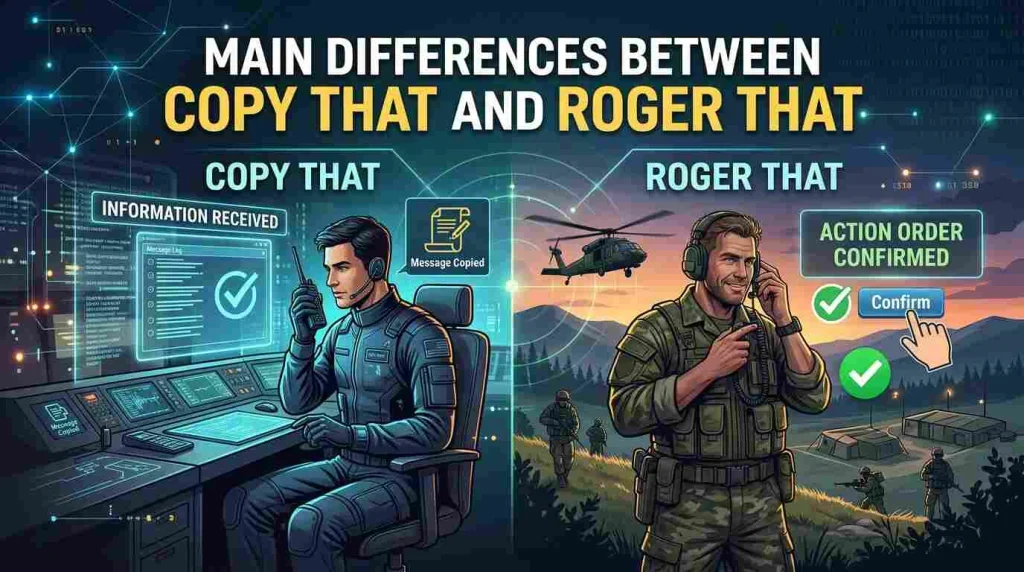
| Aspect | Copy That | Roger That |
| Meaning | Received and understood | Received transmission |
| Focus | Understanding | Reception |
| Origin | Radio communications | Military phonetic alphabet |
| Modern Usage | Military, police, casual speech | Military, aviation, emergency services |
| Everyday English | Very common | Very common |
| Implies Action | No | No |
| Indicates Agreement | No | No |
Key Difference
Think of it this way:
- Copy That = I got your message and understand it.
- Roger That = I received what you said.
Neither phrase means:
- “I agree.”
- “I will do it.”
- “Yes.”
History and Origin
Both expressions originated in radio communications where short, standardized responses reduced confusion.
Copy That
Operators would say they could copy a transmission, meaning they successfully received and understood it.
Roger That
Before the NATO phonetic alphabet, the letter R was represented by Roger.
Since R = Received, operators responded with Roger to acknowledge receipt.
Although today’s NATO alphabet uses Romeo for the letter R, the expression Roger remained in use because of tradition.
Where You Commonly Hear These Phrases
You’ll often hear these expressions in:
- Military operations
- Aviation
- Police communication
- Fire departments
- Security teams
- Movies
- Video games
- Walkie-talkie conversations
- Business teams
- Casual conversations
Grammar Guide
Both Copy That and Roger That function primarily as fixed expressions (interjections or sentence substitutes) rather than complete grammatical sentences.
Neither phrase acts as a noun, adjective, or traditional verb phrase in everyday grammar.
How Each Term Is Used in Sentences
Pattern:
Instruction → Response
Examples:
Person A:
“Please email the report.”
Person B:
“Copy that.”
Person A:
“Move to Position Alpha.”
Person B:
“Roger that.”
Both expressions can also appear after statements.
Examples:
- Copy that. I’ll review it.
- Roger that. Waiting for further instructions.
- Copy that, thanks.
- Roger that, understood.
Common Mistakes Learners Make
Mistake 1
❌ Roger That means “Yes.”
Correct:
It only confirms receipt.
Mistake 2
❌ Copy That means “I agree.”
Correct:
It only confirms understanding.
Mistake 3
❌ Using either phrase in formal academic writing.
Formal writing usually prefers:
- I understand.
- I have received your email.
- Acknowledged.
Mistake 4
Thinking either phrase promises action.
It doesn’t.
To promise action, say:
- Will do.
- Understood.
- I’ll handle it.
Simple Rules to Remember
- Copy = Received + Understood
- Roger = Received
- Neither means “Yes.”
- Neither guarantees action.
- Both work best in spoken communication.
Quick Tips for Writing and Speaking
- Use Copy That when confirming understanding.
- Use Roger That in radio-style communication.
- Avoid both in formal essays.
- They’re excellent in stories involving military or emergency settings.
- Use “Understood” for a more neutral alternative.
When to Use Each One
Use Copy That When
- Confirming instructions
- Responding to a manager
- Team communication
- Online gaming
- Walkie-talkie conversations
- Casual conversations
Example:
“Bring the laptop.”
“Copy that.”
Use Roger That When
- Military role-play
- Aviation communication
- Police simulations
- Emergency response
- Tactical conversations
- Movies and games
Example:
“Unit 7, proceed north.”
“Roger that.”
When NOT to Use Each One
Avoid both phrases:
In Formal Essays
❌ Roger that.
Better:
“I understand.”
In Professional Emails
Instead of:
“Roger that.”
Use:
“Thank you. I have received your email.”
When Giving Consent
Wrong:
“Roger that.”
Correct:
“Yes, I agree.”
When Accepting an Offer
Instead of:
“Copy that.”
Say:
“I’d be happy to.”
Which One to Use (Decision Guide)
Choose Copy That if you want to emphasize that you understood the message.
Choose Roger That if you’re acknowledging receipt in a radio or military-style setting.
Use Understood if you need a neutral response suitable for most professional situations.
If you’re simply chatting with friends, either phrase is acceptable, though Copy That often sounds more modern and conversational.
Real-World Practical Examples
Copy That Examples
- Education: “Submit your assignment by Friday.” — “Copy that.”
- Business: “Please join the meeting at 2 PM.” — “Copy that.”
- Technology: “Restart the server after the update.” — “Copy that.”
- Daily Life: “Pick up milk on your way home.” — “Copy that.”
- Gaming: “Cover the east entrance.” — “Copy that.”
Roger That Examples
- Military: “Advance to checkpoint Delta.” — “Roger that.”
- Police: “Suspect heading north.” — “Roger that.”
- Emergency Services: “Engine 5, proceed immediately.” — “Roger that.”
- Aviation: “Taxi to runway 12.” — “Roger that.”
- Conversation: “I’ll meet you outside.” — “Roger that.”
Self-Assessment (Fill in the Blanks)
- I will use ______ when confirming I understood an instruction.
- The correct word is ______ because it traditionally means transmission received.
- I will use ______ after my manager gives me directions.
- The correct phrase is ______ for military-style radio communication.
- I understood the message, so I replied ______.
- The pilot answered ______ over the radio.
- ______ is commonly used in casual conversations today.
- ______ originated from the old phonetic alphabet.
- I received and understood your message. ______.
- The police officer responded ______.
- I should avoid ______ in a formal research paper.
- ______ is more common in tactical communication.
- The teacher gave homework. I replied ______.
- The dispatcher said, “Proceed.” The officer answered ______.
- ______ does not automatically mean “Yes.”
- ______ does not promise future action.
- The gamer responded ______ after hearing the strategy.
- The soldier replied ______ after receiving orders.
- I need a casual acknowledgment, so I choose ______.
- I simply received the radio transmission. ______.
Answers
- Copy That
- Roger That
- Copy That
- Roger That
- Copy That
- Roger That
- Copy That
- Roger That
- Copy That
- Roger That
- Copy That or Roger That
- Roger That
- Copy That
- Roger That
- Copy That
- Roger That
- Copy That
- Roger That
- Copy That
- Roger That
Final Verdict
Although Copy That and Roger That are closely related, they are not completely identical. Copy That emphasizes that a message has been received and understood, making it a popular choice in both professional teamwork and everyday conversations. Roger That, on the other hand, has its roots in military and aviation radio communication and traditionally confirms that a transmission has been received. Neither phrase means “yes,” “I agree,” or “I will do it.”
By understanding their subtle differences, you can choose the most appropriate expression for the situation. If you want a modern, versatile acknowledgment, Copy That is usually the better choice. If you’re using military, aviation or tactical language, Roger That remains the classic and widely recognized response.
Conclusion
Understanding the difference between Copy That vs Roger That can make your communication more accurate, whether you’re using a walkie-talkie, playing a tactical game, writing realistic dialogue or simply having a casual conversation. While both phrases acknowledge a received message, Copy That usually emphasizes that the message has been received and understood, whereas Roger That traditionally confirms that a transmission has been received.
Knowing this subtle distinction helps you choose the right expression for the situation and avoid common misunderstandings. In modern English, the phrases are often used interchangeably, but recognizing their original meanings adds clarity and confidence to your communication. Whether you’re interested in military terminology, aviation phrases or everyday language, mastering Copy That vs Roger That gives you a better understanding of how these iconic expressions work. Keep their meanings in mind, practice using them in context and you’ll communicate more naturally and effectively.
FAQs
What is the difference between Copy That and Roger That?
The main difference is that Copy That generally means the speaker has received and understood the message, while Roger That traditionally means the transmission has been received. In everyday conversations, people often use them interchangeably, but professional radio communication may still recognize this distinction.
Is Copy That more correct than Roger That?
Neither phrase is more correct than the other because they serve slightly different purposes. Copy That is useful when confirming understanding, while Roger That is commonly used to acknowledge receipt of a message, especially in military and aviation communications.
Does Roger That mean yes?
No. Roger That does not mean “yes” or “I agree.” It simply confirms that a message has been received. If you want to express agreement or acceptance, you should use words like “yes,” “certainly,” or “I agree” instead.
Does Copy That mean I will do it?
No. Copy That only indicates that you received and understood the information. It does not promise that you will complete the task. If you want to confirm action, use responses like “Will do,” “I’ll take care of it,” or “Understood.”
Why do military personnel say Roger That?
Military personnel use Roger That because it has long been a standard acknowledgment in radio communication. The word “Roger” originally represented the letter “R,” which stood for “Received,” making it a quick and reliable way to confirm transmissions.
Can I use Copy That in everyday conversations?
Yes. Copy That has become common in everyday English and is often used in casual conversations, workplaces and online gaming. It sounds friendly and confirms that you understood what someone said without being overly formal.
Is Roger That still used in aviation?
Yes, although modern aviation communication follows standardized phraseology, Roger is still recognized and used in appropriate situations to acknowledge transmissions. Pilots and air traffic controllers rely on precise language to reduce confusion during communication.
Which phrase is better for business communication?
In professional business settings, it is usually better to use expressions such as “Understood,” “Received,” or “I have received your email.” While Copy That may sound acceptable in informal workplaces, Roger That can seem too military or conversational.
Can Copy That and Roger That be used interchangeably?
In casual conversations, movies, and games, they are often used interchangeably because both acknowledge a message. However, if you want to be technically accurate, Copy That emphasizes understanding, while Roger That primarily confirms message receipt.
How can I remember the difference between Copy That and Roger That?
A simple way to remember is that Copy That means “I received and understood your message,” while Roger That means “I received your transmission.” Think of Copy as understanding the content and Roger as acknowledging the communication.