The terms timeslot and time slot often confuse English learners because they refer to the same basic idea but appear in different forms. While both are widely understood, one is generally considered the standard spelling in formal English.
Understanding the difference will help you write more clearly and use the correct form in different situations.
Comparison Overview
Both timeslot and time slot refer to a specific period that has been reserved or assigned for an activity, event, appointment, broadcast or meeting. The main difference is not in meaning but in spelling and writing style.
Generally, time slot (two words) is the preferred form in standard English dictionaries and style guides. Timeslot (one word) is a closed compound that appears in some business, technology, scheduling software and informal writing but is less common in formal publications.
| Feature | Time Slot | Timeslot |
| Spelling | Two words | One word |
| Meaning | A scheduled period of time | Same meaning |
| Formal Writing | Preferred | Less preferred |
| Informal Writing | Common | Sometimes used |
| Dictionaries | Widely accepted | Accepted by some dictionaries and industries |
Definition of Timeslot
A timeslot is a single-word compound noun that means a scheduled period reserved for a particular purpose. It has the same meaning as time slot but appears more often in software interfaces, booking systems, calendars and some business documents.
Examples:
- Select your preferred timeslot for delivery.
- The website lets customers book a timeslot online.
- Every timeslot has a limited number of seats.
Although understandable, this spelling is less common in formal English.
Definition of Time Slot
A time slot is a noun consisting of two words. It refers to a specific period allocated for an event, meeting, television program, appointment or other activity.
It is the spelling recommended in most dictionaries and is the safest choice for academic, professional and formal writing.
Examples:
- Please choose a time slot for your interview.
- The television show moved to a new time slot.
- We reserved a time slot for the presentation.
Main Differences Between Timeslot and Time Slot
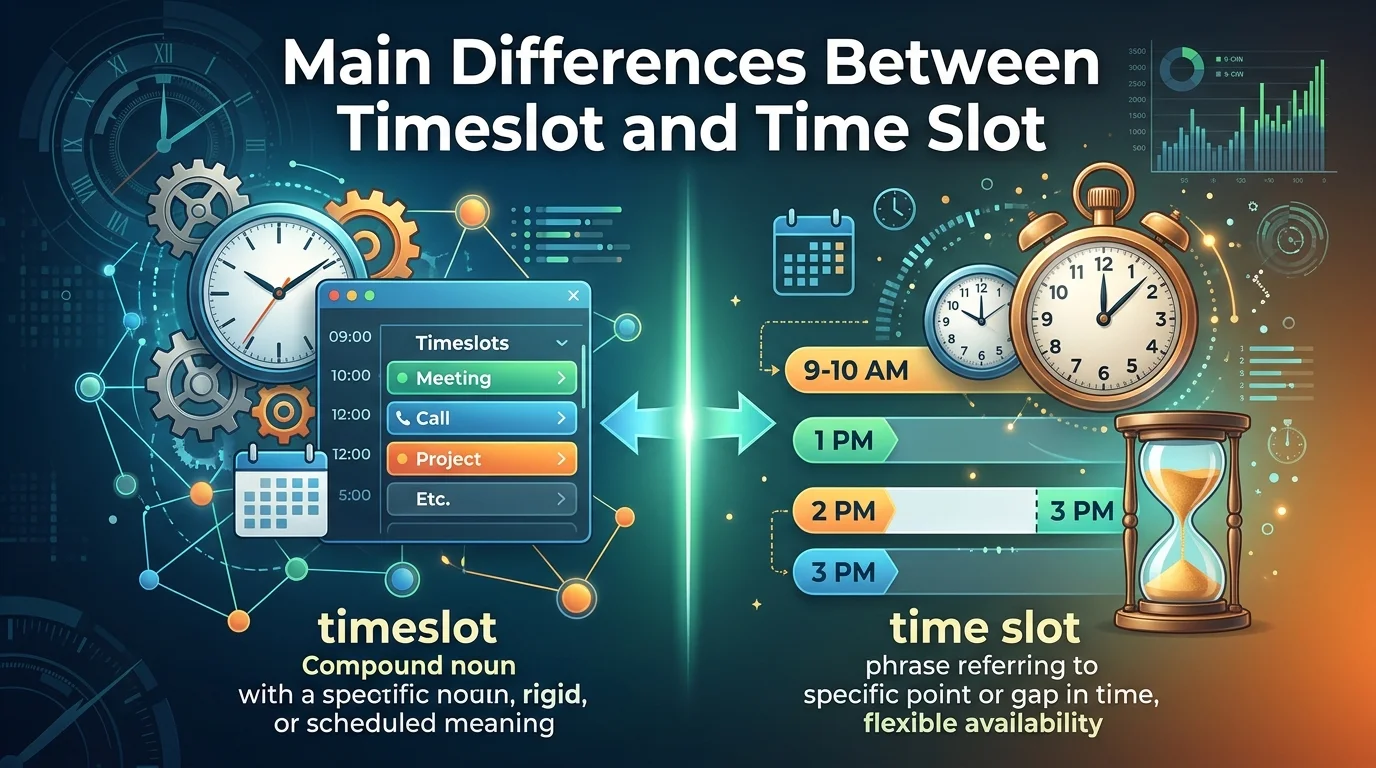
| Aspect | Timeslot | Time Slot |
| Meaning | Scheduled period | Scheduled period |
| Grammar | Compound noun | Noun phrase (preferred) |
| Formality | Less formal | More formal |
| Academic Writing | Usually avoided | Recommended |
| Business Documents | Sometimes used | Common |
| Software Interfaces | Frequently seen | Also common |
| Dictionary Preference | Less common | Standard form |
The meaning remains the same. The difference is mainly spelling and writing convention.
Time Slot vs Timeslot in Modern English
Language naturally evolves and many two-word expressions eventually become one word. Examples include:
- Web site → Website
- On line → Online
- Data base → Database
Some writers believe timeslot may eventually become as common as time slot, but today time slot is still the preferred spelling in most formal English.
Why Do People Get Confused?
Several reasons contribute to the confusion:
- Many scheduling apps display timeslot.
- Some companies prefer shorter compound words.
- Both spellings sound identical.
- Different style guides have different preferences.
- English contains many compound nouns that change over time.
Grammar Guide
Both timeslot and time slot function as countable nouns.
Examples:
- We booked a time slot.
- Choose a timeslot before continuing.
How Each Term Is Used in Sentences
Both words function identically in sentences.
Pattern:
Subject + Verb + time slot/timeslot
Examples:
- I booked a time slot.
- She selected a timeslot.
- They changed our time slot.
- Every timeslot was full.
- We need another time slot.
Common Mistakes Learners Make
Mistake 1
❌ I booked a time-slot.
✅ I booked a time slot.
(Hyphen is generally unnecessary.)
Mistake 2
❌ Timeslot is always the correct spelling.
✅ Time slot is generally preferred in formal English.
Mistake 3
❌ We have many time slotes.
✅ We have many time slots.
Mistake 4
❌ Use both spellings in the same document.
✅ Choose one spelling and remain consistent.
Simple Rules to Remember
- Use time slot for essays, reports, emails, and formal writing.
- Time slott is acceptable in many digital platforms and software.
- Both may mean the same thing.
- Be consistent throughout your document.
- When unsure, choose time slot.
Quick Tips for Writing and Speaking
- Prefer time slot in school assignments.
- Use time slot in professional communication.
- Don’t switch between spellings.
- Follow your company’s style guide if one exists.
- Speaking doesn’t change because both are pronounced the same.
When to Use Each One
Use Time Slot When:
- Writing academic papers
- Writing business reports
- Creating formal emails
- Publishing articles
- Writing books
- Following dictionary recommendations
Use Timeslot When:
- Following company branding
- Using scheduling software
- Working in systems that use the compound spelling
- Following an organization’s style guide
When NOT to Use Each One
Avoid timeslot when:
- Writing university assignments
- Preparing legal documents
- Following strict editorial guidelines
Avoid inconsistent spelling like:
❌ time slot in one paragraph and timeslot in another without reason.
Also avoid unnecessary hyphens:
❌ time-slot
Which One to Use (Decision Guide)
Use this simple guide:
- Academic writing? → Time slot
- Professional email? → Time slot
- General English? → Time slot
- Software interface already uses “timeslot”? → Timeslot
- Unsure? → Time slot
For most English learners, time slot is the safest and most widely accepted choice.
Real-World Practical Examples
Timeslot Examples
- Choose your delivery timeslot before checkout.
- Every interview timeslot has already been booked.
- The booking system shows available timeslots.
- Customers can change their timeslot online.
- The app automatically assigns a timeslot.
Time Slot Examples
- Our teacher assigned each student a presentation time slot.
- I booked a doctor’s time slot for Monday morning.
- The TV show moved to a later time slot.
- We reserved a conference time slot.
- Please arrive five minutes before your time slot.
Self-Assessment (Fill in the Blanks)
- I booked a ______ for my doctor’s appointment. The correct word is ______ because it is formal English.
- The app lets users choose a ______ online. The correct word is ______ because software often uses it.
- Our TV program has a new ______ this season. The correct word is ______ because it is standard writing.
- Every interview ______ lasts thirty minutes. The correct word is ______ because it follows formal style.
- The booking website displays every available ______. The correct word is ______ because it follows the platform’s wording.
- We reserved a meeting ______ yesterday. The correct word is ______ because business writing prefers it.
- Select your preferred ______ before payment. The correct word is ______ because the application uses compound spelling.
- The newspaper announced a different broadcast ______. The correct word is ______ because newspapers prefer standard spelling.
- My presentation ______ begins at 10 a.m. The correct word is ______ because it is formal writing.
- The scheduling software created a new ______ automatically. The correct word is ______ because it follows software terminology.
- Please arrive before your assigned ______. The correct word is ______ because it is standard English.
- The website offers a morning ______. The correct word is ______ because the interface uses one-word spelling.
- Every conference ______ has a moderator. The correct word is ______ because it is formal.
- The online portal shows every available ______. The correct word is ______ because it matches the platform.
- I changed my appointment ______ yesterday. The correct word is ______ because formal English prefers it.
- Customers selected their delivery ______ online. The correct word is ______ because the software labels it that way.
- The editor changed the article to use ______ consistently. The correct word is ______ because style guides recommend it.
- The booking system added another ______ for customers. The correct word is ______ because it follows application terminology.
- Our school assigned every student a speaking ______. The correct word is ______ because it is standard written English.
- The reservation app opened another ______ for tomorrow. The correct word is ______ because the application uses compound spelling.
Answers
- time slot
- timeslot
- time slot
- time slot
- timeslot
- time slot
- timeslot
- time slot
- time slot
- timeslot
- time slot
- timeslot
- time slot
- timeslot
- time slot
- timeslot
- time slot
- timeslot
- time slot
- timeslot
Final Verdict
Both timeslot and time slot refer to the same concept: a specific period reserved for an activity, appointment, meeting or event. The difference lies almost entirely in spelling rather than meaning. In modern English, time slot is the standard and preferred form for formal, academic, professional and published writing. Timeslot is increasingly common in software, scheduling systems and certain business environments, but it is still less widely accepted as the default spelling.
If you’re writing for school, work or a broad audience, choosing time slot is the safest option. If you’re following the terminology used by a specific application or organization, timeslot may be appropriate. Above all, stay consistent throughout your writing so your content looks polished, professional and easy to read.
Conclusion
Understanding the difference between Timeslot Vs Time Slot is easier once you know that both terms describe the same idea: a specific period reserved for an activity, appointment, meeting or event. The real distinction lies in spelling and writing style rather than meaning. In most formal, academic and professional contexts, time slot is the preferred and more widely accepted form, while timeslot is commonly seen in software, booking platforms and certain business environments.
Choosing the right version depends on your audience, the writing style you are following and any organizational guidelines you need to meet. When in doubt, using a time slot is usually the safest option. By understanding these subtle differences, you can write with greater confidence, avoid common mistakes and communicate more clearly in everyday conversations, business documents, educational work and digital content.
FAQs
Is “time slot” or “timeslot” more correct?
Time slot is generally considered the standard spelling in formal English. It is commonly used in academic writing, business communication and major dictionaries. Timeslot has the same meaning but is more common in software, scheduling systems and some informal or industry-specific contexts.
Do “timeslot” and “time slot” have different meanings?
No. Both terms refer to a specific period reserved for an activity, appointment, meeting, broadcast or event. The only real difference is how the term is written. Their meaning and usage remain the same in everyday communication.
Which spelling should I use in formal writing?
For formal writing, reports, essays, research papers, and professional emails, time slot is the recommended choice. It follows the standard spelling found in most dictionaries and style guides, making it the safest option for official documents.
Why do some websites use “timeslot”?
Many software developers and online booking platforms prefer timeslot because it is shorter and works well as a compound noun in interfaces, buttons, and menus. This is often a branding or design preference rather than a grammatical rule.
Is “timeslot” accepted in English dictionaries?
Some modern dictionaries recognize timeslot as an alternative spelling. However, time slot remains the more widely accepted and recommended form, especially in formal and edited writing.
Can I use both spellings in the same document?
It is best not to mix the two spellings in one document. Choose either time slot or timeslot based on your style guide or audience and use it consistently throughout your writing for a professional appearance.
Is “time-slot” with a hyphen correct?
The hyphenated form time-slot is generally unnecessary in modern English. Most style guides and dictionaries prefer either time slot as two words or timeslot as one word, depending on the chosen writing style.
Which spelling is better for business communication?
In business communication, time slot is usually the better choice because it is more formal and widely recognized. However, if your company’s scheduling software or branding uses timeslot, following that internal convention is perfectly acceptable.
Are both spellings pronounced the same way?
Yes. Timeslot and time slot are pronounced the same. The difference exists only in spelling, so listeners will not notice any distinction when the words are spoken.
How can I remember which spelling to use?
A simple rule is to use time slot whenever you are unsure, especially in formal writing. If you are writing for a scheduling app, booking platform or organization that specifically uses timeslot, then follow that preferred spelling consistently.