
The words sale and sail sound exactly alike, making them classic examples of homophones in English. Although their pronunciation is the same, their meanings, spellings, and uses are completely different. Understanding the difference between sale vs sail helps you avoid common writing mistakes and communicate more clearly in everyday conversations, business writing, and academic work.
Comparison Overview
At first glance, sale vs sail may seem interchangeable because they are pronounced the same (/seɪl/). However, they belong to different parts of speech and describe completely different ideas.
| Feature | Sale | Sail |
| Meaning | Exchange of goods or services for money; a discount event | A piece of fabric that catches wind or traveling by boat |
| Part of Speech | Mainly noun | Noun and verb |
| Pronunciation | /seɪl/ | /seɪl/ |
| Common Contexts | Shopping, business, marketing | Boating, ships, travel, sports |
| Can Be a Verb? | Rarely (mainly in legal/business usage) | Yes |
The only similarity between these words is their pronunciation. Their meanings and usage are entirely different.
Definition of Sale
Sale is a noun that refers to the exchange of goods or services for money. It can also describe a special event where products are sold at reduced prices.
Meaning
A sale happens whenever something is bought or sold. Retail stores often advertise sales to encourage customers to purchase products at discounted prices.
Examples
- The store is having a sale this weekend.
- The house was sold after a successful sale.
- Winter sale prices attracted many shoppers.
- Every sale increases the company’s revenue.
- They celebrated their first online sale.
Definition of Sail
Sail can be both a noun and a verb.
As a noun, it refers to the large piece of fabric attached to a boat that catches the wind.
As a verb, it means to travel on water using a boat or ship.
Meaning
A sail helps move a boat by capturing wind. People also sail for transportation, racing, or recreation.
Examples
- The boat raised its sail before leaving the harbor.
- We will sail across the lake tomorrow.
- The sailors repaired the damaged sail.
- They love to sail during summer vacations.
- The yacht sailed smoothly across the ocean.
Main Differences Between Sale vs Sail
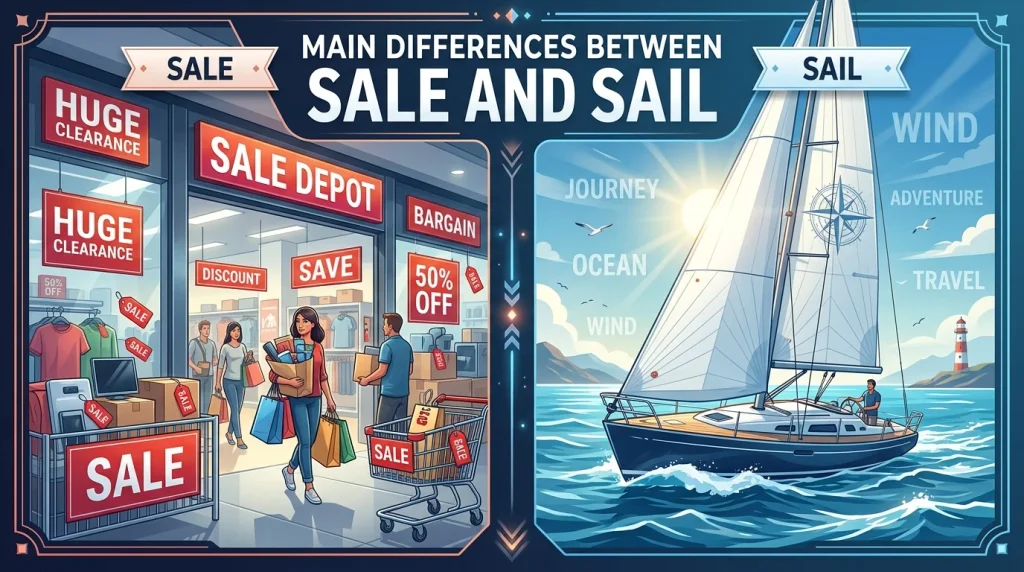
| Aspect | Sale | Sail |
| Basic Meaning | Buying and selling | Traveling by boat or boat equipment |
| Category | Commerce | Transportation and boating |
| Part of Speech | Mostly noun | Noun and verb |
| Related Words | Sell, seller, sales, salespeople | Sailing, sailor, sailed |
| Common Places | Stores, markets, businesses | Oceans, lakes, rivers, marinas |
Key Difference
- Sale always relates to business, shopping, or transactions.
- Sail always relates to boats, ships, wind, or traveling on water.
Comparison Table
| Question | Sale | Sail |
| Is it about shopping? | ✅ Yes | ❌ No |
| Is it about boats? | ❌ No | ✅ Yes |
| Is it a noun? | ✅ Yes | ✅ Yes |
| Is it a verb? | Rarely | ✅ Yes |
| Is it pronounced the same? | ✅ Yes | ✅ Yes |
Why People Confuse Sale and Sail
These words are confused because they are homophones. They sound identical but have different spellings and meanings.
For example:
- ❌ We went to the shopping sail.
- ✅ We went to the shopping sale.
- ❌ The captain prepared the sale.
- ✅ The captain prepared the sail.
Grammar Guide
How Each Term Is Used in Sentences
Sale
Usually functions as a noun.
Pattern:
- Sale + of + noun
- On sale
- For sale
Examples:
- The bike is for sale.
- Shoes are on sale today.
- The sale of the building took months.
Sail
Functions as both a noun and a verb.
Patterns:
- Sail + boat
- Sail across
- Raise the sail
Examples:
- We sailed across the river.
- The sail caught the wind.
- They enjoy sailing every weekend.
Common Mistakes Learners Make
Many learners confuse spelling because both words sound alike.
Common mistakes include:
- Writing sail instead of sale during shopping discussions.
- Using sale when talking about boats.
- Forgetting that sail can also be a verb.
- Assuming pronunciation changes meaning.
- Mixing them in writing but not in speech.
Simple Rules to Remember
- Think of sale as connected to sell.
- Think of sail as connected to ship.
- Shopping = sale
- Boat = sail
- Wind + water = sail
Quick Tips for Writing and Speaking
- Ask yourself whether you’re talking about shopping or boats.
- If money is involved, choose sale.
- If water travel is involved, choose sail.
- Proofread homophones carefully.
- Read sentences in context before choosing the correct spelling.
When to Use Each One
Use Sale When:
- Talking about discounts
- Referring to business transactions
- Discussing shopping
- Mentioning products
- Speaking about revenue
Use Sail When:
- Talking about boats
- Describing ocean travel
- Referring to sailing sports
- Mentioning wind-powered vessels
- Discussing nautical activities
When NOT to Use Each One
Don’t Use Sale
- When talking about ships
- For boating activities
- When referring to fabric on a boat
- During discussions of sailing competitions
- When describing water travel
Don’t Use Sail
- For discounts
- In shopping advertisements
- When discussing product prices
- In business sales reports
- When referring to commercial transactions
Which One to Use (Decision Guide)
Use this quick guide:
- Are you talking about shopping or selling something?
- ✅ Use sale.
- Are you talking about a boat or traveling on water?
- ✅ Use sail.
- Is money involved?
- ✅ Sale
- Is wind moving a boat?
- ✅ Sail
Real-World Practical Examples
Sale Examples
- The supermarket announced a weekend sale.
- Our online sale doubled monthly profits.
- Students received books during a clearance sale.
- The furniture sale attracted hundreds of customers.
- The company recorded its biggest sale this year.
Sail Examples
- Scientists used a solar sail for spacecraft research.
- We will sail around the island tomorrow.
- The old sail needed repairs after the storm.
- The children learned to sail during summer camp.
- Professional athletes compete in Olympic sailing events.
Self-Assessment (Fill in the Blanks)
- I will use ______ when referring to discounted prices. The correct word is ______ because it relates to shopping.
- I will use ______ when referring to traveling by boat. The correct word is ______ because it relates to water travel.
- I bought shoes during a ______. The correct word is ______ because products were discounted.
- The captain raised the ______. The correct word is ______ because it catches the wind.
- The car is for ______. The correct word is ______ because it is being offered to buyers.
- We will ______ across the lake. The correct word is ______ because it means travel by boat.
- Every successful ______ increased company profits. The correct word is ______ because it involves business.
- The damaged ______ was replaced. The correct word is ______ because it belongs to a boat.
- The clothing ______ starts Friday. The correct word is ______ because it’s a shopping event.
- They learned to ______ in summer camp. The correct word is ______ because it’s a boating activity.
- The house was listed for ______. The correct word is ______ because it is available for purchase.
- Strong winds filled the ______. The correct word is ______ because wind powers boats.
- Our biggest ______ happened online. The correct word is ______ because it refers to commerce.
- The yacht will ______ tomorrow morning. The correct word is ______ because it means travel on water.
- Customers waited for the holiday ______. The correct word is ______ because discounts were expected.
- The sailor repaired the torn ______. The correct word is ______ because it is part of the boat.
- The business celebrated another successful ______. The correct word is ______ because revenue increased.
- We love to ______ every summer. The correct word is ______ because it’s a boating activity.
- Electronics are on ______ today. The correct word is ______ because prices are reduced.
- The crew lowered the ______ before docking. The correct word is ______ because it belongs to the boat.
Answers
- sale, sale
- sail, sail
- sale, sale
- sail, sail
- sale, sale
- sail, sail
- sale, sale
- sail, sail
- sale, sale
- sail, sail
- sale, sale
- sail, sail
- sale, sale
- sail, sail
- sale, sale
- sail, sail
- sale, sale
- sail, sail
- sale, sale
- sail, sail
Final Verdict
Understanding the difference between sale vs sail is easier once you remember their meanings. Sale is associated with buying, selling, discounts, and business, while sail relates to boats, ships, wind, and traveling on water. Although they sound identical, they belong to completely different contexts and should never be used interchangeably. Whenever you encounter these words, think about the topic of your sentence. If it’s about shopping or commerce, choose sale. If it’s about boating or navigation, choose sail. Keeping this simple distinction in mind will improve your grammar, spelling, and confidence in both writing and speaking English.
Conclusion
Understanding the difference between Sale Vs Sail becomes much easier once you focus on the meaning and context of each word. Although they are pronounced the same, they represent completely different ideas. Sale refers to buying, selling, or discounted products, while sail relates to boats, ships, and traveling on water using wind or other means. Choosing the correct word helps you avoid spelling mistakes and makes your writing clearer and more professional.
Whether you’re writing an email, preparing school assignments, creating business content, or simply having a conversation, knowing when to use sale and sail will improve your confidence in English. By remembering that sale is connected to shopping and sail is connected to boating, you can quickly decide which word fits your sentence. With regular reading and practice, this common homophone pair will become easy to recognize and use correctly in both spoken and written English.
FAQs
What is the difference between sale vs sail?
The main difference is their meaning. Sale refers to the act of selling something or a period when products are offered at reduced prices. Sail refers to the fabric that catches wind on a boat or the act of traveling by boat. They sound alike but are used in completely different situations.
Are sale and sail pronounced the same?
Yes, sale and sail are pronouncey the same. They are homophones, meaning they share the same pronunciation but have different spellings and meanings. You must rely on the context of the sentence to determine which word is correct.
Is sale a noun or a verb?
Sale is primarily a noun. It describes the exchange of goods for money or a promotional event with discounted prices. While it may appear in certain legal or business expressions, it is rarely used as a verb in everyday English.
Is sail a noun or a verb?
Yes, sail can be both a noun and a verb. As a noun, it refers to the cloth attached to a boat that catches the wind. As a verb, it means to travel across water in a boat or ship.
When should I use sale in a sentence?
Use sale whenever your sentence is about shopping, business transactions, discounts, or selling products. Examples include “The shoes are on sale” and “The company made a successful sale.” It is the correct word whenever money or commerce is involved.
When should I use sail in a sentence?
Use sail when talking about boats, ships, or traveling on water. It is also correct when referring to the cloth attached to a boat. For example, “We will sail across the lake” and “The sail caught the wind.”
Why do people confuse sale and sail?
People often confuse these words because they sound exactly alike. Since their pronunciation is identical, writers sometimes choose the wrong spelling. Understanding the meaning of the sentence is the easiest way to select the correct word.
How can I remember the difference between sale and sail?
A simple memory trick is to connect sale with sell because both relate to shopping and business. Connect sail with sea because both are associated with boats and water travel. This association makes it easier to remember the correct spelling.
Can sale and sail ever be used interchangeably?
No. Even though they sound the same, sale and sail have completely different meanings. Replacing one with the other changes the meaning of a sentence and creates a spelling mistake. Always choose the word that matches your intended context.
Which word is correct: sale or sail?
Both words are correct, but only in the right context. Choose sale for shopping, discounts, and business transactions. Choose sail when discussing boats, ships, sailing, or water travel. Understanding the topic of your sentence will help you make the correct choice.