
The words scrap and scrape look and sound similar, but they have different meanings and uses in English. Because they differ by just one letter, many English learners confuse them.
Understanding the difference between scrap and scrape will help you write, speak and communicate more accurately in everyday conversations, school, business and professional writing. Like Scrap and Scrape, many words get confused by one extra letter. See Gases or Gasses.
Comparison Overview
Although scrap and scrape are both common English words, they serve different purposes.
- Scrap usually refers to a small leftover piece of something or the act of throwing something away because it is no longer useful.
- Scrape means to rub or drag something against a rough surface, often causing friction or removing material.
The table below provides a quick comparison.
| Feature | Scrap | Scrape |
| Primary Meaning | Small leftover piece or discard | Rub against a rough surface |
| Part of Speech | Noun and Verb | Verb and Noun |
| Common Contexts | Recycling, writing, manufacturing | Injuries, cleaning, technology |
| Refers to Leftovers? | Yes | No |
| Refers to Friction? | No | Yes |
Definition of Scrap
Scrap can be used as both a noun and a verb.
As a noun, it means a small remaining piece or leftover part of something.
Examples:
- A scrap of paper
- Metal scraps from a factory
- Fabric scraps for sewing
As a verb, it means to throw away, cancel or stop using something because it is no longer useful.
Examples:
- The company scrapped the old project.
- We decided to scrap the broken machine.
The main purpose of the word scrap is to describe leftovers, discarded materials, or abandoned plans.
Definition of Scrape
Scrape is mainly used as a verb.
It means to rub something against a rough surface or remove material by rubbing.
Examples include:
- Scrape mud off your shoes.
- Scrape paint from the wall.
- Scrape ice from the windshield.
As a noun, scrape refers to a scratch or minor injury caused by rubbing against a rough object.
Examples:
- He got a scrape on his knee.
- The bicycle left a small scrape on the car.
The word scrape focuses on rubbing, friction or slight damage.
Main Differences Between Scrap and Scrape
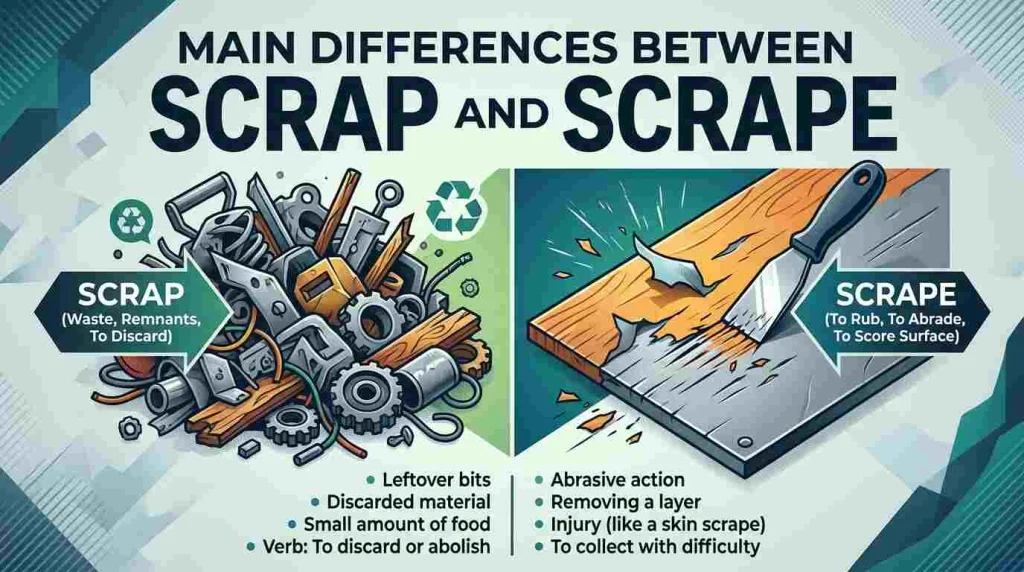
| Point | Scrap | Scrape |
| Meaning | Leftover piece or discard | Rub or remove by friction |
| Action | Throw away or cancel | Rub, scratch, or clean |
| Common Objects | Paper, metal, fabric, projects | Paint, ice, dirt, skin |
| Result | Something is discarded | Something is removed or scratched |
| Memory Trick | Scrap = leftover | Scrape = rubbing |
The easiest way to remember them is:
- Scrap relates to leftovers or discarding.
- Scrape relates to rubbing or scratching.
Scrap vs Scrape in Everyday English
These words appear in very different situations.
You may hear scrap when talking about recycling, project management, manufacturing or leftover materials.
You may hear scrape when talking about cleaning, injuries, cooking, driving or removing substances from surfaces.
For example:
- We scrapped the old proposal.
- Please scrape the mud off your boots.
Although they sound alike, substituting one for the other changes the meaning completely.
The same extra-letter confusion happens in smoothe vs smooth.
Comparison Table
| Situation | Correct Word | Example |
| Throw away an old plan | Scrap | We scrapped the idea. |
| Remove paint | Scrape | Scrape the paint carefully. |
| Leftover fabric | Scrap | Save every fabric scrap. |
| Minor knee injury | Scrape | She has a scrape on her knee. |
| Recycled metal | Scrap | Scrap metal is valuable. |
| Clean burned food | Scrape | Scrape the pan gently. |
Grammar Guide
How Each Term Is Used in Sentences
Scrap
As a noun:
- I found a scrap of paper.
As a verb:
- They scrapped the old design.
Sentence pattern:
Subject + scrap/scrapped + object
Examples:
- We scrapped the proposal.
- The factory scrapped outdated equipment.
Scrape
As a verb:
- Please scrape the pan.
Sentence pattern:
Subject + scrape/scraped + object
Examples:
- She scraped the ice away.
- He scraped mud from his shoes.
As a noun:
- He suffered a small scrape.
Common Mistakes Learners Make
Many learners write:
❌ I scraped my old project.
Correct:
✅ I scrapped my old project.
Incorrect:
❌ Scrap the dirt off your shoes.
Correct:
✅ Scrape the dirt off your shoes.
Incorrect:
❌ I have a scrap on my knee.
Correct:
✅ I have a scrape on my knee.
Simple Rules to Remember
- Scrap = leftovers or throw away.
- Scrape = rub, scratch, or remove.
- Projects are scrapped.
- Dirt is scraped off.
- Paper has scraps.
- Knees get scrapes.
Quick Tips for Writing and Speaking
- Think of scrap metal when remembering leftovers.
- Think of scraping paint when remembering rubbing.
- Double-check whether you mean “discard” or “rub.”
- Read your sentence aloud to hear whether the meaning fits.
- Practice with everyday examples.
When to Use Each One
Use scrap when:
- Talking about leftover materials.
- Referring to recycled items.
- Canceling projects.
- Throwing away equipment.
- Discussing unused pieces.
Use scrape when:
- Cleaning surfaces.
- Removing paint.
- Talking about minor injuries.
- Removing food from pans.
- Rubbing against rough surfaces.
When NOT to Use Each One
Do not use scrape when you mean:
- Scratch
- Rub
- Remove by friction
- Clean a surface
Do not use scrape when you mean:
- Throw away
- Cancel
- Leftover material
- Recycled metal
Which One to Use (Decision Guide)
Choose scrap if you mean:
- Leftover material
- Recycling
- Discarding
- Canceling
Choose scrap if you mean:
- Rubbing
- Cleaning
- Removing
- Minor scratches
- Friction
A simple question to ask yourself:
Am I talking about leftovers or discarding?
→ Use scrap.
Am I talking about rubbing or removing?
→ Use scrape.
Real-World Practical Examples
Scrap Examples
- The teacher used scrap paper for classroom activities.
- The factory sells scrap metal for recycling.
- We decided to scrap the marketing campaign.
- She made a quilt from fabric scraps.
- Engineers scrapped the outdated machine design.
Scrape Examples
- Scrape the mud off your shoes before entering.
- The chef scraped the bowl clean.
- He scraped his knee while riding his bike.
- Workers scraped old paint from the wall.
- The software managed to scrape data from public websites.
Self-Assessment (Fill in the Blanks)
- I will use ______ when referring to leftover pieces of paper.
- The correct word is ______ because it means rubbing paint off a wall.
- I will use ______ when talking about canceling a project.
- The correct word is ______ because the child injured his knee.
- I will use ______ when discussing recycled metal.
- The correct word is ______ because mud is removed from boots.
- I will use ______ when referring to unused fabric pieces.
- The correct word is ______ because food is removed from a pan.
- I will use ______ when an old machine is discarded.
- The correct word is ______ because the wall is cleaned by rubbing.
- I will use ______ when referring to leftover wood.
- The correct word is ______ because ice is removed from a windshield.
- I will use ______ when discussing discarded equipment.
- The correct word is ______ because someone has a minor skin injury.
- I will use ______ when talking about recycling materials.
- The correct word is ______ because dirt is rubbed away.
- I will use ______ when referring to canceled plans.
- The correct word is ______ because the surface is cleaned by friction.
- I will use ______ when talking about leftover fabric.
- The correct word is ______ because the spoon removes food from the bowl.
Answers
- Scrap
- Scrape
- Scrap
- Scrape
- Scrap
- Scrape
- Scrap
- Scrape
- Scrap
- Scrape
- Scrap
- Scrape
- Scrap
- Scrape
- Scrap
- Scrape
- Scrap
- Scrape
- Scrap
- Scrape
Final Verdict
Although scrap and scrape differ by only one letter, they have completely different meanings. Scrap relates to leftovers, recycling, discarding or canceling something that is no longer useful. Scrape, on the other hand, refers to rubbing, scratching or removing material from a surface through friction and it can also describe a minor skin injury.
Remember this simple rule: if you’re talking about throwing away or leftover pieces, choose scrap. If you’re talking about rubbing, cleaning or scratching, choose scrape. Mastering this distinction will improve your grammar, vocabulary and confidence in both writing and speaking English.
For another commonly misspelled pair, check persue or pursue.
Conclusion
Understanding the difference between scrap and scrape is easier once you know the meaning behind each word. While they may look and sound similar, they are used in completely different situations. Scrap refers to discarding, canceling or leftover materials, whereas scrape describes rubbing a surface, removing material or causing a minor scratch. Choosing the correct word helps you write more clearly, speak more confidently and avoid common grammar mistakes.
Whether you’re learning English, improving your writing, or simply checking which word fits a sentence, remembering the context is the key. A simple trick is to associate scrap with getting rid of something and scrape with rubbing or scratching. With regular practice and exposure to real-life examples, you’ll quickly recognize which term belongs in each situation. Mastering this small but important distinction will make your communication more accurate, natural and professional in both everyday conversations and formal writing.
FAQs
What is the difference between scrap and scrape?
The main difference is their meaning. Scrap means to throw something away, cancel it or refer to leftover pieces of material. Scrape means to rub something against a rough surface, remove material or cause a scratch. Although they are similar in spelling, they are never interchangeable.
Is scrap a noun or a verb?
Yes, scrap can be both a noun and a verb. As a noun, it refers to leftover or discarded material, such as scrap metal. As a verb, it means to discard, abandon, or cancel something that is no longer useful or needed.
Is scrape a noun or a verb?
Yes, scrape functions as both a noun and a verb. As a verb, it means to rub or remove material from a surface. As a noun, it can refer to a minor scratch, injury or even a difficult situation someone finds themselves in.
When should I use scrap instead of scrape?
Use scrap whenever you’re talking about discarding an object, canceling a plan, or referring to leftover materials. If the meaning involves getting rid of something rather than rubbing or scratching it, scrap is the correct choice.
When should I use scrape instead of scrap?
Choose scrape when describing rubbing against a surface, removing paint, dirt or ice or talking about a minor injury caused by friction. If physical contact or scratching is involved, scrape is the appropriate word.
Why do people confuse scrap and scrape?
People often confuse these words because they differ by only one letter and have similar pronunciations. However, their meanings are entirely different. Learning their definitions and seeing them used in context makes it much easier to remember which word fits a sentence. Want to master more confusing pairs? Check sale vs sail.
Can scrap and scrape be used interchangeably?
No. Despite their similar appearance, they cannot replace each other. Saying you “scraped a project” instead of “scrapped a project” changes the meaning completely. Always choose the word based on whether you mean discarding something or rubbing a surface.
What are some common examples of scrap?
Common examples include scrap metal, scrap paper, scrap fabric and scrapping an old vehicle. Businesses also use the word when canceling projects or removing outdated equipment that is no longer useful.
What are some common examples of scrape?
Everyday examples include scraping ice from a windshield, scraping paint off a wall, scraping mud from shoes or scraping your knee after a fall. Each example involves rubbing a surface or causing a minor scratch.
How can I remember the difference between scrap and scrape?
A simple memory trick is to think of scrap as something you throw away or cancel, while scrape involves rubbing or scratching. Associating each word with its most common action helps you choose the correct one quickly in speaking and writing.