Many English learners wonder whether unaccessible and inaccessible mean the same thing or if one is more correct than the other. Although both words appear to express the idea of something that cannot be reached or accessed, only one is considered standard English in most situations. Understanding the difference will help you write and speak more accurately and confidently. Many learners also get confused between loose vs lose difference and examples.
Comparison Overview
The words unaccessible and inaccessible both describe something that cannot be reached, entered, used or understood. However, they are not equally accepted in modern English.
| Feature | Unaccessible | Inaccessible |
| Meaning | Not accessible | Not accessible |
| Standard English | Rare and generally discouraged | Yes |
| Common Usage | Very uncommon | Very common |
| Dictionaries | Listed as rare or nonstandard in many references | Widely accepted |
| Best Choice | Usually avoid | Recommended |
In nearly every form of modern English, including academic writing, business communication, journalism, and everyday conversation, inaccessible is the preferred and correct word.
Definition of Unaccessible
Unaccessible is an adjective that means not accessible, unable to be reached or difficult to approach.
Although the word is grammatically formed using the prefix un-, it is considered uncommon in modern English. Many style guides recommend avoiding it because inaccessible has become the accepted standard.
Key Characteristics
- Adjective
- Means “not accessible”
- Rarely used in modern writing
- Usually replaced with inaccessible
Example:
- The mountain peak was inaccessible after the storm. (Possible, but uncommon.)
Definition of Inaccessible
Inaccessible is an adjective meaning unable to be reached, entered, obtained, or understood.
It is the standard and widely accepted word used in dictionaries, schools, businesses, technology, healthcare and everyday communication.
Key Characteristics
- Adjective
- Standard English
- Common in formal and informal writing
- Suitable in every context
Examples:
- The website became inaccessible due to server issues.
- Some historical records remain inaccessible to the public.
- The road is inaccessible because of flooding.
Main Differences Between Unaccessible and Inaccessible
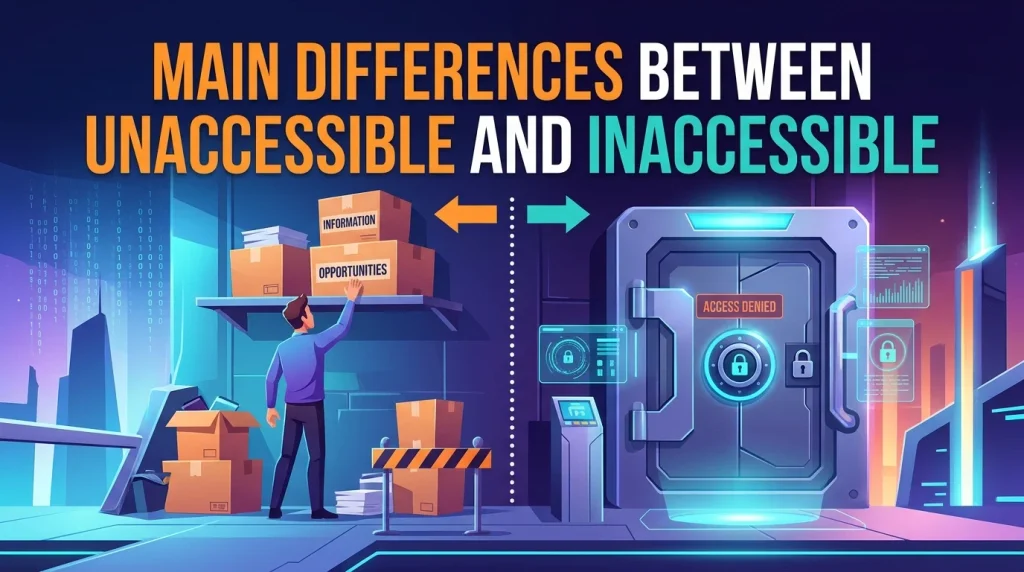
| Aspect | Unaccessible | Inaccessible |
| Acceptance | Rare | Standard |
| Frequency | Very low | Very high |
| Formal Writing | Avoid | Recommended |
| Everyday Speech | Rarely heard | Very common |
| Academic English | Not preferred | Preferred |
| Professional Documents | Avoid | Use confidently |
The Biggest Difference
The meaning is essentially the same.
The difference is usage:
- Unaccessible is rare and outdated in many contexts.
- Inaccessible is the accepted modern English form.
Why Is “Inaccessible” Preferred?
English often uses different negative prefixes. Some words naturally take un-, while others traditionally use in-.
Examples:
| Correct | Incorrect or Rare |
| Incomplete | Uncomplete |
| Inaccurate | Unaccurate |
| Inactive | Unactive (rare) |
| Inaccessible | Unaccessible |
Because English has evolved, inaccessible became the conventional form.
Comparison Table
| Category | Unaccessible | Inaccessible |
| Part of Speech | Adjective | Adjective |
| Meaning | Not accessible | Not accessible |
| Modern Usage | Rare | Common |
| Formal Writing | No | Yes |
| Business Writing | No | Yes |
| Academic Writing | No | Yes |
| Recommended? | No | Yes |
Grammar Guide
Both words are adjectives. They describe nouns.
Also read the difference between less and fewer.
Examples:
- an inaccessible building
- an inaccessible website
- an inaccessible location
How Each Term Is Used in Sentences
Unaccessible Pattern
Subject + be + unaccessible
Example:
- The cave was inaccessible after heavy rain.
Inaccessible Pattern
Subject + be + inaccessible
Examples:
- The server is inaccessible today.
- The trail became inaccessible during winter.
- The files remain inaccessible.
Common Mistakes Learners Make
Mistake 1
❌ The report is unaccessible.
✅ The report is inaccessible.
Mistake 2
Thinking both words are equally common.
Only inaccessible is widely accepted.
Mistake 3
Using unaccessible in academic papers.
Professional writing almost always prefers inaccessible.
Mistake 4
Believing unaccessible is incorrect grammar.
It is not completely wrong, but it is uncommon and generally avoided.
Simple Rules to Remember
- Use inaccessible in nearly every situation.
- Avoid unaccessible unless discussing historical or rare usage.
- If you’re unsure, choose inaccessible.
- Most dictionaries and style guides recommend inaccessible.
Quick Tips for Writing and Speaking
- Use inaccessible in emails.
- Use inaccessible in essays.
- Use inaccessible in presentations.
- Use inaccessible in business writing.
- Avoid unaccessible unless quoting or discussing language itself.
When to Use Each One
Use Unaccessible When
- Discussing historical English usage.
- Quoting older texts.
- Explaining uncommon word forms.
- Comparing language evolution.
- Talking about rare vocabulary.
Use Inaccessible When
- Writing essays.
- Creating reports.
- Speaking professionally.
- Writing emails.
- Describing roads, websites, files, books, places, or information.
- Communicating in everyday English.
When NOT to Use Each One
Avoid Using Unaccessible
Do not use it:
- In school assignments.
- In business reports.
- On professional websites.
- In formal letters.
- In academic research.
- In resumes.
Avoid Using Inaccessible
Do not use inaccessible when something is actually accessible.
Incorrect:
- The library is inaccessible. (when everyone can enter)
Correct:
- The library is accessible.
Also avoid confusing inaccessible with words like:
- unavailable
- impossible
- hidden
Each has a different meaning.
Which One to Use (Decision Guide)
Choose inaccessible if:
- You want correct modern English.
- You’re writing professionally.
- You’re speaking naturally.
- You’re taking an English exam.
- You’re writing online content.
Choose inaccessible only if:
- You’re analyzing historical language.
- You’re quoting an old document.
- You’re discussing uncommon word forms.
Quick Decision Chart
| Situation | Best Choice |
| Essay | Inaccessible |
| Inaccessible | |
| Business | Inaccessible |
| School | Inaccessible |
| Conversation | Inaccessible |
| Historical Discussion | Unaccessible (rare) |
Real-World Practical Examples
Unaccessible Examples
- The castle became inaccessible after the bridge collapsed.
- Some older books use the word unaccessible.
- The trail was described as inaccessible in historical records.
- Linguists sometimes discuss unaccessible as a rare variant.
- The manuscript contained several uncommon words like unaccessible.
Inaccessible Examples
- The university library is inaccessible during renovations.
- The website became inaccessible after a cyberattack.
- The mountain road is inaccessible because of snow.
- Important files were inaccessible after the hard drive failed.
- The technical report was inaccessible to beginners because of difficult language.
Self-Assessment (Fill in the Blanks)
- I will use ______ when writing a business email. The correct word is ______ because it is standard English.
- I will use ______ when describing a closed road. The correct word is ______ because it is widely accepted.
- I will use ______ when referring to a broken website. The correct word is ______ because it is the preferred adjective.
- I will use ______ when writing an academic essay. The correct word is ______ because formal writing prefers it.
- I will use ______ when discussing a rare historical word. The correct word is ______ because it refers to an uncommon variant.
- I will use ______ when talking about an unavailable building entrance. The correct word is ______ because it is modern English.
- I will use ______ when describing restricted files. The correct word is ______ because it is commonly used.
- I will use ______ when writing a newspaper article. The correct word is ______ because journalists use the standard form.
- I will use ______ when describing a blocked hiking trail. The correct word is ______ because it is accepted by dictionaries.
- I will use ______ when describing difficult-to-reach islands. The correct word is ______ because it is the normal choice.
- I will use ______ when explaining rare English vocabulary. The correct word is ______ because it is the uncommon form.
- I will use ______ when preparing a school presentation. The correct word is ______ because teachers expect standard English.
- I will use ______ when describing password-protected information. The correct word is ______ because it is commonly used.
- I will use ______ when writing professional reports. The correct word is ______ because it sounds natural.
- I will use ______ when talking about inaccessible medical records. The correct word is ______ because it is standard.
- I will use ______ when comparing historical and modern English. The correct word is ______ because it is the rare alternative.
- I will use ______ when describing software errors. The correct word is ______ because it is preferred.
- I will use ______ when writing formal documents. The correct word is ______ because it follows standard usage.
- I will use ______ when referring to archived language examples. The correct word is ______ because the discussion is historical.
- I will use ______ when speaking everyday English. The correct word is ______ because native speakers commonly use it.
Answers
- inaccessible
- inaccessible
- inaccessible
- inaccessible
- unaccessible
- inaccessible
- inaccessible
- inaccessible
- inaccessible
- inaccessible
- unaccessible
- inaccessible
- inaccessible
- inaccessible
- inaccessible
- unaccessible
- inaccessible
- inaccessible
- unaccessible
- inaccessible
Final Verdict
Although unaccessible and inaccessible share the same basic meaning, they are not equally appropriate in modern English. Inaccessible is the standard, widely accepted adjective used in formal writing, education, business, technology and everyday conversation. Unaccessible exists but is rare and generally avoided outside discussions of historical or linguistic usage.
If your goal is clear, natural, and grammatically correct English, inaccessible is almost always the best choice. By remembering that modern English strongly favors inaccessible, you can avoid common mistakes and communicate with greater confidence in both writing and speech.
See also serpent vs snake difference and examples.
Conclusion
Choosing between unaccessible and inaccessible becomes much easier once you understand how each word is used in modern English. While both terms express the idea of something that cannot be reached, entered or understood, inaccessible is the standard and widely accepted choice in everyday conversation, academic writing, business communication and professional documents. Unaccessible does exist, but it is rare and generally avoided except when discussing historical language or uncommon word forms.
If your goal is to write clear, natural and grammatically correct English, inaccessible is almost always the better option. Remembering this simple distinction will help you avoid common mistakes, improve your vocabulary and communicate with greater confidence. Whether you’re writing an essay, sending an email or simply expanding your English skills, knowing the difference between unaccessible vs inaccessible ensures your writing sounds polished, accurate and easy for readers to understand.
FAQs
Is unaccessible a real English word?
Yes, unaccessible is a real English word, but it is very uncommon in modern usage. Most dictionaries recognize it as a rare variant, while inaccessible is the standard form used in everyday English, education, business and professional writing. In most situations, it is better to choose inaccessible.
Is inaccessible grammatically correct?
Yes, inaccessible is grammatically correct and is the preferred adjective in standard English. It describes something that cannot be reached, entered, obtained or easily understood. It is widely accepted in both formal and informal writing and is the word recommended by teachers and style guides.
What is the main difference between unaccessible and inaccessible?
The main difference is their usage rather than their meaning. Both mean “not accessible,” but inaccessible is the accepted modern English word. Unaccessible is rarely used and may sound unusual to native speakers, making inaccessible the safer choice in almost every context.
Which word should I use in academic writing?
You should use inaccessible in academic writing. Universities, schools, publishers and professional editors expect standard English, and inaccessible is the accepted form. Using unaccessible may distract readers because it is considered uncommon and outdated in many situations.
Can unaccessible and inaccessible be used interchangeably?
Technically, they share the same meaning, but they are not equally accepted. Although some readers may understand unaccessible, inaccessible is the preferred option in modern English. For clear and natural communication, it is best to avoid using unaccessible in everyday writing.
Why is inaccessible more common than unaccessible?
English has developed preferred negative prefixes over time. While both un- and in- can create opposite meanings, some words traditionally use one form. Inaccessible became the accepted standard through long-term usage, which is why it appears much more often in books, articles and conversations.
Is inaccessible used for both physical and abstract situations?
Yes. Inaccessible can describe physical places, such as roads or buildings that cannot be reached, as well as abstract ideas like information, language or concepts that are difficult to understand. This flexibility makes it a useful word in many different contexts.
Can I use inaccessible to describe websites and technology?
Absolutely. Inaccessible is commonly used when websites, apps, files or online services cannot be reached or used. For example, if a website is offline or a file cannot be opened, saying it is inaccessible is both natural and grammatically correct.
Are there synonyms for inaccessible?
Yes. Depending on the context, synonyms include unreachable, unavailable, blocked, closed, restricted, remote and hard to access. However, each synonym has a slightly different meaning, so inaccessible remains the best choice when something simply cannot be accessed.
How can I remember which word is correct?
A simple way to remember is that inaccessible is the word you will see in books, newspapers, schools, and professional writing. If you are unsure which form to choose, select inaccessible. It is the standard English term and will be appropriate in almost every situation.