
People often confuse window seal and window sill because the words sound similar, but they refer to completely different parts of a window. Understanding the difference is important whether you’re discussing home construction, repairs, real estate or everyday conversations.
This guide explains each term in simple language, highlights their differences and shows you exactly when to use each one correctly.
Comparison Overview
Although window seal and window sill are both parts of a window, they have different purposes.
- A window seal is the material that prevents air, water and moisture from passing through the window.
- A window sill is the flat horizontal surface at the bottom of the window frame.
Knowing the distinction helps avoid confusion when discussing window maintenance, repairs or home improvement projects.
| Feature | Window Seal | Window Sill |
| Purpose | Prevents air and water leaks | Supports the window and provides a bottom ledge |
| Location | Around or between window components | Bottom horizontal part of the window |
| Material | Rubber, silicone, foam, or sealant | Wood, stone, PVC, metal, or concrete |
| Visible | Usually hidden or partially visible | Fully visible |
| Main Function | Insulation and weatherproofing | Structural support and drainage |
Definition of Window Seal
A window seal is the protective barrier that keeps outside air, moisture, dust`11 and water from entering through a window. It helps maintain indoor temperature and improves energy efficiency.
Window seals are commonly made of rubber, silicone, foam or specialized sealants. In double- or triple-pane windows, the seal also keeps insulating gas trapped between the glass panes.
Purpose of a Window Seal
- Prevents drafts
- Stops water leaks
- Improves insulation
- Increases energy efficiency
- Protects windows from moisture damage
Definition of Window Sill
A window sill is the flat horizontal section located at the bottom of a window. It supports the window frame and directs rainwater away from the wall.
Window sills may be located both inside and outside a building. Interior sills are often used for decoration, while exterior sills help protect the building from water damage.
Purpose of a Window Sill
- Supports the window frame
- Directs water away
- Adds structural stability
- Provides a decorative surface
- Protects walls beneath the window
Main Differences Between Window Seal and Window Sill
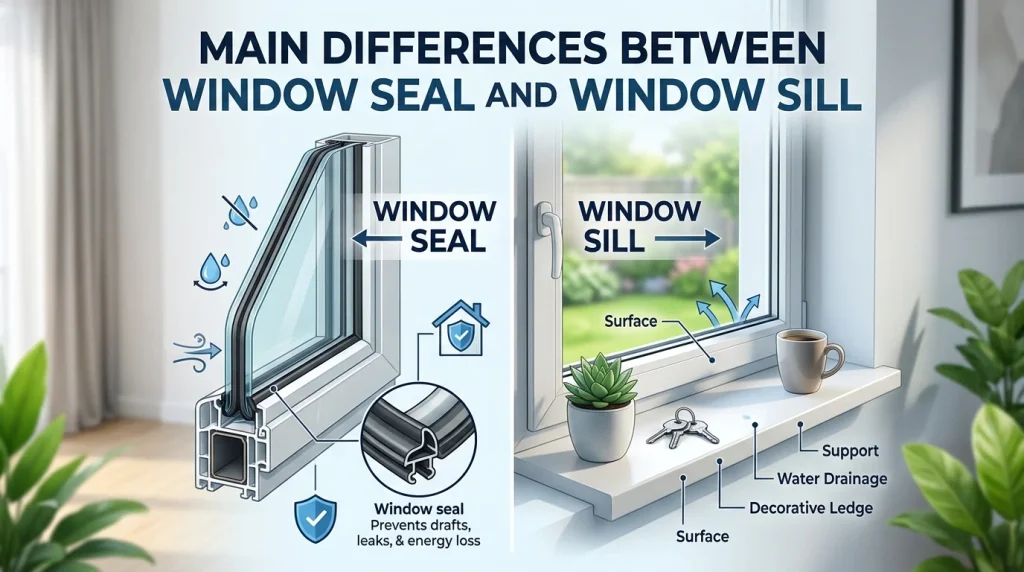
The biggest difference is their function.
A window seal is designed to create an airtight and watertight barrier. Without it, windows may leak air, moisture, or water.
A window sill, on the other hand, is the bottom ledge of the window that provides support and helps drain rainwater away from the building.
| Aspect | Window Seal | Window Sill |
| What it is | A sealing material | A structural part of the window |
| Main job | Prevent leaks | Support and drainage |
| Touch visibility | Often hidden | Easily visible |
| Needs replacement? | Yes, when damaged | Usually only if cracked or rotten |
| Helps insulation | Yes | Indirectly |
Parts of a Window: Where the Seal and Sill Fit
Understanding the location of each part makes the difference much clearer.
- Window Seal: Around the edges of the glass or frame.
- Window Sill: At the bottom of the window opening.
- Window Frame: Holds the entire window together.
- Window Pane: The glass itself.
The seal protects the window from weather, while the sill supports the entire structure.
Signs That Each Part Needs Repair
Damaged Window Seal
- Fog between glass panes
- Drafts near the window
- Higher energy bills
- Water leaks
- Condensation inside insulated glass
Damaged Window Sill
- Rotting wood
- Cracks
- Water stains
- Mold growth
- Peeling paint
Grammar Guide
Although these are construction terms rather than grammar terms, using them correctly in sentences is still important.
Both window seal and window sill are compound nouns.
How Each Term Is Used in Sentences
Window Seal
Pattern:
The + window seal + verb
Examples:
- The window seal needs replacement.
- A broken window seal lets cold air inside.
- The contractor repaired the window seal.
- Moisture entered through the damaged window seal.
- The new window seal improved insulation.
Window Sill
Pattern:
The + window sill + verb
Examples:
- The flowers sit on the windowsill.
- She cleaned the window sill.
- Rainwater flowed off the windowsill.
- The wooden window sill needs painting.
- The cat jumped onto the windowsill.
Common Mistakes Learners Make
- Confusing seal with sill because they sound similar.
- Saying “window seal” when referring to the bottom ledge.
- Assuming both words describe the same part.
- Using “seal” when talking about placing decorations.
- Using “sill” when discussing insulation.
Simple Rules to Remember
- Seal = Seals out air and water.
- Sill = Surface at the bottom.
- If it blocks leaks, it’s the seal.
- If you can place a plant on it, it’s the sill.
Quick Tips for Writing and Speaking
- Think of seal as protection.
- Think of sill as support.
- In repair discussions, identify the exact part.
- Don’t rely only on pronunciation.
- Visualizing the window helps remember the difference.
When to Use Each One
Use “Window Seal” When
- Discussing insulation
- Talking about drafts
- Referring to moisture protection
- Mentioning condensation
- Describing weatherproofing
Use “Window Sill” When
- Referring to the bottom ledge
- Talking about decoration
- Describing structural support
- Discussing water drainage
- Mentioning interior or exterior window surfaces
When NOT to Use Each One
Do not use window seal when talking about:
- The flat ledge
- Placing objects beneath a window
- Cleaning the bottom surface
Do not use window sill when discussing:
- Air leaks
- Broken insulation
- Weatherproof seals
- Double-pane gas leakage
- Silicone or rubber sealing materials
Which One to Use (Decision Guide)
Use this simple guide:
| Situation | Correct Term |
| Air leaking around a window | Window Seal |
| Water entering through gaps | Window Seal |
| Bottom ledge of the window | Window Sill |
| Putting flowers beneath a window | Window Sill |
| Energy efficiency | Window Seal |
| Decorative interior ledge | Window Sill |
| Replacing weatherproof material | Window Seal |
| Cleaning the bottom surface | Window Sill |
Real-World Practical Examples
Window Seal Examples
- The technician replaced the broken window seal to stop drafts.
- Our energy bills dropped after installing a new window seal.
- Moisture entered because the window seal had failed.
- The office building upgraded every window seal for better insulation.
- Scientists tested different materials for stronger window seals.
Window Sill Examples
- She placed her herbs on the sunny windowsill. The painter sanded the wooden windowsill.
- Rainwater drained off the exterior window sill.
- Students decorated the classroom windowsill with artwork.
- The cat spent hours sleeping on the windowsill.
Self-Assessment (Fill in the Blanks)
- I will use ______ when referring to insulation around a window. The correct word is ______ because it prevents air leaks.
- I will use ______ when talking about the bottom ledge. The correct word is ______ because it supports the window.
- The damaged ______ caused drafts.
- She placed a vase on the ______.
- The contractor replaced the broken ______.
- The wooden ______ needed repainting.
- Moisture entered through the failed ______.
- The cat sat on the ______.
- Better insulation requires a good ______.
- The flowers were displayed on the ______.
- Rainwater drained from the ______.
- Cold air entered because of the damaged ______.
- The mason repaired the cracked ______.
- Foggy glass often indicates a failed ______.
- We cleaned the dusty ______.
- Silicone is often used for a window ______.
- Stone is commonly used for a window ______.
- Energy efficiency depends on a good window ______.
- Decorative plants were arranged on the window ______.
- Weatherproofing usually involves replacing the window ______.
Answers
- Window seal
- Window sill
- Window seal
- Window sill
- Window seal
- Window sill
- Window seal
- Window sill
- Window seal
- Window sill
- Window sill
- Window seal
- Window sill
- Window seal
- Window sill
- Window seal
- Window sill
- Window seal
- Window sill
- Window seal
Final Verdict
Although window seal and window sill are closely related because they are both parts of a window, they serve entirely different purposes. A window seal keeps air, moisture and water from passing through the window, improving insulation and energy efficiency. A window sill is the bottom horizontal ledge that supports the window and helps direct water away from the building.
If you’re talking about weatherproofing, leaks or insulation, use window seal. If you’re referring to the bottom surface where decorations, plants, or other items can be placed, use window sill. Remembering that “seal stops leaks” and “sill is the bottom ledge” will help you confidently choose the correct term in both writing and conversation.
Conclusion
Understanding the difference between window seal and sill is essential for using the correct term in conversations, home improvement projects and written communication. While these words may sound similar, they describe completely different parts of a window. A window seal creates a protective barrier against air, moisture and water, helping improve insulation and energy efficiency. A window sill, on the other hand, is the bottom horizontal ledge that supports the window and often serves both structural and decorative purposes.
By remembering each term’s function, you can avoid common mistakes and communicate with greater confidence. Whether you’re discussing repairs, reading construction guides or simply describing a window, choosing the right word makes your message clearer and more accurate. Keep this comparison in mind whenever you encounter these terms and you’ll easily know whether the situation calls for a window seal or a window sill.
FAQs
What is the difference between a window seal and a window sill?
A window seal is the material that prevents air, water and moisture from passing through gaps around a window. A window sill is the flat horizontal ledge located at the bottom of the window frame. The seal focuses on insulation, while the sill provides structural support and can also serve as a decorative surface.
Is a window seal the same as a window sill?
No, they are not the same. A window seal is designed to create a weatherproof barrier around the window, whereas a window sill is the bottom section of the window frame that supports the structure and helps direct rainwater away from the building.
Which term should I use when talking about window leaks?
You should use window seal when discussing leaks, drafts, condensation or insulation problems. A damaged seal often allows air and moisture to enter, making it the correct term in situations involving weatherproofing and energy efficiency.
Which term refers to the ledge beneath a window?
The correct term is window sill. It is the horizontal ledge at the bottom of the window and may be found inside or outside the home. Many people use it for placing plants, decorations or other small household items.
Can a damaged window seal affect energy efficiency?
Yes. A damaged window seal can allow heat to escape during winter and let warm air enter during summer. This reduces insulation, increases energy consumption, and may lead to higher heating and cooling costs if not repaired promptly.
What materials are commonly used for window sills?
Window sills are commonly made from wood, stone, concrete, vinyl, metal or engineered materials. The choice depends on the building’s design, durability requirements, and maintenance preferences, with each material offering different aesthetic and practical benefits.
How can I tell if my window seal has failed?
Signs of a failed window seal include drafts, moisture between glass panes, condensation, water leaks and reduced insulation. If you notice these issues, inspecting or replacing the seal can help restore the window’s performance and comfort.
Why do people confuse window seal and window sill?
People often confuse these terms because they sound similar and are both parts of the same window. However, their functions are entirely different. Learning that the seal prevents leaks while the sill supports the window makes the distinction much easier to remember.
Can a window sill be repaired if it is damaged?
Yes. Depending on the material and extent of the damage, a window sill can often be repaired by filling cracks, replacing rotted sections, repainting or installing a new sill. Prompt repairs help prevent further structural or moisture-related problems.
What is the easiest way to remember the difference between a window seal and a window sill?
A simple memory trick is to think of seal as something that “seals” gaps against air and water, while sill is the “shelf” or ledge beneath the window. If it stops leaks, it is the seal. If it supports the window, it is the sill.